
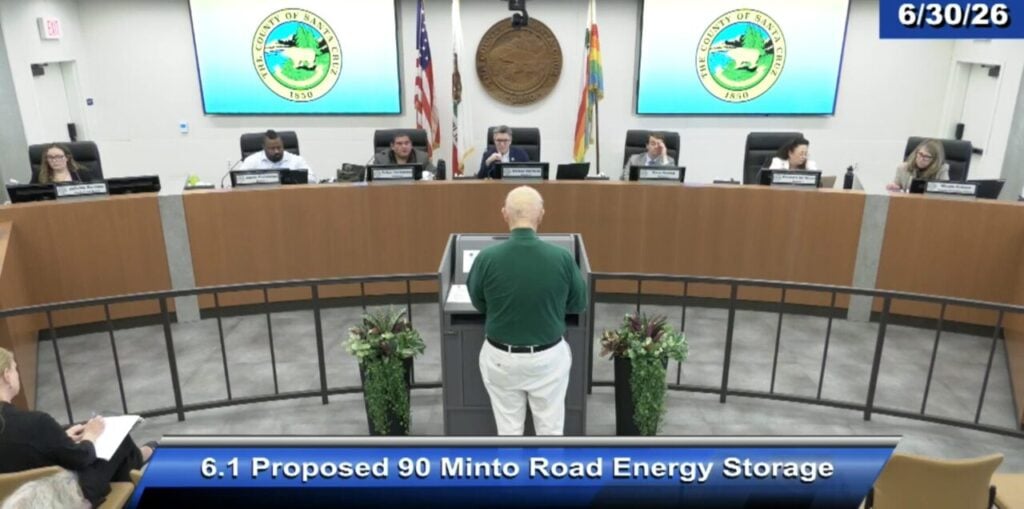
Developer New Leaf Energy withdrew its application for a battery energy storage system (BESS) in Santa Cruz County, California, US, choosing to seek approval through the California Energy Commission (CEC).
Shortly after the developer’s decision, the Santa Cruz County Board of Supervisors voted on 30 June, unanimously to defer a local ordinance regulating BESS.
New Leaf Energy initially filed an application with Santa Cruz County in late 2024 seeking permission to construct a BESS facility valued at approximately US$200 million on Minto Road, outside of Watsonville, California.
The project, which the Board refers to as the “90 Minto Road Energy Storage System”, is designed to enhance grid reliability and reduce power disruptions in the region by storing renewable energy for dispatch during peak demand periods.
Try Premium for just $1
- Full premium access for the first month at only $1
- Converts to an annual rate after 30 days unless cancelled
- Cancel anytime during the trial period
Premium Benefits
- Expert industry analysis and interviews
- Digital access to PV Tech Power journal
- Exclusive event discounts
Or get the full Premium subscription right away
Or continue reading this article for free
The company withdrew its county application and submitted a new filing directly to the CEC in early June, utilising the Opt-in Certification Program, a state certification pathway that supersedes local land use authority.
A 2022 state law expanded the CEC’s jurisdiction to encompass battery storage facilities exceeding 200MWh capacity, enabling developers to bypass local permitting processes in favor of direct state authorisation.
While the commission incorporates community input during project evaluation, ultimate approval authority rests with state officials rather than local governments, a dynamic that has generated opposition among those who prioritise municipal control over land use decisions.
This effectively removes the project from county oversight and places decision-making power with state regulators. So far, the CEC has approved two solar-plus-storage projects and one standalone BESS project through the optional permitting scheme, the most recent being Potentia-Viridi, a 400MW/3,200MWh BESS project from a subsidiary of Clearway Energy Group.
Potentia-Viridi was approved in late May, while the only other standalone BESS to be submitted through Opt-in, Engie’s Compass Energy Storage 250MW/1,000MWh BESS, was withdrawn by the project developer. Although Compass Energy Storage had drawn more than a thousand negative public comments, European energy major Engie said it had withdrawn the project in January due to commercial reasons based on market forces.
As reported by local news outlet Lookout Santa Cruz, the county had been preparing to conduct a comprehensive environmental analysis of both the proposed ordinance and the New Leaf project, a process that would have examined long-term impacts on the community, agricultural resources, public safety, and local infrastructure.
Under the original arrangement, New Leaf would have funded the environmental study while the county maintained control over the scope and execution of the review.
County officials estimated the environmental assessment would cost in the vicinity of half a million dollars. With the developer now pursuing state authorisation, that financial burden would fall entirely on county government, which is currently grappling with budget pressures.
Staff members advised elected officials that proceeding with the ordinance without environmental analysis would be imprudent from both a legal and policy perspective.
Stephanie Hansen, who oversees community development and infrastructure for the county, indicated that the draft regulations represent a substantial investment of staff time across multiple departments and reflect extensive consideration of both technical requirements and community input.
County officials plan to submit the draft ordinance to state regulators as a reference document that outlines local priorities and concerns.
Community concerns
The proposed BESS facility has generated significant apprehension among Southern California residents, particularly in light of a large-scale fire that occurred at Vistra Energy’s Moss Landing facility in January 2025.
The track record of safety events at Moss Landing suggests this location was especially prone to such incidents, potentially indicating it faced risks beyond those typical of similar facilities. Several industry experts have written about the fire that destroyed the 300MW first phase of the Moss Landing BESS project, noting that its design, which housed battery enclosures inside an old gas turbine building and featured nickel manganese cobalt (NMC) chemistry cells, is not being repeated at newer projects. Industry standards and best practices have also moved on considerably since.
However, it has still generated concern and occurred weeks after New Leaf submitted its initial county application.
Local residents have expressed concerns about multiple aspects of the proposed Minto Road facility, including its proximity to residential neighborhoods, the capacity of emergency services to respond effectively to potential thermal events, and the conversion of productive agricultural land—specifically, a portion of an existing apple orchard—to industrial energy infrastructure.
Once the application is deemed complete, the CEC will prepare its own environmental impact analysis and has a statutory deadline of 270 days to reach a final determination. State officials have committed to holding at least two public hearings in Santa Cruz County before commissioners cast a final vote at the agency’s Sacramento headquarters.
County seeks influence
While Santa Cruz County no longer has formal approval authority over the project, officials plan to advocate for specific conditions and requirements during the state review process.
The county’s draft ordinance, though never formally adopted, will be transmitted to the CEC as a statement of local values and priorities. County staff characterised the document as a comprehensive framework that reflects careful consideration of safety, environmental protection, and community character—elements they hope state regulators will incorporate into their decision-making process.
The situation in Santa Cruz County illustrates a larger tension in California’s approach to climate policy. The state’s renewable energy targets require rapid deployment of new infrastructure, yet communities often seek to maintain control over land use decisions that affect neighborhood character, property values, or quality of life.
The 2022 legislation that expanded state certification authority was explicitly designed to remove potential bottlenecks in the renewable energy approval process. Supporters argued that inconsistent local regulations and lengthy permitting timelines were impeding the state’s ability to meet statutory clean energy mandates and climate commitments.
Critics, however, contend that the opt-in certification process undermines democratic accountability by allowing developers to avoid engaging with the communities most directly affected by their projects. Local elected officials, who are directly accountable to residents, lose decision-making power to appointed state commissioners who must balance local concerns against statewide policy objectives.
This tension is not unique to the opt-in process either. In March 2025, when the California Public Utilities Commission (CPUC) modified General Order 167, which provides a method to implement and enforce maintenance and operation standards for electric generating facilities, California governor Gavin Newsom took steps to accelerate IPP Baywa r.e.’s 300MW Cornucopia Hybrid Project in Fresno County.
Newsom certified Cornucopia using an infrastructure package passed in 2023 to ‘build more, faster’, in combination with a senate bill.
