Battery energy storage systems (BESS) operating in California’s grid left approximately US$98 million on the table due to suboptimal bidding strategies, according to a new analysis from Gridmatic.
Gridmatic, a company specialising in AI-powered grid forecasting and battery optimisation, released its California Independent System Operator (CAISO) Storage Report on 24 June, an analysis of 30 energy storage systems in the market, and found that many operators are using static “set it and forget it” bidding approaches that fail to capture available revenue opportunities.
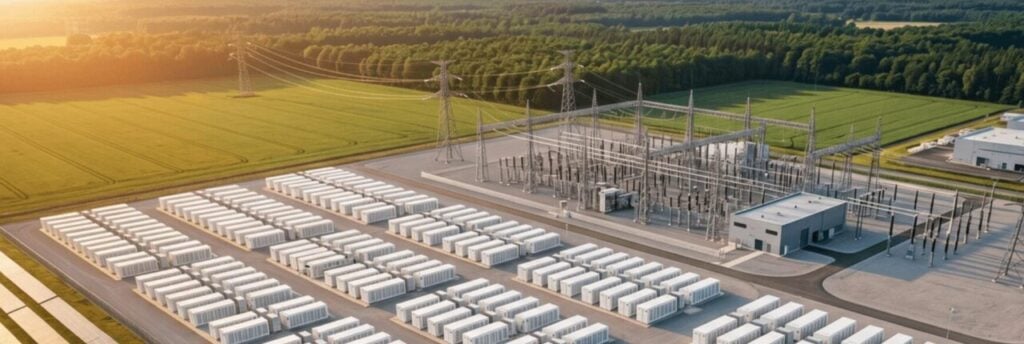
The US$98 million estimate represents the potential additional revenue the 30 batteries in the study could have earned if they had achieved the same performance ratio as Gridmatic’s top-performing asset, the 100MW/400MWh Caballero BESS in San Luis Obispo County, from Fengate Asset Management and Alpha Omega Power (AOP).
“We got to that figure by taking the 30 batteries in the study, and asking, ‘What if they had achieved the same top-bottom (TB) capture rate?’” explained Gridmatic CCO David Miller, who authored the CAISO report.
Try Premium for just $1
- Full premium access for the first month at only $1
- Converts to an annual rate after 30 days unless cancelled
- Cancel anytime during the trial period
Premium Benefits
- Expert industry analysis and interviews
- Digital access to PV Tech Power journal
- Exclusive event discounts
Or get the full Premium subscription right away
Or continue reading this article for free
He continued, “Instead of whatever they actually performed relative to TB, what if they performed 141% of their TB value, which was what Caballero did? How much incremental revenue would the fleet have made?”
The “TB value” refers to “top-bottom”—a benchmark that measures the difference between the highest and lowest price hours of the day based on a battery’s duration. For a four-hour battery, it’s the value of the top four hours minus the bottom four hours.
Miller noted the figure is meant to be indicative rather than precise. “We’re not saying that we think those batteries could have made exactly that amount. In some cases, it would have been hard to make that percentage of their TB value based on their location. Other batteries, maybe they could have made even more.”
The analysis revealed significant variation in battery performance, with some systems earning less than US$1-per-kw-per-month while top performers exceeded US$6-per-kw-per-month. The median performance was approximately US$2-per-kw-per-month.
Gridmatic found that one battery, Caballero, exceeded its TB benchmark value, achieving 141% of that target, while many others fell short. This variation was primarily attributed to bidding strategies rather than location or equipment differences.
As Miller explained in greater detail in an upcoming conversation with Energy-Storage.news Premium, the report identified three main areas where underperforming batteries left revenue on the table.
The first was static bidding. Many operators maintained the same bid prices and quantities for extended periods, failing to adjust for changing market conditions or high-price events.
Next was limited market participation. Some batteries focused only on day-ahead energy markets, missing opportunities in real-time markets and ancillary services.
Third, similar to limited market participation, but concerning what is being sold rather than when, was single-product focus. Lower performers often concentrated on one revenue stream rather than co-optimising across energy and ancillary service markets.
ESN Premium subscribers will be able to read the full interview with Gridmatic’s David Miller in a feature article to be published in the coming days.
Battery Asset Management Summit USA 2026 will be held 15-16 September in Garden Grove, California, hosted by Energy-Storage.news publisher Solar Media (part of the Informa Group). The agenda emphasises addressing the roles of AI, cybersecurity, and second-life applications, broken down into two tracks: Technical Asset Management and Commercial Asset Management. This year, the conference is also co-located with Solar & Storage Finance Summit USA. Visit the official site for more details.