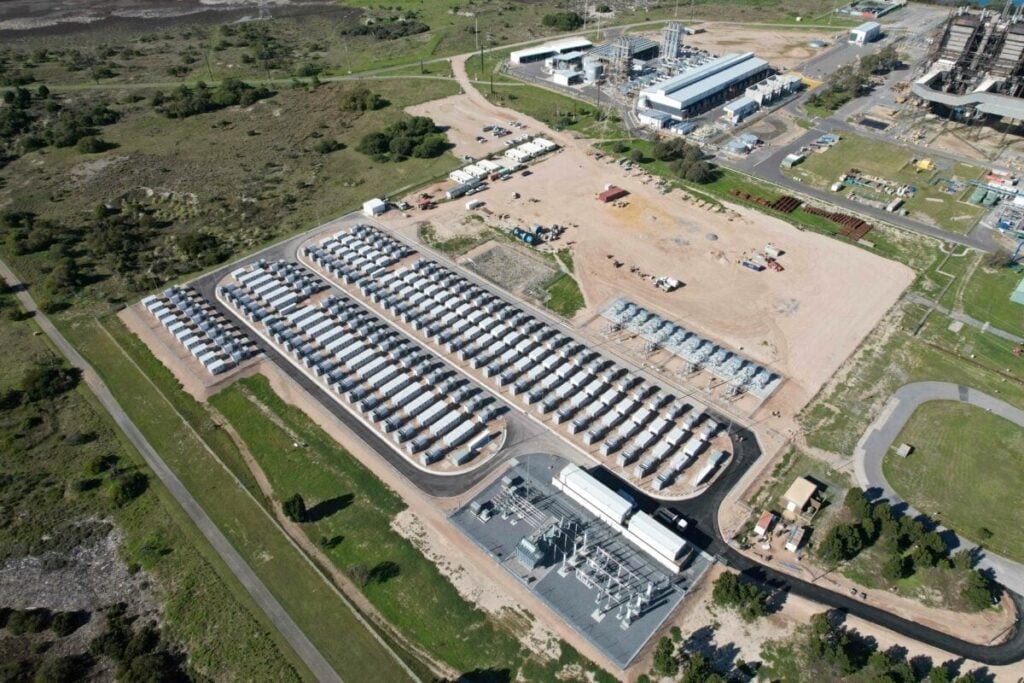
Australia’s battery energy storage sector faces mounting operational pressures, following the Australian Energy Market Operator (AEMO) issuing its latest direction to AGL’s Torrens Island battery energy storage system (BESS) on 9 March.
The 250MW/250MWh facility in South Australia was directed to synchronise and follow dispatch targets from 07:00 under minimum system load management protocols, with AEMO citing “elevated risk of insufficient demand to maintain a secure operating state” as the primary concern.
The intervention, which lasted seven hours until it was cancelled at 14:00, represents the latest in a series of out-of-market actions reshaping how battery storage systems operate within Australia’s evolving energy landscape.
The March direction follows a pattern established in November 2025, when Torrens Island became the first battery storage system in the National Electricity Market (NEM) to be subjected to minimum system load management interventions.
Try Premium for just $1
- Full premium access for the first month at only $1
- Converts to an annual rate after 30 days unless cancelled
- Cancel anytime during the trial period
Premium Benefits
- Expert industry analysis and interviews
- Digital access to PV Tech Power journal
- Exclusive event discounts
Or get the full Premium subscription right away
Or continue reading this article for free
Coverage of that event by Energy-Storage.news outlines that the facility faced similar directions on 11, 12 and 15 November 2025, which prevented optimal charging during the most economically attractive periods and resulted in significant revenue losses for the operator.
Revenue impact and compensation framework challenges
The financial implications of these interventions extend beyond immediate operational constraints, with the November events alone costing the facility AU$5,354 (US$3,830) and AU$3,876 in lost revenue opportunities on consecutive days.
These losses occurred when the battery storage system was prevented from charging during the cheapest one-hour windows, directly undermining the price arbitrage strategies that underpin battery storage economics in the NEM.
The compensation framework designed to address such interventions presents its own complexities for storage operators.
Under the National Electricity Rules, facilities like Torrens Island may be eligible for compensation when dispatch is altered through out-of-market intervention, with payments calculated using a benchmark price equal to the 90th percentile price over the past 12 months multiplied by the difference in energy output.
For the November events, this formula suggested potential compensation of up to AU$37,895 and AU$28,091, respectively, significantly exceeding the actual financial losses incurred.
However, the compensation process remains unpredictable, with the current framework proving difficult to apply to storage assets as it was originally designed for traditional generators.
The system pays based on benchmark pricing rather than spot prices, creating outcomes that do not always reflect the actual financial losses experienced by battery operators, adding uncertainty to an already challenging operational environment.
The Energy Storage Summit Australia 2026 will be returning to Sydney on 18-19 March. It features keynote speeches and panel discussions on topics such as the Capacity Investment Scheme, long-duration energy storage, and BESS revenue streams. ESN Premium subscribers receive an exclusive discount on ticket prices.
To secure your tickets and learn more about the event, please visit the official website.