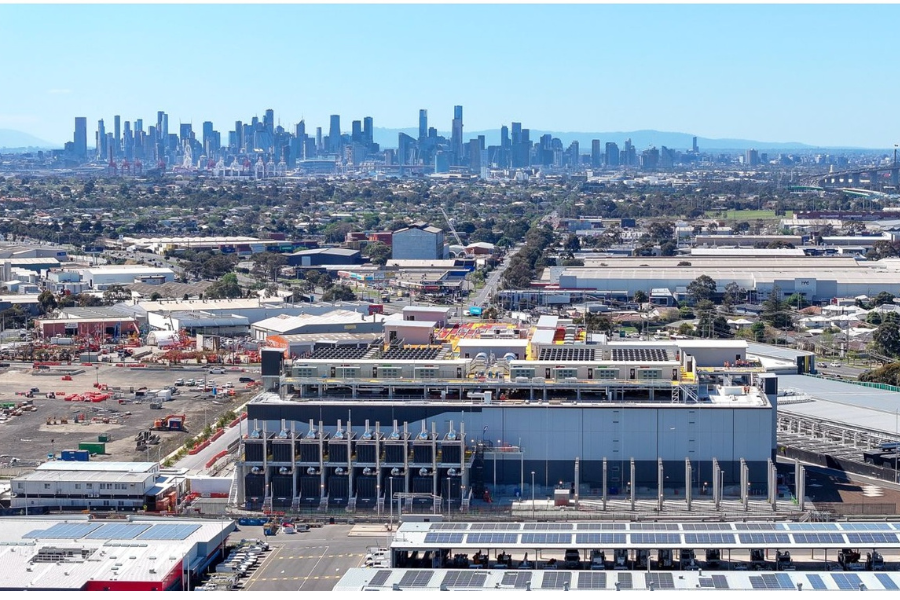
Victoria will require new data centres to supply their own renewable energy and battery storage rather than drawing on the existing grid, under rules released by the state government on 22 September as part of its new Sustainable Data Centre Action Plan.
Under the policy, new data centres will be required to match new electricity demand with new generation, meet their own connection costs and network upgrades, and use recycled or non-drinking water for cooling.
Where recycled water cannot be used immediately, operators will be required to offset the water they draw and pay for the infrastructure upgrades needed to reduce reliance on drinking water over time.
The government said data centres currently use less than 1% of Victoria’s drinking water supply for cooling.
Try Premium for just $1
- Full premium access for the first month at only $1
- Converts to an annual rate after 30 days unless cancelled
- Cancel anytime during the trial period
Premium Benefits
- Expert industry analysis and interviews
- Digital access to PV Tech Power journal
- Exclusive event discounts
Or get the full Premium subscription right away
Or continue reading this article for free
New developments will also need to remain at least 150 metres from homes, a distance the government described as wider than the Melbourne Cricket Ground.
Data centres will be prohibited in residential zones and excluded from sites near schools, childcare centres and rural areas judged unable to support them.
Operators will be required to submit a traffic management plan covering both construction and operation, even though the government noted data centres generate relatively few vehicle movements once running.
Victoria’s Minister for Planning, Sonya Kilkenny, said the rules were designed to protect household energy costs while giving communities certainty about where developments can be built.
“Data centres must bring their own supply to protect our energy costs, and they can’t be built near homes,” Kilkenny said.
New data centre developments will also be required to deliver a Local Investment Guarantee, a community benefit scheme still subject to consultation that could include funding for jobs, TAFEs and parks.
Operators will additionally be required to train Victorian workers and hire locally by working with employment and training services in the areas where they build.
The state government said the data centre sector delivered AU$5.8 billion (US$4 billion) in capital expenditure into Victoria last year, and that the new rules will not apply retrospectively to applications already under assessment.
Victoria’s Minister for Artificial Intelligence and the Digital Economy, Anthony Carbines, said the state intended to keep attracting data centre investment within the new guardrails.
“Companies like Amazon and Microsoft choose to invest in Victoria, that will continue within sensible guardrails,” Carbines said.
Victoria’s policy builds on the Commonwealth’s own framework for data centre energy obligations, announced by Prime Minister Anthony Albanese on 15 July, which will legally require large-scale data centres to become net generators of renewable energy, putting at least as much power into the grid as they draw from it, and to reduce their draw when the grid is under strain.
Victoria’s rules add to a national framework built around firmed renewables
Victoria’s requirement that data centres bring their own generation and storage aligns with a federal policy architecture that has taken shape in stages since Albanese’s announcement.
Earlier this year, the Australian Energy Market Commission (AEMC) published a four-point framework in August, requiring large data centres to offset consumption with renewable energy certificates tied to new generation rather than existing supply, contract for firming capacity alongside those certificates, register as National Electricity Market (NEM) participants to give AEMO visibility of large loads, and support co-location of generation and storage through connection agreements.
The AEMC estimates the certificate obligation could be implemented within 12 months of ministerial endorsement, with the market registration and connection reforms taking 24 to 36 months.
New South Wales has taken a different legislative route toward a similar goal. The state introduced a bill in August that gives its energy minister renewable energy zone-style powers to control large-load grid access, covering any facility capable of drawing 5MW or more.
The bill’s cost-allocation provisions require that data centres, not existing electricity customers, bear the cost of the network infrastructure their load requires, and expressly prevent the state’s consumer trustee from maximising financial value for households when setting access fees for large loads. This ensures the focus is on ensuring data centres pay the full cost of their grid impact.
Not every jurisdiction has backed the nationally consistent approach. Queensland and the Northern Territory opposed the framework at a Ministerial Council meeting on 28 July, a position the Climate Council said was out of step with public opinion, citing its own polling, which found 82% of Australians wanted new data centres to fund additional renewable energy and storage infrastructure that matched their consumption.
Federal Climate Change and Energy Minister Chris Bowen responded directly to the dissent. Bowen said states could impose tighter requirements than the national floor but could not weaken it, confirming the federal government would use its powers over AEMO and the AEMC to enforce consistent connection terms regardless of individual state positions. Victoria’s rules, which go further than the federal minimum on siting, buffer zones, and community benefit sharing, are consistent with that framing.
Battery storage emerges as the mechanism for compliance
The firming requirement embedded across both the national and Victorian frameworks has direct implications for battery storage demand, converting what has so far been a voluntary commercial preference into a regulatory necessity for large loads.
In an interview with ESN Premium, Fluence, a battery storage system integrator, has mapped three distinct commercial uses for batteries co-located with data centres.
This includes load smoothing to manage the highly variable power draw of AI workloads, cold-start backup to replace diesel generators without abandoning existing carbon-neutral commitments, and speed-to-power, where co-located storage reduces the firm capacity a data centre needs from the grid operator and shortens connection timelines.
Fluence’s chief growth officer, Jeff Monday, said the speed-to-power case is potentially the company’s largest global commercial application for the technology, citing US data showing that a 100MW data centre sitting idle while awaiting a grid connection loses around US$100 million in revenue per month, and that co-located storage has compressed three-year US interconnection waits to as little as 15 months.
In the same interview, Fluence’s Sam Markham argued the same principle applies in Sydney, where transmission constraints ahead of the Sydney Ring’s completion in 2032 or 2033 make peak-shaving via co-located storage a practical way to extract more capacity from existing infrastructure.
Markham has separately cautioned that policy details matter as much as the principle, warning that a data centre procuring certificates from existing renewable energy assets rather than new generation could technically meet a renewability test while adding no new capacity to the grid.
AEMO has forecast that data centre electricity demand could reach 10% of total National Electricity Market demand by 2050, up from around 2% today, against a national data centre investment pipeline valued at AU$150 billion by the federal government.
Never miss an Australian energy storage story. Sign up for our Australia newsletter and get the latest project announcements, policy updates and market analysis delivered directly to you.