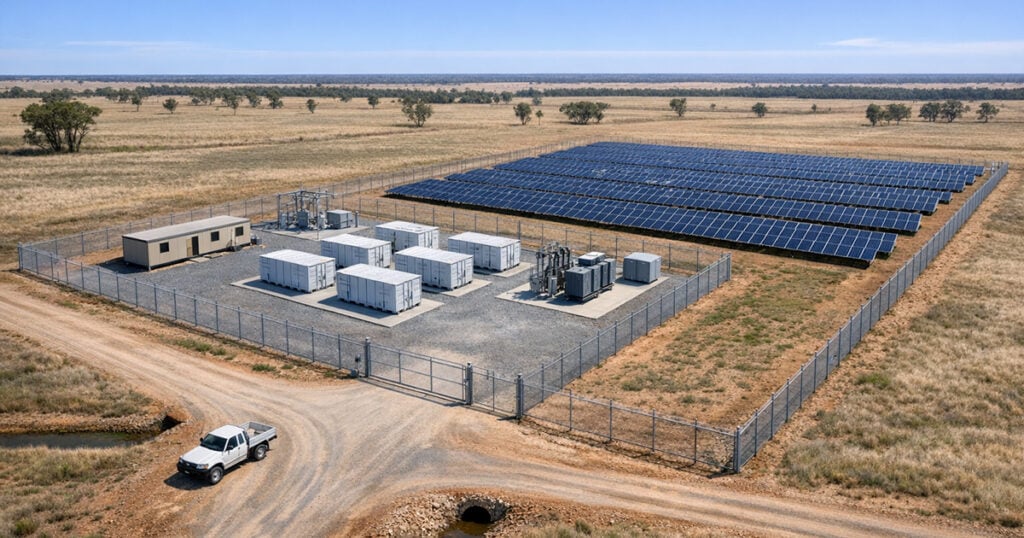
The New South Wales government in Australia is investing AU$3 million (US$2.1 million) to scope new solar-plus-storage-powered microgrid projects across four remote communities in the state’s Far West.
The initiative is part of a broader response to electricity reliability problems that have affected the region since a storm destroyed transmission infrastructure in October 2024.
Delivered in partnership with distribution network operator Essential Energy, the pre-feasibility programme will examine microgrid options for White Cliffs, Tibooburra, Milparinka and Packsaddle.
In White Cliffs, the study will examine expanding the town’s existing solar generation. In Tibooburra, the work will assess how a proposed solar-powered microgrid could replace the town’s existing diesel-backed system.
Try Premium for just $1
- Full premium access for the first month at only $1
- Converts to an annual rate after 30 days unless cancelled
- Cancel anytime during the trial period
Premium Benefits
- Expert industry analysis and interviews
- Digital access to PV Tech Power journal
- Exclusive event discounts
Or get the full Premium subscription right away
Or continue reading this article for free
Meanwhile, in Milparinka and Packsaddle, the programme is examining battery storage options to support the communities during outages.
No details on the size of the microgrid projects, nor the size of the battery storage system, have been disclosed.
Essential Energy will assess whether the proposed systems could keep essential services running during outages, including communications infrastructure, emergency response facilities and fuel supplies, before reporting its findings to the government ahead of any decision to progress to the next phase.
The announcement follows a storm that destroyed seven transmission towers on the single high-voltage line supplying Broken Hill and the Far West region on 17 October 2024, cutting power to Broken Hill, Wilcannia, Menindee, Tibooburra and White Cliffs for weeks and prompting a parliamentary inquiry that reported in June 2026.
NSW Department of Climate Change, Energy, the Environment and Water executive director of energy infrastructure, Liam Ryan, said the scoping work builds on lessons from that event.
“In helping respond to the Far West electricity supply disruption in October 2024, I saw first-hand how important a reliable electricity supply is to regional and remote communities,” Ryan said.
“These microgrid projects could improve energy security, reduce reliance on diesel and help communities stay connected when they need it most.”
Essential Energy chief assets and digital officer Luke Jenner said the pre-feasibility work was a first step in assessing whether local solar generation and battery storage could offer a more resilient solution for the four communities, where long distances, extreme weather and fuel supply lines can all affect energy security.
As part of the project, Essential Energy will also work with local First Nations communities on economic opportunities tied to the programme.
The New South Wales scoping programme sits within a broader pattern of microgrid deployment in remote and regional Australia, where grid access constraints have made behind-the-meter generation and storage a commercially practical route to improving reliability.
The Australian Renewable Energy Agency (ARENA) launched a AU$50 million Regional Australia Microgrid Pilots Program in 2021 to demonstrate solutions to the technical, regulatory and commercial barriers facing microgrid deployment, building on earlier funding for projects including a solar and battery system on Lord Howe Island and a hybrid renewable energy microgrid at the Agnew Gold Mine in Western Australia.
AGL Energy is delivering a 10.2MWh battery storage microgrid for Koompartu Farms, South Australia’s largest almond orchard, structured as a 20-year power purchase agreement under which AGL builds, owns and operates the assets.
Never miss an Australian energy storage story. Sign up for our Australia newsletter and get the latest project announcements, policy updates and market analysis delivered directly to you.