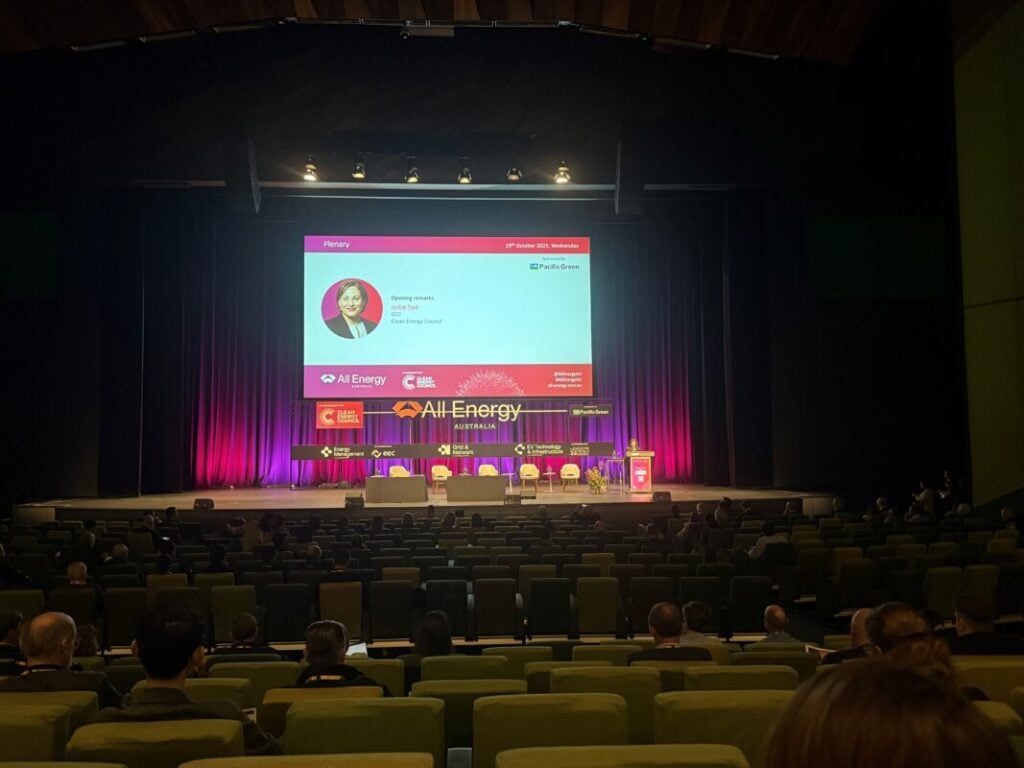
“The energy transition is not a pipe dream. It’s here and it’s happening right now,” declared Jackie Trad, the newly appointed CEO of the Clean Energy Council, at the start of All-Energy Australia 2025 in Melbourne this morning (29 October).
Trad’s opening remarks, delivered on her ninth day in the role as leader of the trade association, emphasised the tangible progress of Australia’s renewable energy transformation, backed by substantial deployment figures across both distributed and utility-scale solar and storage sectors.
Indeed, this has been supported by various notable mechanisms and initiatives that have spurred growth in both solar PV and energy storage, most notably the Cheaper Home Batteries Program, which recently surpassed 100,000 installations.
The former Queensland deputy premier and treasurer stated that the scale of Australia’s rooftop solar adoption has reached unprecedented levels, with over 4.2 million Australian households and small businesses now having installed rooftop solar systems.
Try Premium for just $1
- Full premium access for the first month at only $1
- Converts to an annual rate after 30 days unless cancelled
- Cancel anytime during the trial period
Premium Benefits
- Expert industry analysis and interviews
- Digital access to PV Tech Power journal
- Exclusive event discounts
Or get the full Premium subscription right away
Or continue reading this article for free
Trad counts herself among this group, highlighting the personal connection many Australians have developed with distributed energy generation. These installations delivered substantial output in the first half of 2025, representing “12.8% of all electricity” generated during the period.
The household battery energy storage sector has demonstrated equally impressive growth trajectories.
“1,000 household batteries are being installed daily, boosted by government schemes,” Trad said in a nod to the Cheaper Home Batteries Program. The Clean Energy Council’s biannual rooftop solar and storage report also documented this acceleration, showing “85,000 household batteries were sold nationally” in the first half of 2025 alone.
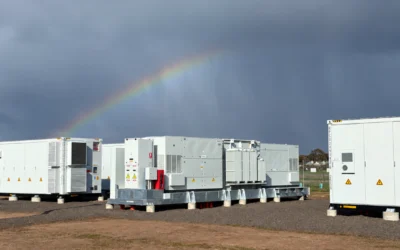
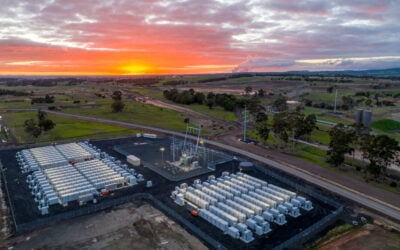
Large-scale battery energy storage deployment continues to exceed expectations, with “newly committed capacity now exceeding 1,000MWh for nine consecutive quarters” through the second quarter of 2025.
This performance positions the sector to “not only meet but beat deployment levels under the Australian energy market operators’ step change scenario,” Trad said, indicating robust growth in utility-scale storage infrastructure that surpasses official projections.
Despite the positives, the new Clean Energy Council CEO acknowledged the operational challenges accompanying this transformation, noting that “a system that has historically been centralised is now devolved with generation and storage assets located right across the country.”
In Trad’s opinion, this evolution “creates complexity in relation to markets, transmission, storage and, of course, social performance” that requires industry attention and collaborative solutions.
Addressing community concerns about project end-of-life responsibilities, Trad announced “Australia’s first decommissioning framework of financial guarantee for renewable energy projects” developed in partnership with the Queensland Renewable Energy Council (QREC).
The framework responds directly to stakeholder feedback: “regional Australians have told us they want clarity on who is responsible for removing wind and solar infrastructure at the end of their operational life.”
The decommissioning framework ensures “when a project reaches its end of life, the costs of decommissioning assets and making good will be covered through a financial guarantee.”
Crucially, Trad explained that if a proponent fails, the bond pays, not the landowner, not the community, and not the government. This provides clear protection for local stakeholders while maintaining project viability.
Trad emphasised the framework’s balanced approach, requiring “funds to be set aside in the mid to late stages of a project’s life once the asset is largely paid off.”
This timing “avoids time and capital early in the project’s life cycle, and ensures that they are built to live the electricity we need” while providing adequate resources for eventual decommissioning obligations.
The CEO positioned this initiative as “our starting point” for broader industry collaboration, expressing commitment to ongoing stakeholder engagement to refine the approach and maintain the sector’s extraordinary development momentum.