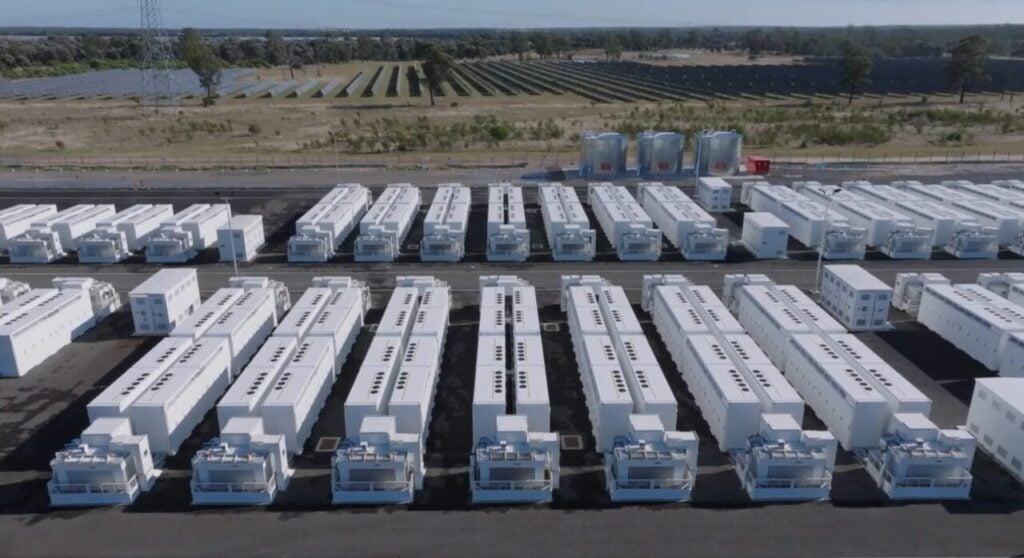
Battery energy storage systems (BESS) have emerged as the defining feature of Australia’s Capacity Investment Scheme (CIS) Tender 7, with 2GW/7.9GWh of co-located energy storage selected.
A total of 19 projects that will deliver 7.8GW of renewable energy generation across the National Electricity Market (NEM), exceeding the original 5GW target by more than 50%, were successful in the latest CIS tender round.
The tender, which opened in October 2025, attracted 53 bids totalling 18.6GW of capacity.
Eight of the 19 selected projects are hybrid developments, combining wind or solar generation with battery storage to deliver over 2GW/7.9GWh of storage to the grid.
Try Premium for just $1
- Full premium access for the first month at only $1
- Converts to an annual rate after 30 days unless cancelled
- Cancel anytime during the trial period
Premium Benefits
- Expert industry analysis and interviews
- Digital access to PV Tech Power journal
- Exclusive event discounts
Or get the full Premium subscription right away
Or continue reading this article for free
Indeed, solar-plus-storage projects feature prominently among successful bids, led by ACEN Australia’s 600MW Birriwa Solar project in New South Wales (NSW), which integrates 2.4GWh of battery storage, one of the largest co-located storage systems awarded in the tender round.
Spark Renewables secured two hybrid solar developments in NSW: the 300MW Dinawan Solar Hybrid paired with 1.2GWh of storage, and the 180MW Wattle Creek Solar Hybrid with 720MWh of battery capacity. Combined, these three solar projects alone deliver 4.32GWh of energy storage to the NEM.
Queensland’s Bungaban Wind Energy Project, developed by Windlab, will deliver 1.15GW of wind generation alongside 1.4GWh of battery storage, making it one of the largest hybrid developments in the tender and a significant addition to the state’s dispatchable renewable capacity.
The 1.5GW Yanco Delta Wind Farm operated by Origin Energy in NSW represents the largest single project and Australia’s biggest wind development to date, though details on integrated storage capacity have not been disclosed.
The prevalence of storage-integrated projects mirrors outcomes from Western Australia’s CIS Tender 5, which awarded 1.9GW of renewables with battery storage (3.7GWh), with storage forming a core component of successful bids.
The integration of battery storage across both solar and wind projects reflects growing recognition that storage is essential for managing intermittency, providing grid stability services, and maximising revenue through participation in frequency control ancillary services (FCAS) and energy arbitrage markets.
According to ASL, the Tender 7 represents the largest allocation to date under the CIS framework, surpassing Tender 4’s 6.6GW outcome, which attracted 84 bids representing 25.6GW of capacity.
CIS mechanism de-risks storage investments as Tender 8 results approach
The CIS scheme provides revenue certainty through Capacity Investment Scheme Agreements (CISAs), which underwrite projects against agreed-upon revenue floors and ceilings.
This mechanism helps attract investment by mitigating financial risk for developers, ensuring projects, particularly those with capital-intensive storage components, can secure financing and reach commercial operation.
The scheme offers both generation and storage support, with successful projects receiving capacity payments that complement wholesale electricity market revenues. This structure has proven particularly effective in de-risking hybrid projects where battery storage adds significant upfront capital costs but delivers long-term grid services and revenue optimisation.
The projects are expected to support more than 19,000 jobs during construction and more than 1,500 operations and maintenance positions over their lifetime.
Subject to final contract execution, developers have committed an estimated AU$504.6 million (US$361 million) in community-shared benefits, AU$678.7 million in First Nations benefits, and AU$257 million in Australian-made steel.
Running in parallel, the Australian government officially opened registrations for CIS Tender 9 yesterday (25 May), seeking an indicative target of 5GW of renewable energy generation across the NEM. Bids will close on 20 July 2026.
However, eligibility restrictions apply: NSW projects are ineligible as the state has reached its maximum allocation through previous tenders, while Victoria has limited solar-only projects to a total capacity of 470MW at the request of the state government.
The outcomes of Tender 8, which focuses specifically on dispatchable capacity in the NEM and seeks 16GWh of storage, are expected to be announced in June 2026.
Tender 10, targeting additional dispatchable capacity, is scheduled to open in June 2026, continuing the federal government’s push to integrate large-scale energy storage across the NEM as coal-fired generation retires and renewable penetration increases.
To read the full article, please visit PV Tech, where it first appeared.
Interested in Australia? Read Energy-Storage.news’ Energy Storage Summit Australia coverage and related content.