Eku Energy and Valent Energy have recorded separate milestones in their respective expansions of battery energy storage systems (BESS) in Australia.
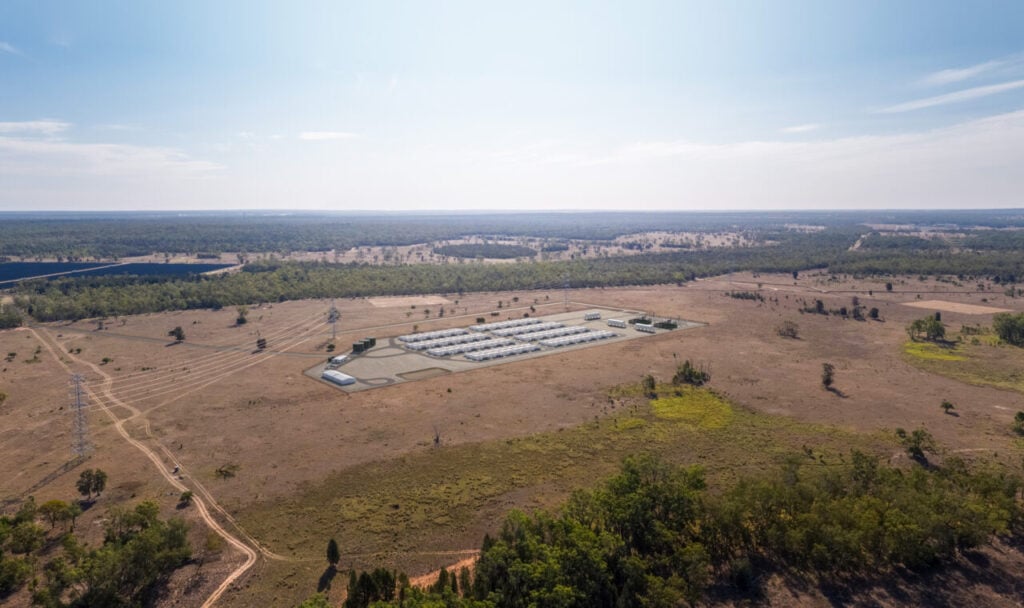
Eku Energy and LP Renewables have submitted their 400MW/1,600MWh Belah BESS to Queensland’s State Assessment and Referral Agency (SARA).
Meanwhile, in Victoria, Valent Energy’s 240MW/590MWh Mornington BESS has entered the Australian Energy Market Operator’s (AEMO) Market Management System, commencing testing and commissioning.
Eku Energy advances 1,600MWh Belah BESS through Queensland approval process
The proposed 1.6GWh Belah BESS will be located approximately 19km south of Chinchilla in Queensland’s Western Downs region, connecting directly to the existing Orana substation through a new underground high-voltage transmission cable.
Try Premium for just $1
- Full premium access for the first month at only $1
- Converts to an annual rate after 30 days unless cancelled
- Cancel anytime during the trial period
Premium Benefits
- Expert industry analysis and interviews
- Digital access to PV Tech Power journal
- Exclusive event discounts
Or get the full Premium subscription right away
Or continue reading this article for free
The 4-hour duration system is designed to store and release electricity for the National Electricity Market (NEM) over a proposed operational lifespan exceeding 20 years.
The Belah project submission comes as Queensland pursues renewable energy targets outlined in its Energy Roadmap 2025, which calls for 4.3GW of short-duration energy storage by 2030.
Despite these targets, it is worth noting that Queensland, once the leader in renewable energy investment across Australia’s states, has seen investor confidence drop since the arrival of the Crisafulli government in 2024.
Indeed, alongside energy storage, renewables, such as solar and wind, have been been wrestling with stricter regulations in the state.
In a statement, Eku Energy already noted that it has completed specialist studies covering environmental, heritage, safety and amenity impact assessments as part of the development application lodgement.
The company is conducting community consultation sessions throughout April, May and June 2026 to enable stakeholders to meet with the project team and learn about environmental and social impact assessments.
These sessions will also introduce Eku Energy’s “Powering Big Dreams” benefit-sharing plan, which encompasses local partnerships and community investment initiatives.
Eku said that the programme has already awarded nine grants totalling AU$500,000 (US$349,867) to support initiatives including solar deployment for underprivileged communities, cancer research and local environmental projects.
In a recent interview with ESN Premium, Tom Best, chief operating officer at Eku Energy, emphasised the importance of maintaining strong community relationships as the number of battery storage projects increases across Australia.
“Standalone batteries have generally enjoyed strong community support, but as the number of projects increases, we need to be proactive in engaging with communities to ensure that support continues,” Best said in a recent interview.
SARA is Queensland’s central coordinating agency responsible for assessing development applications that require state government input, ensuring projects comply with state planning policies and environmental regulations before local councils make final approval decisions.
The submission to SARA complies with the updated planning regulations for battery storage released by the Queensland government.
A social impact assessment and additional technical assessments are being prepared to support the application, which will be accompanied by a community benefit agreement to be developed with Western Downs Regional Council.
Beyond its Australian operations, Eku Energy has expanded internationally with its entry into the New Zealand market through a utility-scale BESS acquisition on the country’s North Island.
Mornington BESS enters AEMO Market Management System for commissioning
In other news, the 590MWh Mornington BESS has officially entered into AEMO’s Market Management System, marking the start of its testing and commissioning phase.
Owned by Valent Energy, the facility is situated 55km south-southeast of Melbourne’s central business district, adjacent to the Tyabb Terminal Station.
The system features 590MWh of storage capacity, with an operating maximum of 240MW. The facility boasts a ramp rate of 96MW per minute, providing rapid response capabilities for grid stabilisation.
The project utilises CATL battery technology and Power Electronics inverters, with ACLE Services serving as the engineering, procurement and construction contractor.
Valent Energy completed a 12-month construction period for the project, which connects to AusNet Services’ Tyabb Terminal Station. The commissioning phase will extensively test all system components, including battery modules, inverters, control systems and grid integration protocols, validating the system’s performance capabilities before commercial operation begins.
The Mornington BESS is a successful participant in the Australian government’s Capacity Investment Scheme (CIS), and is designed to provide critical dispatchable capacity to the NEM.
The project forms part of Valent Energy’s broader portfolio, totalling over 1.6GW of battery energy storage projects across Australia, with backing from Gaw Capital Partners and BW ESS.