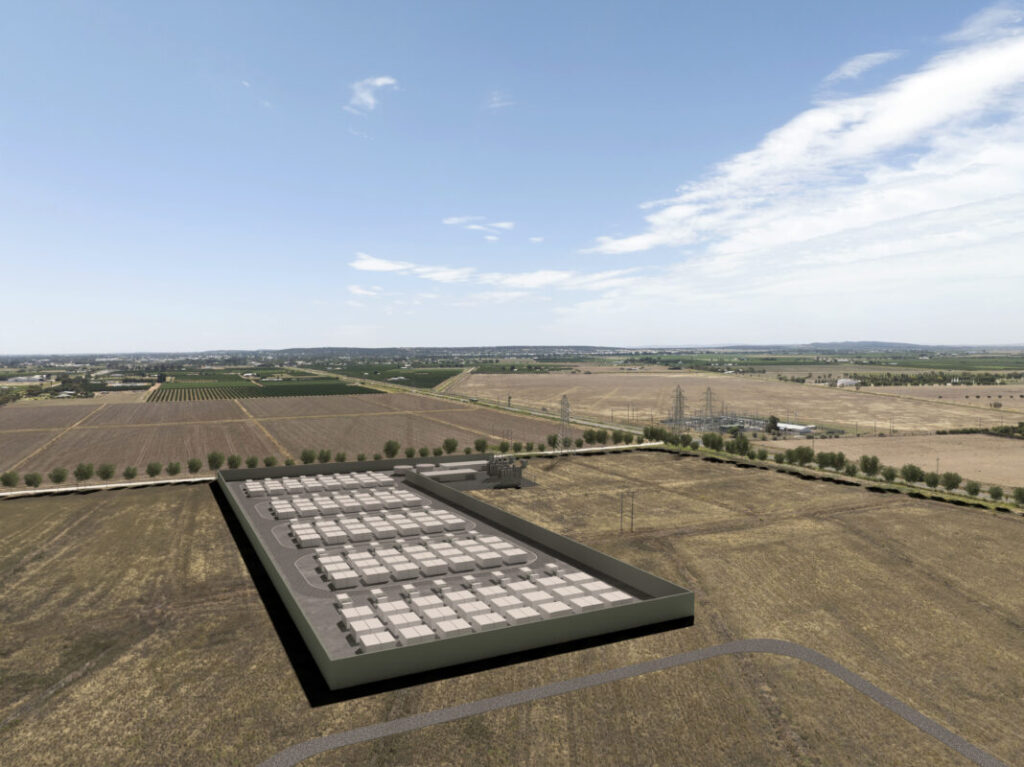
Energy storage developer Eku Energy has submitted its 1,000MWh Griffith battery energy storage system (BESS) for environmental assessment under Australia’s Environment Protection and Biodiversity Conservation (EPBC) Act.
The proposed facility will have a nominal power output of 100MW and 1,000MWh of energy storage capacity, making it a 10-hour-duration system.
It will be located on a 9.33-hectare project area in Yoogali, approximately 5km east of Griffith, New South Wales. The disturbance footprint covers 7.49 hectares, with the facility to be co-located alongside the proposed 15MW Yoogali solar PV plant, meaning no additional ecological impact from the battery storage development.
The project will connect to the National Electricity Market (NEM) via 132kV underground transmission cabling running to Transgrid’s Griffith Substation, with a new switch bay to be installed at the substation to accommodate the connection.
Try Premium for just $1
- Full premium access for the first month at only $1
- Converts to an annual rate after 30 days unless cancelled
- Cancel anytime during the trial period
Premium Benefits
- Expert industry analysis and interviews
- Digital access to PV Tech Power journal
- Exclusive event discounts
Or get the full Premium subscription right away
Or continue reading this article for free
The Griffith BESS has grown from the configuration that originally secured regulatory support. In February 2025, Eku Energy was awarded a long-duration energy storage (LDES) Long-Term Energy Service Agreement (LTESA) from AEMO Services for a 100MW/800MWh version of the project, which at that stage was planned as an 8-hour-duration system.
The LDES LTESA carries a maximum contract term of 14 years, with financial close originally targeted for the first quarter of 2026. The EPBC submission reflects an expanded 1,000MWh configuration, adding 2-hours of duration to the contracted design.
In its original 800MWh form, the Griffith BESS was one of the first 8-hour battery storage systems to secure an underwriting agreement through the NSW government’s Electricity Infrastructure Roadmap in 2023, alongside RWE’s 50MW/400MWh Limondale project, which is now operational.
The expansion to 1,000MWh and a 10-hour duration place it among the longest-duration standalone battery projects currently advancing through approvals in the NEM.
The project site sits within an established renewable energy precinct. Neighbouring assets include the 36MW Griffith solar PV power plant, already operational; the 275MW Darlington Point solar PV power plant, under development; and the 15MW Yoogali plant.
Eku Energy noted that the BESS will connect to the same 132kV substation infrastructure that serves these existing and proposed facilities, giving it grid access without requiring new transmission construction beyond the underground cabling to the substation.
Eku’s growing battery storage pipeline
The Griffith submission is the latest in a run of EPBC Act referrals from Eku Energy as the developer advances projects across multiple Australian states.
As Energy-Storage.news reported in March 2026, Eku Energy and LP Renewables submitted their 400MW/1,600MWh Belah BESS to Queensland’s State Assessment and Referral Agency, with the 4-hour duration system located approximately 19km south of Chinchilla in the Western Downs region and designed to connect directly to the existing Orana substation through a new underground high-voltage transmission cable.
Before that, Eku submitted its 400MW/1,600MWh Monduran BESS near Bundaberg in northern Queensland for EPBC assessment, a 4-hour duration system adjacent to the existing Monduran Substation designed to contribute to Queensland’s target of 4.3GW of short-duration energy storage by 2030.
Eku’s Victorian portfolio has also been advancing in parallel. Eku’s 300MW/1,200MWh Tramway Road BESS in Gippsland received planning approval through Victoria’s Development Facilitation Program, with construction potentially commencing in late 2026 and operations in 2028.
The Griffith project’s 10-hour duration exceeds the 8-hour minimum that NSW established through its long-duration storage tender framework and exceeds the 8-hour committed output requirement that South Australia’s FERM tender specified for its first round of contracted projects.
As noted in an interview with ESN Premium earlier this year, Eku Energy argued that the NEM’s market design must evolve to properly reward long-duration storage assets for the system services they provide, including inertia, frequency control, and voltage support, beyond the arbitrage and FCAS revenues that currently dominate storage revenue streams.
The Griffith project, operating for 10-hours in a region heavily reliant on solar generation during daylight hours, would be well-positioned to capture extended evening dispatch windows as solar output declines and demand remains elevated.
Eku Energy is jointly owned by Macquarie Asset Management and the British Columbia Investment Management Corporation, with a stated target of 9GWh of global storage capacity by 2028. The Griffith BESS, anticipated to be operational in 2028, forms one of the near-term delivery points toward that target.
Interested in Australia? Read Energy-Storage.news’ Energy Storage Summit Australia coverage and related content.