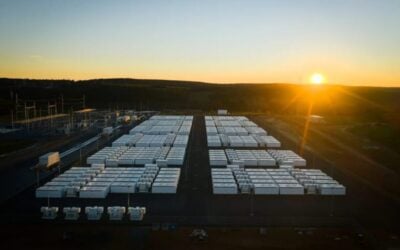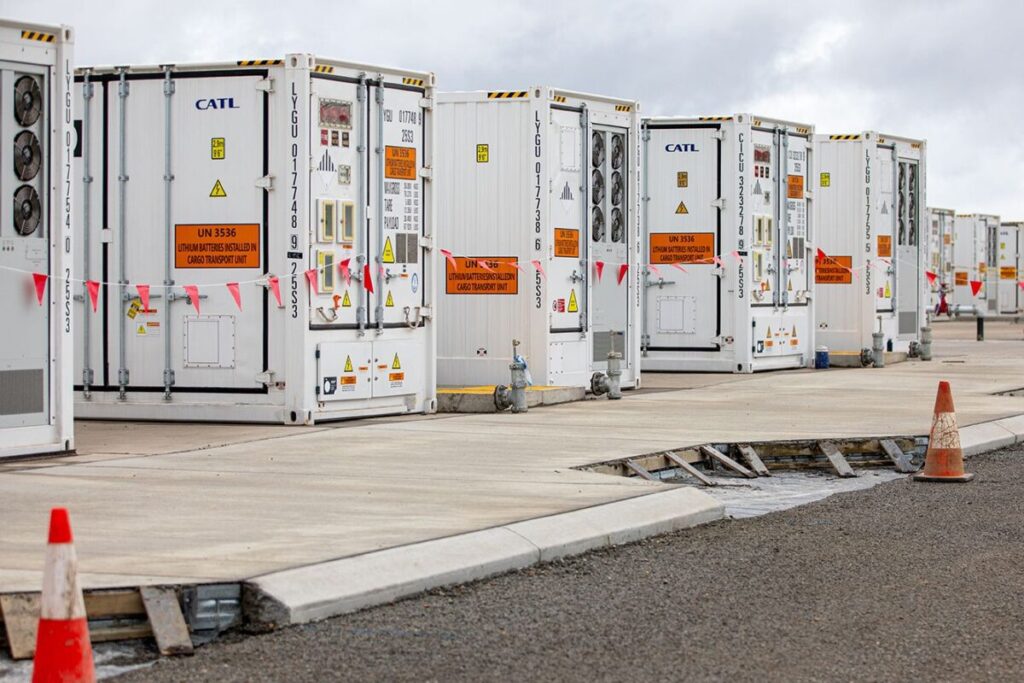
The Australian government has announced the results of Capacity Investment Scheme (CIS) Tenders 5 and 6 for Western Australia, awarding contracts to 10 projects that will deliver 1.886GW of renewable energy generation and 3.683GWh of standalone battery energy storage to the state’s Wholesale Electricity Market (WEM).
The tenders represent AU$5 billion (US$3.5 billion) in new energy infrastructure investment.
They are also expected to support more than 7,000 construction jobs and 500 operations and maintenance positions annually across their lifetime, according to a joint statement from federal energy and climate minister Chris Bowen, assistant minister Josh Wilson, and Western Australia’s energy and decarbonisation minister Amber-Jade Sanderson.
Tender 5, the first generation-focused tender in the WEM, awarded contracts to six wind farms and one solar-battery hybrid project, totalling 1.536GW of wind capacity, 350MW of solar, and 2.1GWh of battery storage.
Try Premium for just $1
- Full premium access for the first month at only $1
- Converts to an annual rate after 30 days unless cancelled
- Cancel anytime during the trial period
Premium Benefits
- Expert industry analysis and interviews
- Digital access to PV Tech Power journal
- Exclusive event discounts
Or get the full Premium subscription right away
Or continue reading this article for free
Neoen Australia secured two wind projects: the 420MW Yathroo Wind Farm and the 168MW Narrogin Wind Farm.
Other successful wind projects include Shell Energy and Foresight’s 130MW Kondinin Wind Farm, SynergyRED’s 240MW Tathra Wind Farm, Tilt Renewables’ 108MW Waddi Wind Farm, and Zephyr Energy’s 470MW Parron Maam Marang Wind Farm.
Trina Solar’s 350MW/2,100MWh Killawarra Hybrid Project was the sole solar-battery hybrid awarded under Tender 5.
| Project | Proponent | Technology | Generation capacity (MW) | Location (all WA) |
| Yathroo Wind Farm | Neoen Australia | Wind | 420 | Yathroo |
| Narrogin Wind Farm | Neoen Australia | Wind | 168 | Minigin |
| Kondinin Wind Farm | Shell Energy & Foresight | Wind | 130 | Kondinin |
| Tathra Windfarm | SynergyRED | Wind | 240 | Eneabba |
| Waddi Wind Farm | Tilt Renewables | Wind | 108 | Dandaragan |
| Parron Maam MarangFarm | Zephyr Energy (AtmosRenewables) | Wind | 470 | Hill River |
| Killawarra Hybrid Project | Trina Solar | Solar-plus-storage | 350 | Kadathinni |
Meanwhile, Tender 6, the second dispatchable capacity tender in the WEM following Tender 2 in March 2025, which resulted in four projects being selected for Capacity Investment Scheme Agreements (CISAs), awarded contracts to three battery storage projects totalling 482MW/3,683MWh.
Enpowered and Plenary Group’s Collie Battery and Solar Hybrid Project will deliver 200MW/1,518MWh, while Neoen Australia’s Yathroo Battery will provide 200MW/1,600MWh. Frontier Energy’s Waroona Renewable Energy Project Stage 1 will contribute 82MW/565MWh.
The battery storage projects awarded under Tender 6 have durations ranging from approximately 6.9 to 8 hours, reflecting Western Australia’s growing need for longer-duration energy storage as the state prepares to exit coal-fired power by 2030.
The Yathroo Battery, with an 8-hour duration, will be co-located with Neoen’s Yathroo Wind Farm but developed as a standalone asset.
| Project | Proponent | Power output (MW) | Capacity (MWh) | Location |
| Collie Battery and Solar Hybrid Project | Enpowered & Plenary Group | 200 | 1,518 | Palmer |
| Yathroo Battery | Neoen Australia | 200 | 1,600 | Mimegarra |
| Waroona Renewable Energy Project (WREP) – Stage 1 | Frontier Energy | 82 | 565 | Wagerup |
Supporting coal transition and grid reliability
The projects are designed to support Western Australia’s transition away from coal generation while maintaining grid reliability on what is regarded as the world’s largest isolated grid.
Unlike other Australian states connected through the National Electricity Market (NEM), Western Australia’s South West Interconnected System (SWIS) operates independently and cannot rely on interstate connections or pumped hydro resources.
“This is the biggest electricity boost in WA’s history, and it is exactly what the Capacity Investment Scheme was designed to deliver,” Bowen said in the statement.
“WA’s energy system is changing, and the Albanese Government is making sure that change means more reliability, more investment, more jobs and lower bills and emissions.”
All projects are due to be operational by 2030.
Tenders 5 and 6 opened in August 2025, targeting 2.4GWh of energy storage capacity and 1.6GW of renewable energy generation. The final awarded capacity of 3.683GWh exceeds the initial target by more than 50%.
As previously noted by Energy-Storage.news, both tenders were the first to implement a streamlined single-stage bidding process that consolidates technical and financial proposals, intended to shorten the tender duration from nine months to approximately six.
This approach is designed to increase efficiency and support the timely signing of Capacity Investment Scheme Agreements (CISAs).
In an interview with ESN Premium, Nick Hawke, director of Australia’s Clean Energy Finance Corporation (CEFC), previously said this move was a positive shift for the CIS scheme.
Developers have committed AU$75.7 million in community shared benefits and AU$157 million in First Nations benefits across both tenders, along with over AU$22.2 million in Australian-made steel.
These commitments add to the broader CIS programme’s social licence achievements, which now total over AU$1.1 billion in shared community benefits, AU$894.8 million in First Nations benefits, and over AU$1.1 billion in Australian steel across 65 previously announced projects.
The CIS programme has now supported 75 projects across Australia, translating to 13GW of renewable energy generation and 21.6GWh of clean dispatchable capacity. The Australian government recently opened CIS Tender 8, seeking 16GWh of energy storage across the NEM.
Interested in Australia? Read Energy-Storage.news’ Energy Storage Summit Australia coverage and related content.