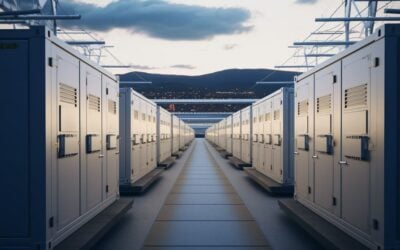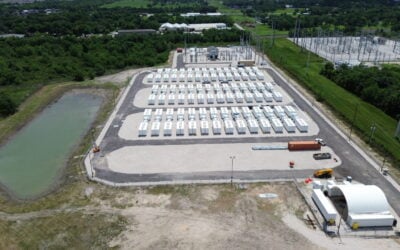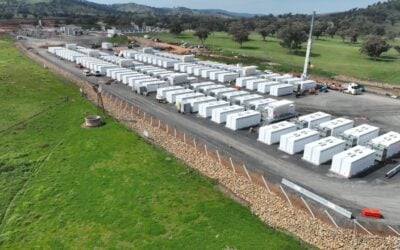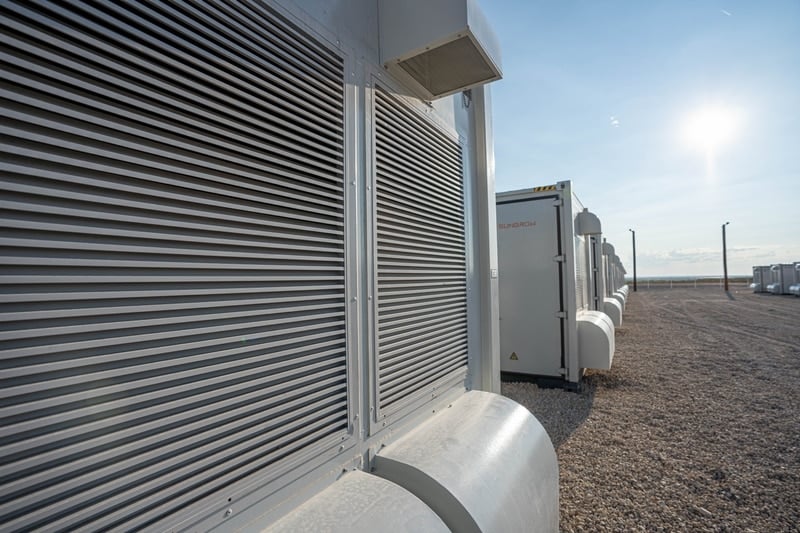
Energy storage developer Jupiter Power has turned a 200MWh battery energy storage system (BESS) in Texas online and expects to have over 650MWh operational before ERCOT’s summer peak season.
Flower Valley II, located in Reeves County, has started commercial operations, the company said yesterday (30 March 2022). The 100MW/200MWh BESS is Jupiter’s first transmission-connected project and amongst the largest operating commercially in Texas, it added.
It will provide power to the Electric Reliability Council of Texas (ERCOT) grid through energy capacity and grid-firming ancillary services. The main ancillary service that energy storage participates in on the Texas grid is the regulation reserve service (RRS), and within that fast frequency response (FFR), which together account for the bulk of revenues for energy storage assets.
“We are thrilled to announce the commencement of commercial operations at our largest battery to date,” said Andy Bowman, chief executive officer, Jupiter Power. “Our utility-scale energy storage projects provide fast-responding, dispatchable energy that is essential for allowing the grid to better match renewable resources with customer demand.”
Try Premium for just $1
- Full premium access for the first month at only $1
- Converts to an annual rate after 30 days unless cancelled
- Cancel anytime during the trial period
Premium Benefits
- Expert industry analysis and interviews
- Digital access to PV Tech Power journal
- Exclusive event discounts
Or get the full Premium subscription right away
Or continue reading this article for free
Texas is far and away the leading state with 45.1GW of renewable energy generation, nearly double California’s 22.9GW, by year-end 2021. However, it only has about half of California’s 2.6GW of grid-connected energy storage (as of 31 January 2022).
Flower Valley II sits next to Flower Valley I, a smaller 9.9MW/19.8MWh system which entered commercial operations in mid-2021, and more than US$70 million was invested in the two projects.
Jupiter has two other transmission-connected projects in Texas totalling another 400MWh currently in commissioning and expected to be operational before ERCOT’s summer peak season. Crossett in Crane County is a 200MW/200MWh system while Swoose II, also adjoining an existing 9.9MW/19.8MWh BESS, holds 100MW/200MWh of energy.
With 15MWh of energy from the already operational Triple Butte I in Pecos County, the two larger upcoming projects will bring Jupiter Power’s operational storage capacity in the state to 654.6MWh (and 427.3MW of power).
ERCOT has a streamlined interconnection process for generation resources below 10MW, which may partially explain the size of Jupiter’s already commercially operating projects. The requirements of RRS and FFR have also driven the deployment of one-hour systems, meaning smaller average size BESS projects compared to California where four-hour systems became mainstream at least four years ago.
Jupiter’s strategy in Texas is to start developing projects without contracts in place in order to deliver capacity to the grid or ancillary services. It choose strategic locations where storage is most needed like system bottlenecks or regions with volatile power prices that storage could mitigate.
RRS provides 10-minute energy deployments in response to significant generation losses on the system as well as operating reserves for frequency containment after large generation contingency events. Within RRS, RRS-FFR (fast frequency response) requires assets to be automatically deployed and provide a full response within 15 cycles after the frequency meets or drops below 59.85 Hz.
A market source told Energy-storage.news that these two services will remain the main revenue driver for some time with no signs of a saturation of the market. Although storage is increasingly making money through arbitrage too, they added.
The state suffered a major power crisis after a winter storm last year in which hundreds died, some as a result of power outages. Industry sources at the time said the crisis highlighted the importance of energy storage on the grid.