
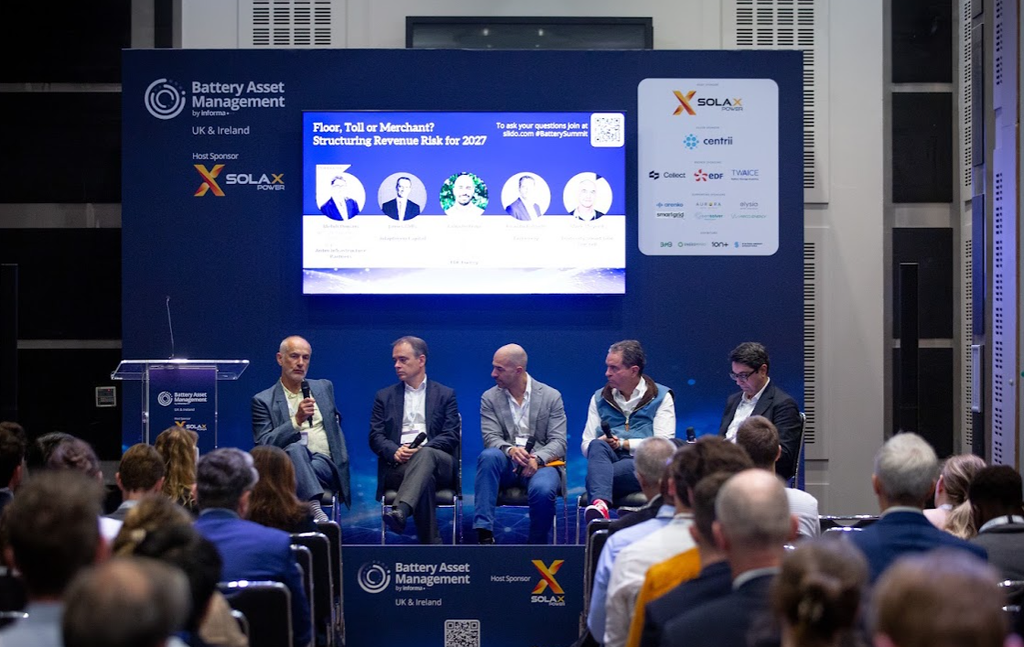
There is limited benefit to questioning every decision made, but operators should be hands-on with their optimiser, industry sources said at the Battery Asset Management Summit UK & Ireland 2026 last month.
Panellists from investors and optimisers discussed battery energy storage system (BESS) asset offtake and revenue strategies on the ‘Floor, Toll or Merchant? Structuring Revenue Risk for 2027’ panel discussion at the two-day event held in London (pictured above).
We covered the part of the discussion around tolls and floors in a piece last week, while in this article we look at what the panellists had to say about trading and optimisation.
The UK event will be followed by the Battery Asset Management Summit Europe in Rome, Italy in a few weeks, on 2-3 December.
Try Premium for just $1
- Full premium access for the first month at only $1
- Converts to an annual rate after 30 days unless cancelled
- Cancel anytime during the trial period
Premium Benefits
- Expert industry analysis and interviews
- Digital access to PV Tech Power journal
- Exclusive event discounts
Or get the full Premium subscription right away
Or continue reading this article for free
Evolving revenue opportunities
Moderator Mehdi Omrani, investment director at investor Antin Infrastructure Partners, asked the panellists what part of the revenue stack they would not want to give away to an offtaker.
James Mills, managing director of Adaptogen Capital, said that the market is still learning about the available revenue opportunities from capitalising on intra-day market spreads, and so he wouldn’t want to give away that opportunity. Adaptogen owns UK BESS owner-operator Varco Energy.
Mills: “The multiple spreads in a day are something we don’t yet fully understand, so I don’t want to give up too much of that second-spread opportunity. Everyone sees the main daily spread, and utility solar portfolios know they’re short on that spread, with capture rates collapsing. What’s less clear is what the other 18 hours of the day generate through wholesale arbitrage or the balancing mechanism. The midday-to-peak spread will clearly be a structural part of the market for the next couple of decades, but that’s actually less than a majority of the value across a 24-hour period.”
Building on this theme of an evolving market, Mark Meyrick, general manager at the optimisation arm of green utility Ecotricity said that people need to talk more about the rationale of sitting tight and waiting for opportunities even if that means days, not hours.
Meyrick: “I have strong opinions here. Someone at Energy Trading Week a couple of weeks ago said ‘revenue is not the same as value’ and I completely agree. There are times when, with 650 cycles a year to play with, you might choose not to do anything for two days because the value isn’t there, and instead go harder a week later. An optimiser shouldn’t feel obliged to hammer the asset every day just to hit a cycling target — you wait until the market’s hot and then plough in. People don’t talk about that enough, but I absolutely think it matters.”
Optimiser transparency and performance
Omrani then asked how owner-operators work with their optimiser to ensure they work the asset hard when needed. Ricardo Folgado, managing partner of BESS owner-operator TagEnergy, said it can be a challenge because optimisers vary.
“Some are a black box, others less so, and it also depends how much trading capability you want to internalise. You need to be hands-on with the optimiser, challenge them constantly, and really understand their trading strategies — and sometimes assess whether you’re willing and able to bring some of that in-house. It’s not easy. It’s very easy to hand it to an optimiser and let it be a black box you don’t control, and for some people that’s good enough. We prefer to challenge it.”
Mills quipped that Adaptogen is “a complete pain for its optimisers,” to which Fabrizio Fenu, head of business development & account management services, EDF Business & Wholesale, part of energy major EDF, reassured him that it wasn’t true.
Picking up on that, Mills said that there’s limited benefit to trying to micro-manage your traders and ultimately you need a long-term view.
And on that long-term view, he thinks the market is going to move to high-cycling applications as a key revenue driver.
“There’s also diminishing returns to questioning every single day or week — you have to look at performance over an extended period to let the maths work. Our view is that we’ve built high-cycling, expensive machines, and we want to maximise cash and revenues over that machine as much as possible — this is an IRR game,” he said.
“We’ve built systems and negotiated LTSAs that allow us to cycle three times a day, which comes with real costs in auxiliary load, cooling, and LTSA costs — but we believe there’s significant economic value to be realised from that. We’re only just starting to see signs of it in the market; the opportunity for very high cycling hasn’t fully been there yet, but we think it’s beginning to emerge.”