Portugal-based utility EDP has received clearance to deploy a 1MWh vanadium flow battery system as part of a hybrid energy storage project at the site of a retiring thermal plant in Asturias, Spain.
EDP España was granted the authorisation to deploy the vanadium redox flow battery (VRFB) system at the 1.2GW Soto de Ribera coal and gas plant on January 25, 2023, by the government of Asturias, one of Spain’s autonomous communities.
The system, called REDOX2025, will have a power output of 0.25MW and an energy storage capacity of 1.05MWh meaning a duration of 4.2 hours.
Flow batteries, be it vanadium or anything else, decouple the power and energy components of the system, unlike lithium-ion. The power section will be housed in a single 20-foot shipping container, containing 16 stacks of redox flow batteries, 8 pumps and a set of valves and pipes and a battery management system (BMS).
Try Premium for just $1
- Full premium access for the first month at only $1
- Converts to an annual rate after 30 days unless cancelled
- Cancel anytime during the trial period
Premium Benefits
- Expert industry analysis and interviews
- Digital access to PV Tech Power journal
- Exclusive event discounts
Or get the full Premium subscription right away
Or continue reading this article for free
Eight electrolyte tanks totalling 58m3 of vanadium electrolyte and an electrolyte thermal conditioning system will be housed separately, making up the energy component of the system. EDP hasn’t yet revealed which company will provide the VRFB solution.
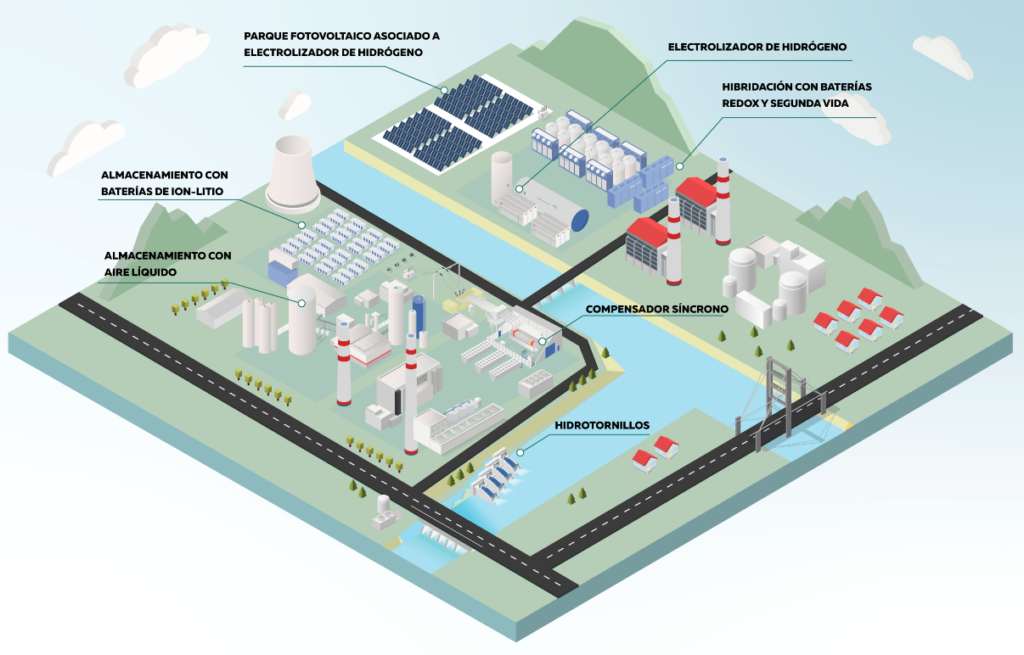
Soto de Ribera was meant to be decommissioned last year but has been kept online due to the energy crisis sparked by Russia’s invasion of Ukraine. EDP is turning the site into a renewable energy park combining multiple technologies, visualised in the infographic above (in Spanish).
The construction of a run-of-river hydroelectric plant and solar PV array is already underway. The energy produced by these will primarily be stored as green hydrogen while the “excess” is to be stored in a combination of lithium-ion battery storage, the VRFB system and second-life EV batteries, the company says on its website. It is also considering building a liquid air energy storage (LAES) system (almacenamiento con aire liquido).
The stored green hydrogen could be used for decarbonising transport as well as used in combined cycle gas plants. Most agree today that using green hydrogen for conversion back to electricity has a round-trip efficiency too low to be cost-effective.
Two years ago EDP stated it had an aim to deploy 1GW of energy storage by 2026. In July 2022, it announced it would add a 26MW battery storage unit to a floating solar-hydropower hybrid plant.
Read the Asturias government’s authorisation filing for the VRFB project here.
In related non-lithium energy storage news in Spain, European chemicals company BASF’s subsidiary BASF Stationary Energy Storage (BSES) yesterday announced a distribution deal for sodium-sulphur (NAS) battery products in the Iberian country. The high-temperature NAS battery was developed by Japanese company NGK Insulators, has been used in more than 600MW/4,000MWh of projects globally since the mid-1980s. BASF and NGK entered a partnership to further commercialise and deploy the technology in 2019 marking BASF’s entry into the energy industry.
BASF Stationary Energy Storage GmbH and Sener Renewable Investments will deploy the technology at hybrid solar power plants, starting with a project on the Canary Islands. Sener has three-year exclusivity for BASF’s tech in Spain as part of the agreement.
The announcements coincide with senior US figures both calling for, and predicting, an uptick in investment in non-lithium energy storage technologies there, as reported by Energy-Storage.news yesterday.
Energy-Storage.news’ publisher Solar Media will host the eighth annual Energy Storage Summit EU in London, 22-23 February 2023. This year it is moving to a larger venue, bringing together Europe’s leading investors, policymakers, developers, utilities, energy buyers and service providers all in one place. Visit the official site for more info.