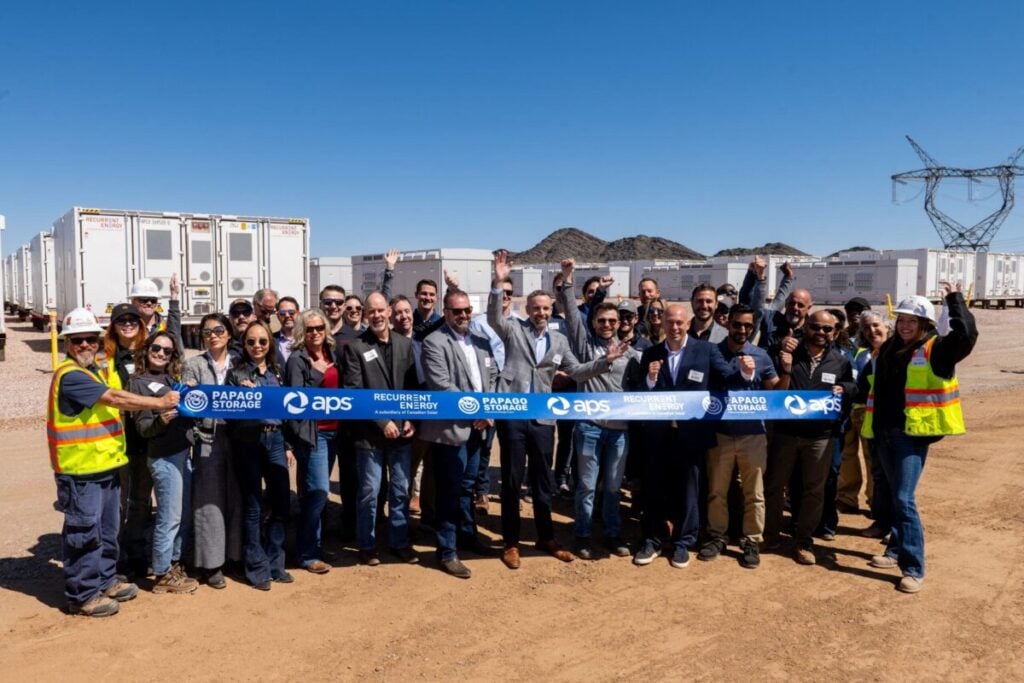
Developer and independent power producer (IPP) Recurrent Energy, subsidiary of Canadian Solar, announced commercial operation of its 1,200MWh Papago Storage facility in Maricopa County, Arizona.
The project has a 20-year tolling agreement with utility Arizona Public Service (APS), the largest electric utility in Arizona.
Recurrent has two other projects that have tolling agreements with APS. Together with Papago, they will total 1,800MWh of energy storage capacity and 150MWac of solar generation.
Canadian Solar’s majority-owned subsidiary, e-STORAGE, provided the project with turnkey engineering, procurement and construction (EPC) and will continue to support Papago Storage under a long-term service agreement.
Try Premium for just $1
- Full premium access for the first month at only $1
- Converts to an annual rate after 30 days unless cancelled
- Cancel anytime during the trial period
Premium Benefits
- Expert industry analysis and interviews
- Digital access to PV Tech Power journal
- Exclusive event discounts
Or get the full Premium subscription right away
Or continue reading this article for free
Recurrent claims that Papago also benefits the local community by providing tax revenues and direct assistance. As part of its Community CaRE (Community and Renewable Energy) Programme, the company has made donations to the Harquahala Fire District and Arlington Elementary School in Maricopa County.
The tolling agreement was signed in 2023 and originates from APS’s All Resource request for proposal (RFP) conducted in May 2022, which sought 1-1.5GW of resources, including 800MW of renewable energy.
In March of this year, Recurrent closed a US$183 million financing for its 200MWh Fort Duncan Storage project. Located in Maverick County, Texas, the project is expected operational this summer.
Canadian Solar is primarily recognised for its PV modules, but it has significantly expanded into energy storage over the past few years, as well as project development across both technologies.
In 2024, the company announced it would build a battery energy storage system (BESS) and cell manufacturing facility in Kentucky, in a factory vacated by metal-hydrogen battery company EnerVenue.
As reported in May of this year, Canadian Solar’s battery storage arm expects to make between 7GWh and 9GWh of shipments in 2025, with the final figure dependent on trade policy developments.
Ismael Guerrero, CEO of Recurrent Energy, said of the Papago project:
“The commissioning of Papago Storage marks a major milestone in our collaboration with APS to strengthen Arizona’s energy infrastructure.”
“We’re proud to deliver flexible capacity that meets the state’s growing energy needs and grateful for APS’s continued partnership. As we begin operations, we remain committed to building long-term value for the local community and our partners.”