
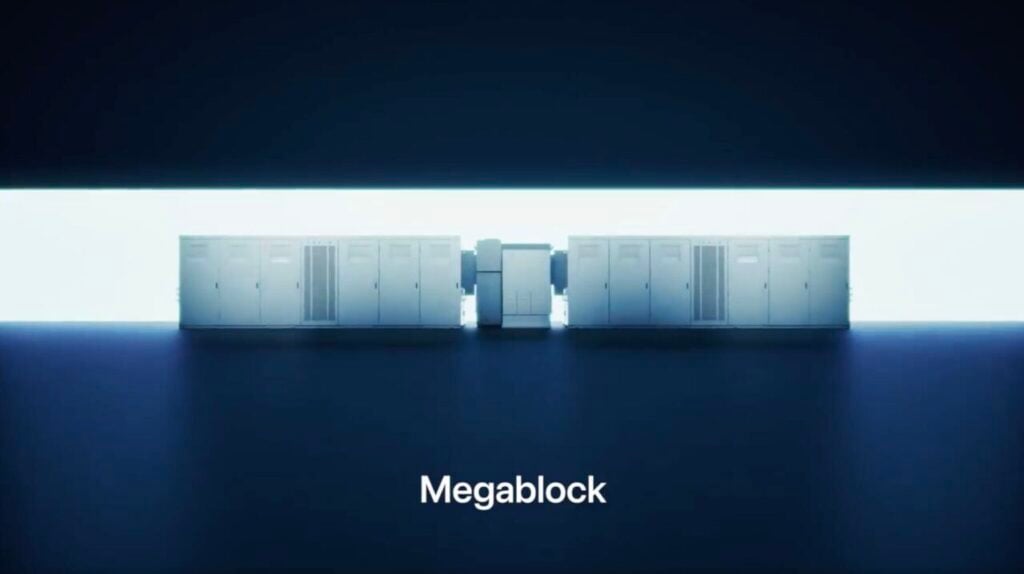
Tesla was one of the pioneers of the grid-scale battery storage market, but has faced increasing competition in the past few years. In this article we look under the hood of its latest grid-scale BESS product, the Megapack 3.
Wood Mackenzie’s most recent figures pegged Tesla as the largest battery energy storage system (BESS) integrator last year, while others showed Sungrow taking the top spot. Companies generally launch new products about once a year to stay up to date and stay competitive, and this time last year Tesla launched its new Megapack 3 XL and associated Megablock configuration.
In this piece, we dig into the product’s specifications and how it builds on the Megapack 2 XL, its predecessor.
Tesla starts Megapack 3 construction in Texas
Tesla currently has over 77GWh of Megapack units in operation around the world, with an uptime of 99.3%. This includes the deployment of 8.8GWh of energy storage in Q1, and 13.5GWh in Q2 this year―the latter of which is the company’s 2nd highest quarter installation capacity to date. While the quarterly figures pertain to both the large-scale Megapack and the residential Powerwall, the utility-scale product accounts for the bulk of sales. Tesla has also recently signed a multi-year supply and execution agreement with NatPower to supply over 25GWh BESS in Italy and the UK and is part of a wider programme that aims to deploy over 100GWh storage capacity.
Try Premium for just $1
- Full premium access for the first month at only $1
- Converts to an annual rate after 30 days unless cancelled
- Cancel anytime during the trial period
Premium Benefits
- Expert industry analysis and interviews
- Digital access to PV Tech Power journal
- Exclusive event discounts
Or get the full Premium subscription right away
Or continue reading this article for free
Tesla currently has three facilities that produce the Megapack in Lathrop, California, the new Brookshire facility in Texas, and one in Shanghai, China. The California and Shanghai facilities have an annual production output of around 40GWh.
With the growth of Megapack demand, Tesla has just started producing its next-generation Megapack 3 BESS at its facility in Brookshire―a small city just outside of Houston. There are plans for the Texas site to have a 50GWh annual capacity for the Megapack 3. Deliveries of the BESS are expected to start towards the end of 2026.
The Megapack 3 is a lithium iron phosphate-based (LFP) BESS that has been designed to deliver 5MWh capacity and a 2.5MW power output. The Megapack is being sold in many configurations, all with this capacity and power output, which have been designed for different applications. This includes a standard BESS with an integrated inverter, thermal management systems and an AI control platform for automated energy trading and revenue optimisation.
Other configurations include a Megapack with an electrolyser buffer for combining hydrogen production with grid services, a Megapack BESS optimised for carbon capture, utilisation and storage (CCUS) operations, and a mobile Megapack which is a trailer-mounted and supercharger compatible BESS for EV fleets and temporary power applications. The final configuration comes with a 50kw fuel cell and is a hybrid design.
The Megapack 3 has been designed for peak shaving, frequency regulation, capacity firming, transmission deferral, renewable integration and black start capability. The Megapack 3 can be deployed as a standalone utility system for keeping the grid running smoothly, for maintaining the reliability of renewable energy sources integrated into the grid, providing backup power for data centres and commercial and industrial (C&I) businesses, and within microgrid setups.
One of the biggest developments of the new Megapack 3 is the development of the Megablock. This is a larger configuration where up to four Megapack 3 units are combined to provide 20MWh capacity and four-hour discharge durations. Up to 248MWh of capacity can be installed in an acre.
The Megablock is pre-engineered with transformers and switchgear. Individual Megapack installations need to be connected to a medium-voltage transformer and can require up to 24 cable connections per pack. By comparison, the Megablock only need three busbar connections per pack, cutting installation time by 23% and construction costs by 40%, and enabling 1GWh to be deployed in just 20 days. The Megablock has been designed for a 25-year lifespan.
One of the potential barriers facing the Megapack 3 and the Megablock is that Tesla’s current main supply of battery cells comes from China and Southeast Asia. With US tariffs on BESS made with foreign components, the affordability of Tesla’s BESS in the US market is at risk. In addition, to continue qualifying for the production tax credit (PTC) and investment tax credit (ITC) incentives, at least 55% of the BESS units (by total cost) must be manufactured domestically to avoid falling foul of Foreign Entity of Concern (FEOC) rules as of 2026, with the figure increasing incrementally over the next few years.
However, this should be avoided in the coming years as Tesla has partnered with LG Energy Solution (LGES) for the supply of LFP cells produced domestically at LG ES manufacturing facilities in Michigan. The production lines are among several gigawatt-hours at US factories being converted from producing NMC pouch cells to produce LFP prismatic cells. With LG ES relatively early in its mass production of this battery chemistry in the US, Tesla has to hope that manufacturing is not delayed to decouple from reliance on Chinese battery cell supply chains.
Comparing the Megapack 3 to the Megapack 2
The new Megapack 3 builds on the success of the Megapack 2 XL, with the main improvement centred around an improved energy density. As the previous (and smaller) Megapack 2 units have been replaced by the XL, the better comparison is between Megapack 3 and Megapack 2 XL configurations.
However, note that Tesla has not publicly released a full data sheet for the Megapack 3 product yet.
The Megapack 3 stores 5MWh compared to the 3.9MWh of the Megapack 2 XL. This is a 28% increase in energy density without increasing the footprint (28-foot unit) of the container. The primary reason for this energy increase is that Tesla has used larger 2.8L cells in the Megapack 3 system, and while it has enabled a higher unit capacity, it also reduces the thermal-system connection points by 78%. The Megapack 3 can also be configured into the Megablock, unlike the Megapack 2 XL.
However, it’s not quite as simple as a direct capacity comparison. While all the Megapack 3 container configurations have a stated capacity of 5MWh and a power output of 2.5MW, there are different Megapack 2 XL configurations, and they all have different capacity and power metrics. 3.9MWh is the capacity for the 2-hour and 4-hour CO10 and CO11 modules, with the 2-hour unit having a power output of 1.9MW and the 4-hour version having a power output of just below 1MW. However, there is a third configuration, the CO12, with a 4.3MWh capacity and a power output of just over 1MW.
In terms of other key performance metrics, both Megapack 2 XL and Megapack 3 have a depth of discharge of 100%, but their round trip efficiency (RTE) does differ. The newer Megapack 3 has a stated RTE of 92.5%, but the Megapack 2 XL has an RTE between 91.7-93.7% depending on the configuration. This can be broken down further with the 2-hour CO10/CO11 units having an RTE of 91.7%, the 4-hour CO10/CO11 units having an RTE of 93.7% and the CO12 units having an RTE of 91.9%. The original Megapack 2 unit, for reference, had an RTE of 92%. While the Megapack 2 XL units have been designed for 2- and 4-hour durations, the Megapack 3 has been designed for up to 8 hours.
The weight and dimensions are also similar, but there are slight differences. The Megapack 2 XL has dimensions of 8.80m × 1.65m × 2.79m and a weight of 38,100kg whereas the Megapack 3 has dimensions of 8.1m × 1.6m × 2.8m and a container weight of 38,000kg. Both exceed the standard US ton limit of 40 tons and therefore require multi-axle trailers to be transported across the US. Freight of this weight also usually requires permits depending on the states they will be travelling through and will sometimes require a police escort and/or restricted travel windows. However, because both fall into the same logistics category, there is no advantage or disadvantage either way in this regard. Before the Megapack 2 was superseded by the XL units, it had dimensions of 7.25m × 2.506m × 1.637m and weight up to 30,500kg, so the original would have no problems fitting under the limit unlike the newer versions.
When it comes to the life of the systems, the Megapack 3 has a cycle life of at least 10,000 cycles, a design and calendar life up to 25 years, and a warranty of up to 20 years. By comparison, the Megapack 2 XL has a cycle life of 3000-5000 cycles, design and calendar life of 15-20 years, and a warranty of 15 years, extendable to 20 years.
The temperature operating range of the Megapack 3 is wider than the Megapack 2 XL, with an operating temperature range of -40–60°C (-40°F to 140°F) compared to -30–50°C (-22–122°F). Tesla has also stated that the Megapack 2 XL has a carbon offset potential of 88,000 tons of CO₂e per unit over its operational life. No figure has been given yet for the Megapack 3, but it should be at higher because of its bigger size and longer operational life.
The following table summarises and compares the new Megapack 3 against the Megapack 2 XL:
| Specification | Megapack 3 | Megapack 2 XL |
| Unit capacity | 5MWh | 3.9-4.3MWh |
| Power | 2.5MW | Roughly 1-1.9MW |
| Discharge duration | Up to 8 hours | 2 and 4 hours |
| Calendar and cycle life | 10,000+ cycles25-year calendar life | 3000-5000 cycles15-20 years calendar life |
| Round trip efficiency | 92.5% | 91.7-93.7% |
| Operating temperature range | -40–60°C (-40°F to 140°F) | -30–50°C (-22–122°F) |
| Container weight | 38,000kg | 38,100kg |
| Container dimensions | 8.1m × 1.6m × 2.8m | 8.80m × 1.65m × 2.79m |
| Depth of discharge capability | 100% | 100% |
| Warranty | 20 years | 15 years (extendable to 20 years) |
Megapack 3 vs Megapack 2 XL: which one will developers choose?
The Megapack 3 has a higher per-unit MWh and energy density and has the potential to maximise large-scale installations using the Megablock system compared to the Megapack 2 XL. For newer installations where there is a need to maximise space, or sites that operate in more extreme climates, then the Megapack 3 will be the better option. For smaller installations and those where space is not an issue, the Megapack 2 XL may still be a viable choice because it’s already a well-established technology―especially if it is an expansion project where Megapack 2 XL are already used as it may be more expensive to make the switch. For developers who want to stick with proven supply chains and proven technology in the field, the Megapack 2 XL will still be viable.
However, for many the installation and unit costs are going to be similar for both the Megapack 2 XL and the Megapack 3―around US$1.39 million per unit―but because the Megapack 3 will require fewer units to achieve the same capacity, it will lead to a lower total cost of ownership (TCO) for many developers because of fewer initial unit costs, fewer units to maintain, and fewer balance-of-plant (BOP) costs such as foundations, fencing, and trenching. However, the Megablock modules may require different foundation plans compared to standalone units, so this will also have to be accounted for in the planning and budgeting stages.
While it’s still early days, only a few projects have been been announced as using the Megapack 3. One is Neoen’s 907MWh Goyder grid-forming BESS in South Australia. Two projects in Belgium have as well, according to unconfirmed reports: Giga Storage’s 2.8GWh Green Turtle and Storm’s three-project, 1.2GWh pipeline.
