Finland and California-based second life energy storage firms Cactos and Smartville Inc have raised nearly US$10 million to commercialise systems using repurposed Tesla EV batteries – we talked to both companies’ founders.
San Diego-based Smartville Inc recently received a US$6 million grant from the Department of Energy’s (DOE) US$74 million for domestic battery recycling and reuse programme, co-founder and president Mike Ferry told Energy-Storage.news.
The money will go towards productising the firm’s enclosure system into second and third iterations, certify its product to thermal runaway test certification UL 9540A and its manufacturing facility to UL 1974, a certification specifically for second life energy storage systems (ESS), he added.
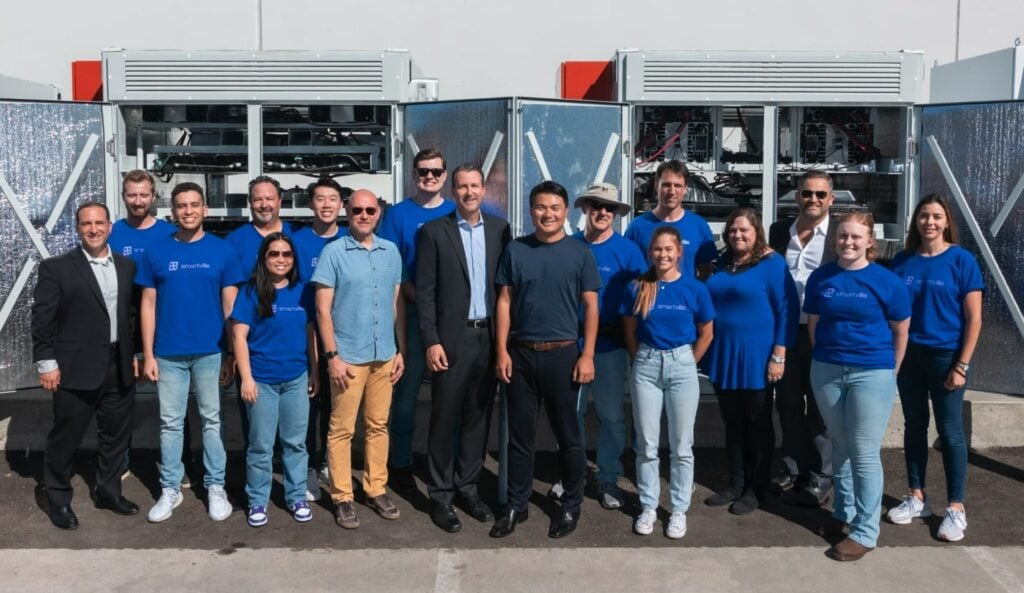
Its current product, MOAB, is a 250kW/500kWh system that uses either repurposed EV battery packs from Tesla and Nissan’s Leaf. The first commercially operating system, made up of two enclosures, one Tesla and one Nissan, recently went online at the UC San Diego library annex in Mira Mesa (pictured). Unlike most second life ESS firms, Smartville uses fully battery packs.
Try Premium for just $1
- Full premium access for the first month at only $1
- Converts to an annual rate after 30 days unless cancelled
- Cancel anytime during the trial period
Premium Benefits
- Expert industry analysis and interviews
- Digital access to PV Tech Power journal
- Exclusive event discounts
Or get the full Premium subscription right away
Or continue reading this article for free
“We believe focusing on battery packs rather than disassembly and modules allows us to scale. For this market to reach the MWh and even GWh projects it does not make sense from a labour or financial perspective to disassemble,” Ferry said.
Energy-Storage.news was previously told by other second life ESS companies that it was hard to work with Tesla, because it did not work with third parties and its battery pack enclosure system was hard to disassemble.
Smartville gets its Tesla EV battery packs from the third-party vehicle salvaging market, while working directly with Nissan and other automakers for theirs – we wrote about which companies were leaders in doing this recently.
That is also the case for Finland-based Cactos which just this week raised €2.5 million (US$3 million) in equity and debt to commercialise its 100kWh behind-the-meter ESS product, also made up of repurposed Tesla EV batteries.
CEO Oskari Jaakkola told Energy-Storage.news that these are received from a battery recycling company in Norway and disassembled into modules.
The company is agnostic about using second life or new batteries, however, as Jaakkola explained.
“We started as a pure play second life firm and our first operational systems have been entirely second life, but going forward we’ll also supplement them with systems made of new batteries. Second life modules are not materially cheaper now but the delivery times are much, much quicker.”
Superhero Capital led the fundraise round, which came a few months after Cactos’ first commercially operating system was installed at a small factory in August, and the firm has done a few residential deployments since then, Jaakkola said.
The company was officially launched earlier this year and will use the funding to double its factory size which should allow for a 10-fold increase in unit production. For the financial year to April 2024, he expects to ship 100 units, i.e. 10MWh of energy storage.
Smartville meanwhile anticipates deploying 50-100MWh of energy storage in 2024, Ferry said.
Energy-Storage.news will be publishing a more in-depth interview with the California-based firm in the coming weeks.
Energy-Storage.news’ publisher Solar Media will host the 5th Energy Storage Summit USA, 28-29 March 2023 in Austin, Texas. Featuring a packed programme of panels, presentations and fireside chats from industry leaders focusing on accelerating the market for energy storage across the country. For more information, go to the website.
But before that, Solar Media will also host the eighth annual Energy Storage Summit EU in London, 22-23 February 2023. This year it is moving to a larger venue, bringing together Europe’s leading investors, policymakers, developers, utilities, energy buyers and service providers all in one place. Visit the official site for more info.