Developer Squadron Energy is seeking approval from the Australian government’s Environment Protection and Biodiversity Conservation (EPBC) Act to develop a 1,000MWh wind-plus-storage project in New South Wales.
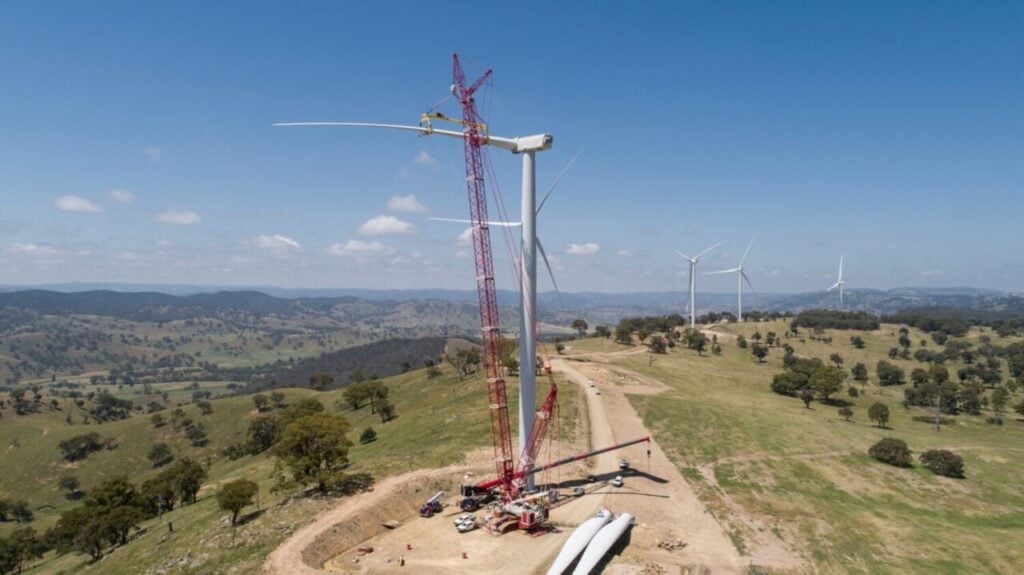
Bookham Wind Farm, which proposes a 594MW wind generation site coupled with a 250MW/1,000MWh 4-hour duration battery energy storage system (BESS), is being proposed for the rural locality of Bookham, nestled within the Yass Valley Shire, around 316km southeast of Sydney.
Including the BESS will enable the project to store and dispatch scheduled and reliable energy to and from the National Electricity Market (NEM) during periods of high energy demand or low wind generation.
The project would be strategically located in close proximity to the HumeLink transmission project, enabling the site to potentially leverage the expansion of transmission infrastructure in the region.
Try Premium for just $1
- Full premium access for the first month at only $1
- Converts to an annual rate after 30 days unless cancelled
- Cancel anytime during the trial period
Premium Benefits
- Expert industry analysis and interviews
- Digital access to PV Tech Power journal
- Exclusive event discounts
Or get the full Premium subscription right away
Or continue reading this article for free
HumeLink, which was approved by the Australian government last year, intends to construct 365km of new 500kV high-voltage transmission infrastructure between Wagga Wagga, Bannaby and Maragle in New South Wales. It will cost around AU$5 billion (US$3.1 billion) to develop and will play an integral role in unlocking the 350GWh Snowy 2.0 pumped hydro energy storage (PHES) expansion.
The Bookham project will feature around 99 wind turbines with an operational lifespan of at least 30 years.
Squadron Energy is also behind a 1,800MWh wind-plus-storage project in New South Wales, which the NSW Independent Planning Commission (IPCN) recently recommended for approval.
The site aims to couple a 700MW wind farm with a co-located 400MW/1,800MWh BESS. It is located west of Gulgong and northeast of Wellington in the Central-West Orana Renewable Energy Zone (REZ), which recently became the first to transition into the delivery phase.
It also submitted another wind-plus-storage project in New South Wales to the EPBC Act in November 2024 in the form of the Conargo Wind Farm. The proposed site features an 8-hour duration 1,200MWh BESS co-located with a 300MW wind project.
Tasmanian wind-plus-storage site granted ‘Major Project’ status
Much like solar-plus-storage, wind-plus-storage sites are becoming increasingly popular in Australia and globally for optimising power plants.
Several notable developments in Australia in recent months have integrated storage into their design to achieve this feat. Two of these are situated in Tasmania, the island state located to the south of the mainland.
Cellars Hill Wind Farm, a community-driven initiative led by local landowners, was recently granted ‘Major Project’ status by the state’s government. The development is expected to cost in the region of AU$1.5 billion and feature a 600MW/2,400MWh. The wind element of the site will have a generation capacity of 350MW.
By being declared a major project under the Land Use Planning and Approvals Act 1993 (LUPAA), the site will be assessed by an independent panel assembled by the Tasmanian Planning Commission. The independent panel makes the final decision on the project. It is not subject to an appeal on planning merit but can be appealed under judicial review on legal matters.
Alongside this development, a 450MW wind-plus-storage project is being pursued by developer Goldwind Australia in Tasmania, featuring a 200-400MWh BESS. Dubbed the Bashan Wind Farm, it is also being proposed for the Central Highlands region. The project would include 56 wind turbines and three substations.