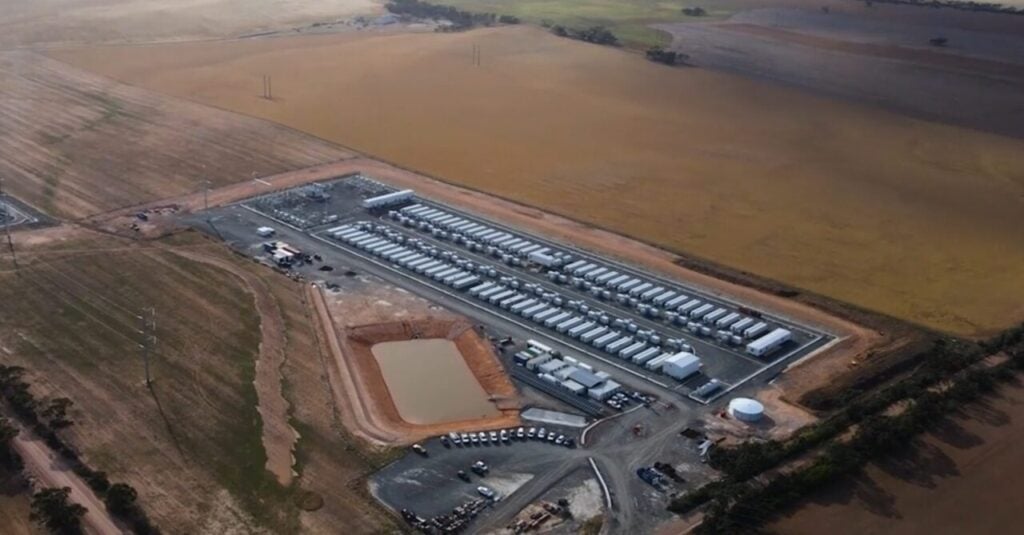
South Australia has officially opened its inaugural Firm Energy Reliability Mechanism (FERM) tender round, seeking up to 700MW of long-duration energy storage (LDES) capacity to enhance grid reliability and support the state’s renewable energy transition.
The tender, administered by ASL (formerly AEMO Services), represents the first implementation of South Australia’s new capacity mechanism designed to ensure adequate dispatchable generation during peak demand periods.
The FERM tender targets energy storage systems capable of providing at least 4-hours of continuous discharge duration, with preference given to technologies offering 8-hours or longer storage capacity.
Successful projects must demonstrate the ability to deliver firm capacity during critical peak demand periods, typically occurring during summer evenings when solar generation declines and air conditioning demand peaks across the state.
Try Premium for just $1
- Full premium access for the first month at only $1
- Converts to an annual rate after 30 days unless cancelled
- Cancel anytime during the trial period
Premium Benefits
- Expert industry analysis and interviews
- Digital access to PV Tech Power journal
- Exclusive event discounts
Or get the full Premium subscription right away
Or continue reading this article for free
The tender is structured across three categories with staggered commercial operation dates. Category 1 seeks 400MW with a target commercial operation date of 1 November 2028, representing the largest procurement portion.
Category 2 targets 200MW for commercial operation by 1 November 2029, while Category 3 seeks 100MW with a target date of 1 November 2031. ASL said this phased approach allows South Australia to secure capacity incrementally while accommodating different project development timelines.
Registration for the tender opened late yesterday (20 October), and the registration and question-and-answer periods will close on 21 November. Tender bids must be submitted by 28 November. Contract execution for successful FERM agreements is scheduled for March or April 2026.
The tender process evaluates both technical and commercial proposals, with assessment criteria including project development status, technology maturity, financial capacity, and proposed commercial terms.
Successful bidders will enter into long-term capacity agreements providing revenue streams independent of energy market prices, offering investment certainty for large-scale energy storage development.
The energy storage industry has closely watched South Australia’s preparation for this tender as the state continues to lead Australia’s renewable energy transformation. The FERM mechanism addresses grid reliability challenges associated with high renewable energy penetration, particularly during periods when wind and solar generation cannot meet electricity demand.
Battery energy storage systems (BESS) are expected to dominate tender responses, given their proven capability to provide rapid response times and flexible dispatch characteristics.
However, the tender remains technology-neutral, allowing other long-duration storage technologies, including pumped hydro, compressed air energy storage, and emerging technologies, to participate, provided they meet technical requirements.
South Australia’s energy transformation grants energy storage an opportunity
South Australia’s electricity market is dominated by renewable energy sources, which now provide most of the state’s electricity generation. However, the intermittent nature of wind and solar generation has created challenges for grid reliability, particularly during extreme weather events when demand peaks coincide with low renewable energy output.
The FERM mechanism addresses these challenges by contracting dedicated dispatchable capacity.
Because of the rise in renewables, South Australia’s energy storage market has also experienced rapid growth, with multiple utility-scale battery projects operational across the state. This includes the 238.5MW/477MWh Blyth project, with additional systems under construction or contracted.
The FERM framework represents South Australia’s response to identified reliability gaps in the National Electricity Market (NEM) as thermal generation retires and renewable energy capacity expands.
The South Australian government previously conducted consultation processes to refine the FERM framework and gather industry feedback on tender design elements, ensuring procurement mechanisms align with market capabilities and technical requirements.