In recent North American sodium-ion news, Hithium is entering the Canadian market with two BESS solutions, while Peak Energy has closed a Series B financing round led by GM.
Hithium enters Canadian market with Na-ion BESS
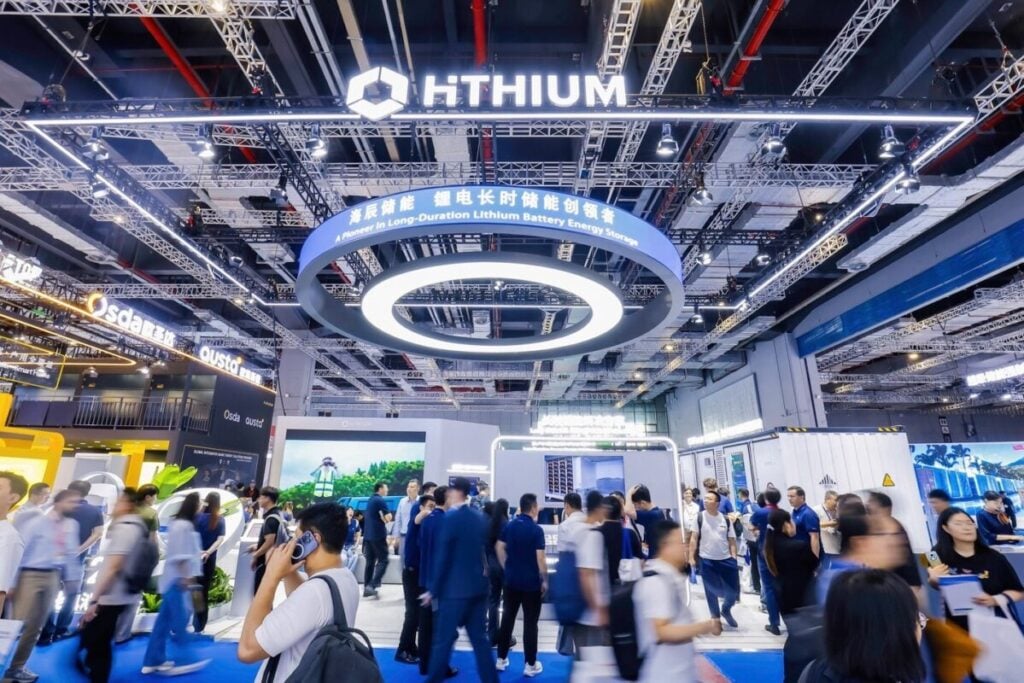
Battery and ESS manufacturer Hithium has entered the Canadian market with 4-hour and 8-hour battery energy storage system (BESS) solutions.
Announced 21 October, Hithium highlighted its recently revealed 4MWh sodium-ion (Na-ion) BESS solution, “which is designed for an extra-long service life, supports storage durations from 2 to 8 hours, and is perfect for extremely cold climates, like Northern Canada.”
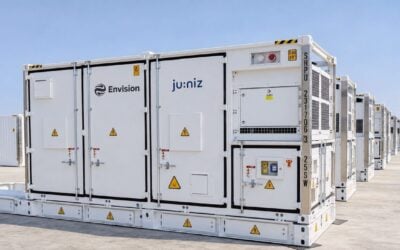
The 4-hour BESS solution consists of its “∞Power” 6.25MWh container, built on Hithium’s 1175Ah cell. Most Canadian projects are currently designed around the 4-hour unit. This could enable them to shift wind, solar, and baseload output to later peak times, strengthen grid reliability, and drive the consumption of more renewables, particularly as electrification increases demand.
Try Premium for just $1
- Full premium access for the first month at only $1
- Converts to an annual rate after 30 days unless cancelled
- Cancel anytime during the trial period
Premium Benefits
- Expert industry analysis and interviews
- Digital access to PV Tech Power journal
- Exclusive event discounts
Or get the full Premium subscription right away
Or continue reading this article for free
The ∞Power system design fits more capacity into the typical 20-foot container but also reduces a project’s overall footprint, because the containers can be placed back-to-back and side-to-side.
Hithium has also developed what it is claiming as the first ever native 8-hour solution based on lithium-ion (Li-ion) technology.
Its 6.9MWh, 8-hour BESS is built with the company’s 1300Ah cells, fewer components overall, and a 25-year lifespan. It is designed to address issues like curtailments and to fill gaps for zero-downtime industrial segments like AI data centres.
Hithium further highlighted Canada’s growing BESS market, stating that installed Canadian BESS is expected to double between 2025 and 2027, and the country’s total wind, solar, and BESS capacity is on track to reach 50GW by 2035
Earlier in 2026, Hithium commissioned UL Solutions to carry out an independent extreme fire test of the intrinsic safety systems in its 6.25MWh block. The test exposed a container to 24 hours of extreme combustion conditions, with its doors left open to maximise thermal spread, while neighbouring containers were positioned just 15cm away. Only the containers’ passive safety systems were active during the test.
The results were presented as validation of Hithium’s multi-layer safety architecture: the tested container remained structurally intact, no thermal propagation occurred between containers, and cell temperatures in the adjacent containers stayed below safety thresholds.
Recently, Energy-Storage.news Premium took an in-depth look at Hithium’s Na-ion BESS. The 785Ah cell uses a sodium iron phosphate pyrophosphate (NFPP) chemistry, which has emerged as a popular choice for commercial Na-ion cells thanks to its longer cycle life and lower thermal runaway risk.
The trade-off is energy density. Some other Na-ion chemistries offer higher energy density, though this matters less for many BESS applications than it does for EVs, where energy density is a critical factor. NFPP is considered a stable chemistry, offering robust cathode structural stability and high thermal stability, making it a well-balanced option among sodium battery chemistries.
Last month in Canada, IPP Northland Power announced that its 80MW/160MWh Jurassic energy storage project in Cypress County, Alberta achieved commercial operations, making it the largest operational BESS in the province.
Peak Energy closes oversubscribed Series B led by GM
Na-ion BESS startup Peak Energy has closed its oversubscribed Series B financing round led by General Motors (GM) Ventures with participation from Maverick Silicon, Infinite Capital, Eclipse, Xora Innovation, and LG Technology Ventures.
Announced 21 October, the company stated that the US$108 million in financing positions Peak to scale domestic manufacturing, fulfill over US$1 billion in existing customer orders, and launch its product to the data centre market.
In June, US automotive giant GM partnered with Peak to develop prototype Na-ion cells at its Wallace Battery Cell Innovation Center R&D facility in Warren, Michigan.
The next month, Peak selected Sacramento, California as the home of its new Na-ion BESS manufacturing facility. The company claimed the facility will produce up to 4GWh of BESS annually.
Peak has already signed multi-year supply agreements with US BESS developers, including a 720MWh agreement with Jupiter Power, potentially extending to 4GWh and a 1.5GWh agreement with Energy Vault. The US division of German power company RWE is also piloting a 3.1MWh Peak Energy system at an R&D lab in Wisconsin.
Peak’s flagship BESS uses passive cooling and is designed to tackle the elements that typically drive up the cost of operating and maintaining energy storage.
Due to what the company describes as a “fundamentally simpler architecture,” Peak can cut the cost of energy by up to 20% compared with conventional storage systems.
By doing away with cooling systems, cutting energy waste, and “requiring zero planned maintenance,” Peak claims its systems can achieve a longer operating life and lower lifetime ownership costs, offering a cheaper and more reliable alternative to conventional BESS technology.