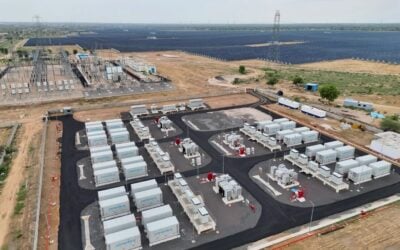
Regulatory approval has been granted in India for what is claimed to be the country’s first commercial standalone battery energy storage system (BESS) project.
The Delhi Electricity Regulatory Commission (DERC), the electricity board for India’s National Capital Territory (NCT), has given approval to the 20MW/40MWh BESS project, the multilateral Global Energy Alliance for People and Planet (GEAPP) announced yesterday (8 May).
The Global Energy Alliance for People and Planet (GEAPP), infrastructure investor IndiGrid, and BSES Rajdhani Power Limited (BRPL), a power distribution company (‘discom’), are developing the project.
The BESS will be deployed at a 33/11kV BRPL substation which is a strategic location that will enable the discom to increase the uptake of variable renewable energy (VRE) on its grid network. BRPL is the largest of Delhi’s three privately-owned discoms, supplying electricity to more than three million customers.
Try Premium for just $1
- Full premium access for the first month at only $1
- Converts to an annual rate after 30 days unless cancelled
- Cancel anytime during the trial period
Premium Benefits
- Expert industry analysis and interviews
- Digital access to PV Tech Power journal
- Exclusive event discounts
Or get the full Premium subscription right away
Or continue reading this article for free
According to the alliance, the capacity tariff that has been signed by the project partners and now approved by DERC is the first of its kind in India for a standalone BESS at the distribution level.
Additionally, GEAPP claimed that the levelised annual tariff, set at IR5.76 million/MW (US$69,000/MW), is 55% lower than previously set benchmark tariffs for BESS offtake in India.
GEAPP: India project ‘demonstrates viability, sets new affordability standard’
GEAPP comprises governments, philanthropic organisations, donors, development banks and development institutions to accelerate and facilitate a just energy transition for all.
In December last year, at the COP28 talks, GEAPP launched the Battery Energy Storage System Consortium (BESS Consortium), through which 11 countries, including India, pledged to facilitate 5GW of energy storage deployments in low- and middle-income countries by the end of 2027 and rapidly scaling up its goals beyond that time.
The project at BRPL’s Kilokari substation marks the first of 1GW of BESS projects targeted in India by 2026 by the GEAPP’s BESS Consortium.
It will be owned by a special purpose vehicle (SPV), Kilokari BESS, which was formed by IndiGrid and local energy storage system integrator Ampere-hour Energy, with BRPL paying its fixed capacity tariff on an availability basis irrespective of actual consumption.
GEAPP is supporting it with a concessional loan worth 70% of the project’s capital cost, along with technical and commercial expertise. For example, the group worked with BRPL to model the benefits of battery storage for India’s discoms.
In addition, a monitoring, evaluation and learning (MEL) plan will be created for the project, which can be shared with other Indian discoms, state regulators and power sector stakeholders across Asia, Africa, Latin America and the Caribbean, GEAPP said.
The alliance said the project could be a replicable business model for how third-party owned BESS solutions can be supported by concessional finance.
Saurabh Kumar, vice president for India at GEAPP, said the organisation was “proud to support the pioneering BRPL BESS project, which demonstrates the viability of battery energy storage solutions and sets a new standard for affordability in the energy sector.”
“Through our concessional financing and strategic partnerships, we are driving innovation and sustainability in India’s energy landscape,” Kumar said.
To date, most of India’s committed BESS investments have been spurred through government agency tenders, or corporate power purchase agreement (PPA) contracts. The country is targeting between 49GW and 74GW of energy storage by 2032, in line with modelling from the Central Electricity Authority (CEA).