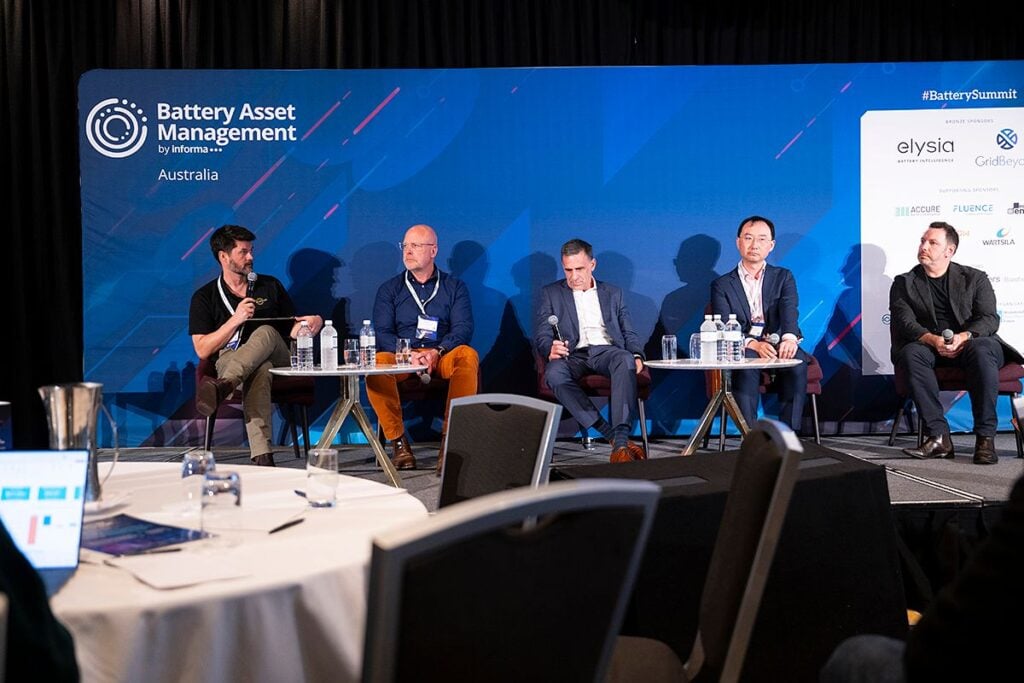
The venture-capital-style returns once available to early-stage renewable energy developers in Australia have disappeared, according to panellists speaking on overseas investment at the Battery Asset Management Summit Australia 2026 in Sydney last month.
Speaking on the panel “Attracting Overseas Investment for Australian BESS,” John Sheehy, chief executive of corporate advisory firm Pottinger, said the market has moved away from the model that defined utility-scale solar roughly a decade ago, in which early-stage developers could sell projects at a premium once they secured land, development approval and a grid connection offer.
“That ready to build phase, so the middle transaction, where you have venture capital style returns for early stage investors… arguably the best time to ever be doing early stage renewables development,” he said.
“Those days are definitely over.”
Try Premium for just $1
- Full premium access for the first month at only $1
- Converts to an annual rate after 30 days unless cancelled
- Cancel anytime during the trial period
Premium Benefits
- Expert industry analysis and interviews
- Digital access to PV Tech Power journal
- Exclusive event discounts
Or get the full Premium subscription right away
Or continue reading this article for free
Sheehy said liquidity in that middle-stage market “has really vaporised” for both standalone battery storage and hybrid projects, with investors now clustering at either end of a project’s development timeline instead.
“There’s been a real thinning of the ready-to-build phase, and investors are either wanting to come in really early, frequently with highly structured transactions, or back to sort of classic financial close deals,” he said.
Asked by moderator Simon Mason, partner in renewables advisory at Everoze, whether the developers who once thrived on that quick approval-to-exit model were “no longer thriving in the market,” Sheehy was direct.
“The naivety of developers calling a project ready to build once you receive your offer to connect is the sort of laughing stock of people who have to actually deliver them,” he said.
“Risk has been entirely repriced between receiving your [connection offer] and going through your final financial close steps.”
Battery developers accused of misreading market timing
Thomas Schmitz, general manager of energy markets at Aquila Clean Energy APAC, said part of the difficulty in reaching a financial investment decision (FID) stems from developers failing to anticipate market shifts early enough.
“You need to spot the trend before it is a trend,” he said.
“If you start developing 4-hour batteries now, you’re probably a little bit late, and you will have the same problem that a 2-hour battery has now, in four years’ time.”
Schmitz noted that the mismatch has left some developers scrambling to restructure financing after the fact.
“I’m trying to structure my way out of a problem that maybe I did not do my homework well enough three years ago, or the risk appetite wasn’t there,” he said, recalling being asked by investors why he hadn’t developed a 4-hour battery five years earlier.
“You did not give me the money for it. You only had a risk appetite for a half-hour battery. Sorry, cannot turn back the clock.”
Mason said the same dynamic is playing out in hybrid solar-battery projects designed only 18 months ago.
“The optimum BESS sizing 18 months ago was a lot smaller than it is now,” he said.
“Now they’re going back through [modifications] and going back through [connection] processes again to change the design just because of that market change in that small time period.”
Raymond Lou, partner and head of energy at Baker & McKenzie, said financing and offtake availability remain the central obstacles to reaching FID.
“For most core investors, they do need some leverage. They cannot just invest 100% equity,” he said.
“You kind of need offtakes to get financing. But if you cannot get offtakes, then you’re not going to get to FID.”
Lou noted that wind projects face a further structural constraint: development timelines of seven to ten years and costs exceeding AU$10 million (US$7.2 million), compared with what he describes as a more favourable environment for battery storage, given greater competition among equipment suppliers.
Public capital absorbing risk that private lenders and equity will not take
Paul Peters, chief executive of the New South Wales government’s Energy Security Corporation (ESC), said the organisation is structured to absorb specific categories of project risk that private capital is unwilling to bear, rather than to replace private investment.
“We can take a late stage development application, we can take late stage connection risk, and absorb some of that capital to allow projects because time is a big gap that we’re focused on, because perfect FID days don’t happen very often,” he said.
Peters said the ESC’s approach involves adjusting revenue underwriting settings over time to avoid crowding out private capital, while accepting merchant risk exposure that commercial lenders typically will not.
“I can take merchant risk because that’s [something] a bank may not take,” he said.
He argues that a state-level view of system-wide supply and demand allows the ESC to treat individual project risks as lower than they would appear to a standalone investor.
“It’s actually not reasonably low risk when you have a holistic view of the system and the state as to what’s going on, which an investor in a specific project cannot,” he said.
Peters said New South Wales requires between 52-53GWh of front-of-the-meter storage capacity operational by 2030, against roughly 12.5GW currently operating or under construction, a gap he attributes to the state’s reliance on rooftop and utility-scale solar without a comparable volume of wind generation.
He said 4-hour and longer-duration battery storage systems are increasingly being hybridised with solar projects to manage curtailment, while standalone battery storage investment from the ESC is now targeted specifically at locations with defined grid constraints, such as Sydney, Newcastle and Wollongong, rather than deployed as a general-purpose asset class.
On foreign investment screening, Lou noted renewable energy assets connected above 30MW are now classified as critical infrastructure under Australia’s Security of Critical Infrastructure Act, creating additional Foreign Investment Review Board (FIRB) scrutiny for sensitive investors, though he noted structures such as deferred payment arrangements and minority equity stakes below 40% can still secure approval, provided operational control does not rest with the sensitive investor.
“We’ve gone from the worst part of geopolitics now down to our current government recognising the national security realities,” Lou said.
Never miss an Australian energy storage story. Sign up for our Australia newsletter and get the latest project announcements, policy updates and market analysis delivered directly to you.