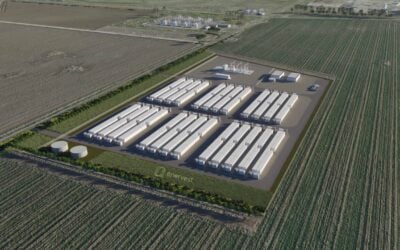
Quinbrook is developing a A$2.5 billion (US$1.7 billion) ‘Supernode’ site in Queensland, Australia, for storing energy and data that would include 2,000MWh of battery storage.
The US-headquartered investment manager said today that it has already received local planning permission and Foreign Investment Review Board approvals, as well as a 30-hectare site for the proposed project in Queensland’s Moreton Bay region.
It will be built adjacent to a substation connecting to a central node of the Queensland Electricity Network and the battery storage would participate in Australia’s National Electricity Market (NEM).
Featuring four data centres which Quinbrook anticipates would be for multi-tenant use, the Supernode would support net zero emissions data operations, with three separate high-voltage transmission connections that offer 800MW of power between them.
Try Premium for just $1
- Full premium access for the first month at only $1
- Converts to an annual rate after 30 days unless cancelled
- Cancel anytime during the trial period
Premium Benefits
- Expert industry analysis and interviews
- Digital access to PV Tech Power journal
- Exclusive event discounts
Or get the full Premium subscription right away
Or continue reading this article for free
It would also be along the newly laid data network lines that connect the region subsea to the island territory of Guam.
Quinbrook said it would also develop, procure and construct renewable energy supply capacity to the site, harnessing abundant and low-cost wind and solar PV resources available in Queensland.
The investment group specialises in projects relating to renewable energy infrastructure. As such, it has been behind some of the biggest standalone battery storage and solar-plus-storage projects around the world.
Examples include Gemini, a US$1.9 billion solar-plus-storage plant in Nevada, US, which pairs 690MWac/966MWdc of bifacial solar modules with 1,416MWh of battery storage. Currently under construction through Quinbrook development subsidiary Primergy and partners including its battery energy storage system (BESS) contractor IHI Terrasun, Gemini is expected to come online in late 2023.
Other projects for the company and its subsidiaries in the US include sites in key renewable energy markets like California and Texas. Meanwhile in the UK Quinbrook is developing a 230MW/460MWh BESS at a former coal power plant site in Wales.
The investment group also has a major project already in the works in Queensland too, with a gas turbine peaker-plus-battery site in the Lockyer Valley region receiving approval in April from the state’s Planning and Environment Court (P&E Court).
Queenslanders contributing to state’s energy transition and digital economy
Quinbrook said the energy portion of the Supernode project would help put downward pressure on power prices by integrating cheap renewable energy into the network and making it dispatchable, while helping to ensure reliability of power supply.
Data centre customers meanwhile, should be able to make what Quinbrook described were significant cost savings based on utilisation of renewables.
“Supernode is the latest example of our strategy to make impactful and ‘hard to repeat’ investments that help decarbonise energy intensive data center operations using renewable power solutions. Brendale is a truly unique location in the Pacific region and is well deserving of the ‘Supernode’ title,” Quinbrook manging partner David Scaysbrook said.
Scaysbrook noted that the founders of Quinbrook are themselves Queenslanders and hailed the opportunity that projects like the Supernode will bring in terms of catching up with Australia’s other states on climate and renewable energy progress, as well as building a digital economy ecosystem.
“This is the critical communications infrastructure needed by progressive industry in this State and it represents a competitive advantage in achieving Net Zero operations at low cost that may become the envy of competing economies the world over,” Scaysbrook said, noting that Quinbrook has recently also brought online the first phase of an 800MW ‘green’ data centre project in Texas.
Queensland has historically been Australia’s most emissions-intensive state, but the government of premier Anastasia Palaszczuk and the Queensland Australian Labor Party appear committed to an energy transition.
Its recently announced state budget included a progressive royalties system for coal industry company profits, as well as funding to invest in a 400MWh BESS as well as 13 smaller battery systems totalling 8MWh. This is in addition to a number of large-scale battery projects underway through state-owned power companies.
In terms of other storage technologies, the government is financially supporting feasibility studies for large-scale pumped hydro energy storage (PHES) while also investing in a vanadium electrolyte processing facility for the flow battery industry. This week it welcomed the start of construction of a factory making flow batteries based on a different electrolyte compound, iron and saltwater.