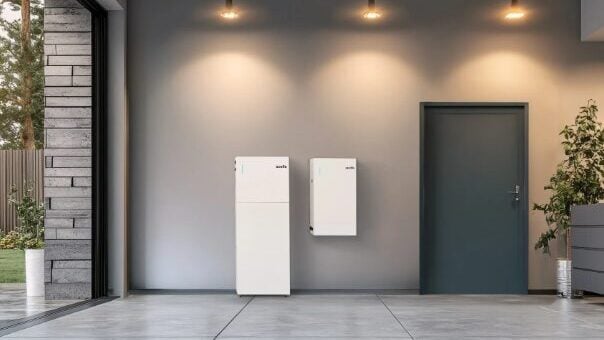
Qcells has introduced its first domestically assembled residential battery energy storage system (BESS) to the US market.
Announced 7 May, the system is assembled at Jabil’s (considered one of the world’s largest contract manufacturers) Auburn Hills facility in Michigan.
According to Qcells the BESS is a domestic content eligible version of the company’s third-generation residential ESS, known as ‘Q.HOME CORE G3’.
The system uses lithium iron phosphate (LFP) cells and has a storage capacity ranging from 13.1kWh-26.2kWh.
Try Premium for just $1
- Full premium access for the first month at only $1
- Converts to an annual rate after 30 days unless cancelled
- Cancel anytime during the trial period
Premium Benefits
- Expert industry analysis and interviews
- Digital access to PV Tech Power journal
- Exclusive event discounts
Or get the full Premium subscription right away
Or continue reading this article for free
Qcells, originally a German solar manufacturer, was purchased out of bankruptcy in 2012 by South Korea’s Hanwha Group after Chinese PV cells flooded the market, effectively ending the European industry. In addition to home energy and energy management solutions, the company also develops, invests in and delivers PV and energy storage projects through its engineering, procurement, and construction (EPC) and development businesses in the US.
In February, LG ES Vertech, the US-based system integrator subsidiary of LG Energy Solution (LG ES) announced with Qcells that it was entering into a multi-year partnership for utility-scale projects.
Under the partnership, LG ES Vertech will provide 5GWh of US-manufactured energy storage products and lifecycle services to its fellow South Korean-owned company, to support Qcells’ EPC projects from 2028-2030.
While some sites may feature integrated Qcells solar PV equipment alongside LG ES Vertech battery storage, Qcells told Energy-Storage.news at the time, that although such opportunities will be pursued, “we won’t necessarily always integrate both on the same projects.”
The newest announcement builds on an existing collaboration between the two companies, which sees Jabil assemble Qcells microinverters in Michigan, which are used for Qcells’ AC solar PV module products.
To date, Qcells and Hanwha claim have to have invested a total of US$17 million in residential solar-plus-storage manufacturing in Michigan.
Qcells also said this collaboration reflects its commitment to onshoring its renewables supply chain. The company noted, “In Georgia, Qcells has invested nearly US$3 billion in building a US solar supply chain, and is closing in on completing the construction of a one-of-a-kind factory in Cartersville, Georgia that will build critical solar components – ingots, wafers, cells and modules – under one roof.”
Q.HOME CORE G3 also pairs with Qcells’ AC module products, Q.PEAK DUO AC and Q.TRON AC, which are both assembled in Georgia, as well as integrated microinverters manufactured in Michigan.
Although the Biden administration had already moved to strengthen domestic supply chains through investment incentives and tariffs on Chinese batteries, the Trump administration altered production tax credit (PTC) and investment tax credit (ITC) eligibility rules last year.
HR 1, the ‘One, Big, Beautiful Bill Act’ (OBBBA), imposed limits on material assistance from foreign entities of concern (FEOC), namely Chinese or Chinese-owned firms, for companies seeking PTC and ITC benefits. This has created an opportunity for South Korean battery makers like LG ES, Samsung SDI, and SK On, which had already committed to US EV battery production facilities.
Qcells is also active in other markets. In March 2025, subsidiary of Nofar Energy, Nofar USA, and Qcells signed an agreement to develop and construct two BESS projects in Texas totalling 350MW/700MWh.