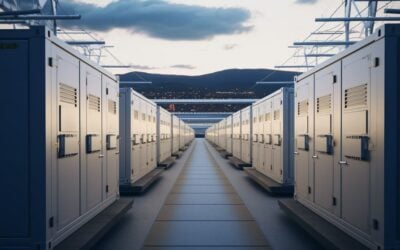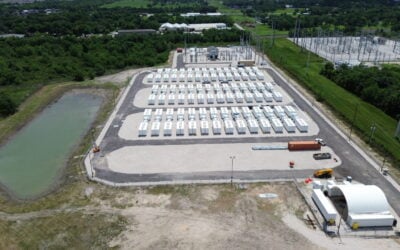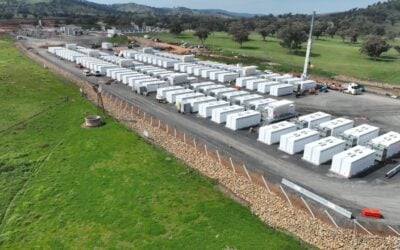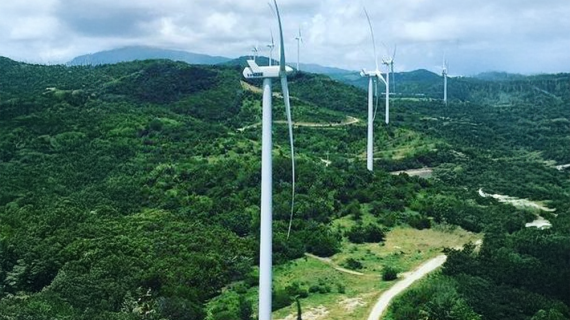
Polaris Renewable Energy, on behalf of the Puerto Rico Electric Power Authority (PREPA), has submitted a battery energy storage system (BESS) standard offer (SO1) agreement to the Puerto Rico Energy Bureau (PREB).
The SO1 Agreement is intended to be executed between PREPA and Polaris Power US, Inc., a subsidiary of Polaris.
The SO1 Agreement has been submitted with a BESS capacity of 71.4MW, comprised of 35.7MW across two projects.
Polaris is also evaluating the technical feasibility of increasing this capacity to 80MW, comprised of 40MW across two projects, alongside the ongoing regulatory process.
Try Premium for just $1
- Full premium access for the first month at only $1
- Converts to an annual rate after 30 days unless cancelled
- Cancel anytime during the trial period
Premium Benefits
- Expert industry analysis and interviews
- Digital access to PV Tech Power journal
- Exclusive event discounts
Or get the full Premium subscription right away
Or continue reading this article for free
The forecast for the Commercial Operation date is Q3 2026, with the SO1 Agreement spanning a 20-year term starting from the Commercial Operation date.
Once the SO1 Agreement is executed and the BESS project is built and fully operational, the Resource Provider will be eligible to receive monthly fixed and performance-based payments from PREPA. These payments are in exchange for providing energy storage services, which include capacity and grid support.
Project submission part of ASAP scheme
The SO1 Agreement submission is a component of the Puerto Rico Accelerated Storage Addition Programme (ASAP), which aims to enhance grid reliability across the island by deploying utility-scale BESS alongside existing generation facilities.
Under this framework, Polaris Power US, Inc. (PPUS) will serve as the “Resource Provider” responsible for installing and operating the BESS, while the Punta Lima Wind Farm, a subsidiary of Polaris, will remain the “Generation Facility Owner” for the Punta Lima site where the storage system is located.
PREB’s contracting with IPPs
In Puerto Rico, the electric generation, transmission, and distribution facilities managed by PREPA are privately operated by Luma Energy. Both PREPA and Luma fall under the oversight of the Puerto Rico Electricity Board (PREB).
In 2024, PREB informed Luma Energy, the US-Canadian joint venture managing Puerto Rico’s electricity distribution, that its plan to contract with independent power producers (IPPs) for BESS resources was consistent with public power policy.
Polaris’s plans come after multiple developers have failed to execute ASAP projects.
Luma, the distribution provider, appointed after privatising PREPA assets, “informally proposed” ASAP in November 2023.
Luma argued that implementing ASAP could greatly cut down the time needed to integrate BESS into the grid, especially when compared to Puerto Rico’s process of procuring renewable energy and energy storage via tenders.
On 4 August 2025, PREB filed a resolution and order regarding ASAP, noting that on 26 April 2024, Luma “highlighted that Phase 1 projects could begin immediately, as they did not require network upgrades and minimal interconnection costs, with some IPP claiming they could be operational in less than 12 months.”
The document continues, “As such, the execution of the referenced agreements should have ‘already taken place, as implementation was contemplated for April 2025. This is extremely concerning.”
PREPA was granted five days to provide a detailed explanation for the cause of the delay on 23 July 2025. PREPA filed a motion of compliance for the order on 1 August. In that motion, PREPA stated that only one developer responded, Ecoeléctrica, stating that it was actively working to complete the required documentation to execute the contract by September. Developers San Fermín, Horizon and Oriana did not respond, it said.
“Based on the information submitted by PREPA, the Energy Bureau FINDS it necessary and appropriate to require San Fermín, Horizon and Oriana, and Ecoeléctrica, as certified companies under its jurisdiction, to provide detailed explanations for their failure to respond to PREPA’s communications in a timely manner,” PREB said.
PREB emphasised the importance of these projects in overcoming Puerto Rico’s generation shortfall and noted that fines will be imposed if the developers fail to comply.
When Luma assumed control of Puerto Rico’s transmission and distribution systems on 1 June 2021, the electrical service declined. By September, the US House of Representatives Natural Resources Committee conducted an oversight hearing regarding the company.
At that time, CEO Juan Saca testified that the infrastructure would take more time to modernise, as part of a multi-year transformation.
In February, Luma announced it would build nine energy interconnection points with Linxon US LLC and their partner AtkinsRéalis Caribe, to integrate renewable energy projects.
Marc Murnaghan, CEO of Polaris, said of the submitted SO1 Agreement for its 71.4MW BESS: “The submission of the SO1 Agreement represents a significant milestone in advancing our energy storage strategy in Puerto Rico. We are proud to support the island’s energy resilience goals while leveraging our existing infrastructure at Punta Lima.”