Pacific Green’s Portland Energy Park, claimed to be Victoria’s largest battery energy storage system (BESS) at 1GW/2.5GWh, has secured federal environmental approval under Australia’s Environment Protection and Biodiversity Conservation (EPBC) Act.
The EPBC Act approval represents the final major environmental clearance required for the AU$1.3 billion (US840 million) project, which previously received expedited approval from the Victorian government through its Development Facilitation Program.
The federal environmental assessment process evaluated the project’s potential impacts on matters of national environmental significance, including threatened species and ecological communities.
The UK-based company focuses on creating large-scale standalone BESS assets in Europe and Australia. Pacific Green refers to these projects as Energy Storage Parks. In Australia, many of the targeted opportunities are expected to feature more than one gigawatt-hour of storage capacity at each site.
Try Premium for just $1
- Full premium access for the first month at only $1
- Converts to an annual rate after 30 days unless cancelled
- Cancel anytime during the trial period
Premium Benefits
- Expert industry analysis and interviews
- Digital access to PV Tech Power journal
- Exclusive event discounts
Or get the full Premium subscription right away
Or continue reading this article for free
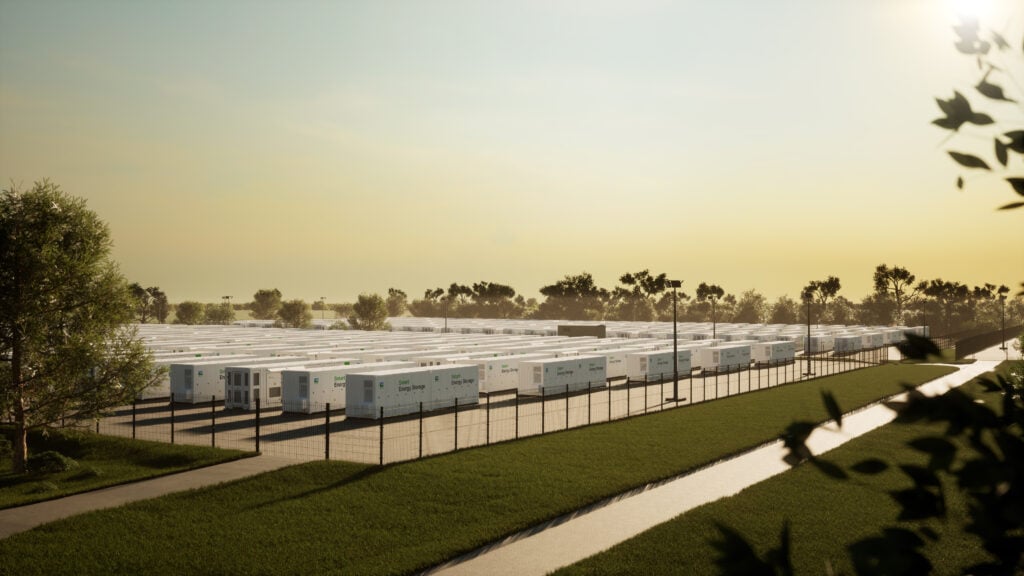
Portland Energy Park will consist of four 250MW battery storage system “parks” with a combined capacity of 1GW/2.5GWh.
The facility will utilise lithium iron phosphate (LFP) battery technology, housed in approximately 200 containerised units, incorporating advanced fire suppression systems and thermal management controls.
Located on approximately 40 hectares of industrial-zoned land adjacent to the Portland Aluminium Smelter in Victoria’s southwest region, the project is positioned to provide grid stabilisation services in areas with significant industrial load requirements.
The facility will connect to the National Electricity Market (NEM) via an on-site terminal station, which is linked to existing transmission infrastructure.
Victoria has emerged as a leading jurisdiction for battery storage deployment, becoming the first Australian state to cross the 1GW BESS charging milestone as the state accelerates its renewable energy transition.
Pacific Green plans to develop the facility in phases over 36 months, with the first 250MW expected online by Q3 2026 and subsequent 250MW increments commissioned at six-month intervals. This phased approach allows the company to respond to market conditions while progressively adding capacity to the grid.
The project represents Pacific Green’s second Australian grid-scale battery storage development, following its Limestone Coast BESS in South Australia, where the company is constructing the first 250MW/1,000MWh phase. The dual-state portfolio demonstrates Pacific Green’s commitment to the Australian market following its AU$77 million capital raising for its Australia projects.
To support the development of its international portfolio, Pacific Green Energy Group inked a memorandum of understanding with Trina Storage for 5GWh of battery energy storage systems between 2026 and 2028.
Pacific Green currently manages a global storage pipeline totalling 11GWh, with 7GWh located in Australia and 4GWh across European markets. The company has secured several major offtake agreements in the Australian market, including a 1.5GWh tolling deal with Zen Energy covering three battery storage systems across Australia.
The EPBC Act approval follows a comprehensive environmental assessment process that evaluated potential impacts on protected species and ecosystems. The approval includes conditions designed to minimise environmental impacts during construction and operation phases.
With federal environmental clearance secured, Pacific Green can advance detailed engineering and procurement activities for the Portland Energy Park.