ON.energy and Crusoe partner on UPS technology for US data centres
System integrator and project developer ON.energy and AI data centre infrastructure developer Crusoe have partnered to deploy 5GW of uninterruptible power supply (UPS) technology across multiple US hyperscale campuses.
Announced 21 July, ON.energy will deploy its AI UPS technology. Commissioning is expected to commence this year and extend into 2027.
AI data centres introduce unprecedented challenges to the grid. During training operations, thousands of GPUs ramp up and down in coordinated bursts, generating significant power demand fluctuations.
From the grid’s perspective, a large AI training facility produces load patterns distinct from traditional facilities, alternating between high and low power consumption with variability occurring hundreds to thousands of times daily.
Try Premium for just $1
- Full premium access for the first month at only $1
- Converts to an annual rate after 30 days unless cancelled
- Cancel anytime during the trial period
Premium Benefits
- Expert industry analysis and interviews
- Digital access to PV Tech Power journal
- Exclusive event discounts
Or get the full Premium subscription right away
Or continue reading this article for free
Without proper management, these fluctuations can travel back through the interconnection point into the transmission system, straining grid equipment and constraining operators’ ability to manage other system-wide variables.
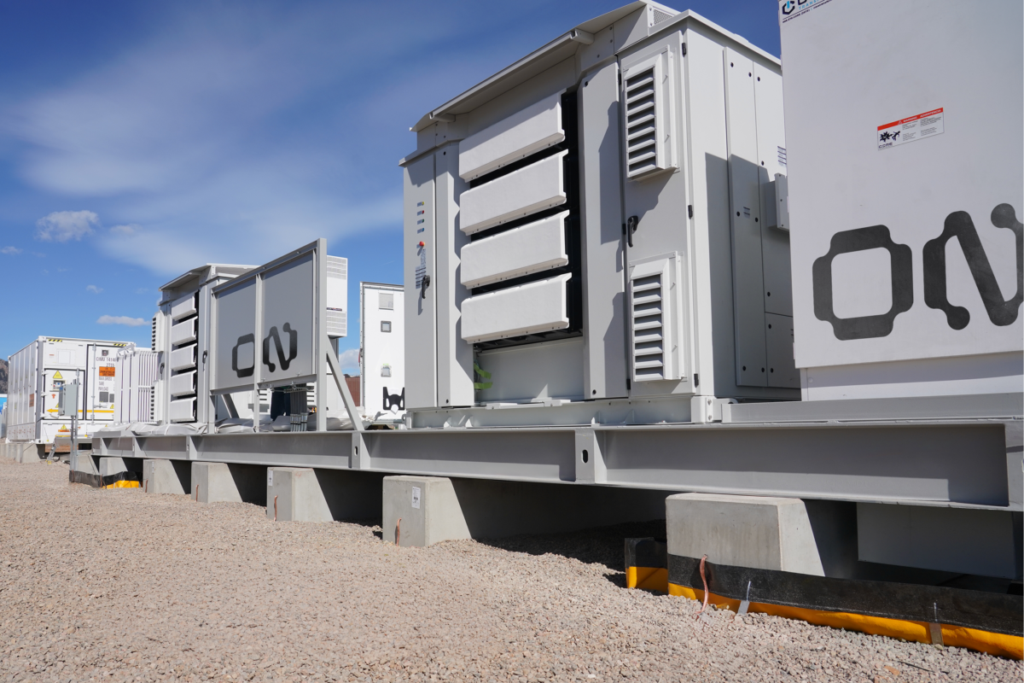
ON.energy’s AI UPS is a patented medium-voltage UPS positioned inline between power sources and AI data centres. By isolating the facility from the grid, the system maintains operation through voltage faults—protecting data centre equipment without disconnecting—while simultaneously preventing internal GPU load variations from impacting the grid.
The AI UPS has been validated against the Electric Reliability Council of Texas’ (ERCOT’s) Large Load Interconnection requirements, satisfying the grid stability and voltage ride-through standards that ERCOT has established as the baseline for responsible large-load interconnection in Texas, including compliance with Nodal Operating Guide Revision Requests (NOGRR) 282 and ERCOT’s Low Voltage Ride-Through (LVRT) protocols.
The AI UPS stores sufficient energy to power an entire campus for extended periods, substantially reducing grid variability during peak hours. ON.energy claims the outcome is a data centre that actively supports grid stability.
Technology news magazine IEEE Spectrum explained that ON.energy’s 3.5MW units include a power conversion system (PCS), energy storage batteries, a second power conversion system (PCS), and a transformer. The batteries provide up to eight hours of backup power. ON.energy sources equipment from established manufacturers and adds proprietary software and controls.
The bidirectional PCS converts AC from the grid to DC for storage, then back to AC for data centre loads. In reverse, it absorbs and smooths load swings that would otherwise disrupt the grid.
The system is installed outside the data centre, freeing interior space for compute resources and enabling medium-voltage operation. Traditional UPS systems operate inside at low voltages for safety.
In February, ON.energy and electrical infrastructure company Shoals Technologies Group agreed to pair ON’s AI UPS with Shoals’ DC Recombiner. The Recombiner consolidates inputs from solar arrays, BESS, and other DC microgrid sources. It enables charging the BESS using renewable energy and discharging it to supply power to the grid through an inverter.
In late 2025, ON announced a 5GW transformer supply agreement with manufacturer Prolec GE for data centre and renewable infrastructure in the US.
Skeleton Technologies announces collaboration with DG Matrix
Solid-state PCS developer DG Matrix and Estonia-headquartered high-power energy storage startup Skeleton Technologies have announced a strategic collaboration to support the data centre industry’s transition to 800 VDC power infrastructure.
Announced 22 July, Skeleton’s ESS solutions will be integrated across DG Matrix’s galvanically isolated Interport multi-port SST platform.
The collaboration will cover “the Interport CM medium-voltage SST skid, which converts 12–34.5 kV AC directly to high-voltage DC; the Interport CL sidecar solution, which mitigates GPU pulse loads directly in the white space; and Interport Flex, an outdoor, grey-space product that can be skid-mounted and paralleled into the Interport 360 end-to-end solution.”
Skeleton claims its power systems are engineered to respond in microseconds to minutes, absorbing peak loads before they propagate to upstream infrastructure, while DG Matrix claims its Interport routes power in real time across AC and DC sources, loads, and storage at multiple voltage levels.
The companies highlight research from independent research company SemiAnalysis projecting that approximately 39GW of incremental AI data centre capacity will be served by 800 VDC architecture by 2030, with a SST total addressable market of approximately US$13 billion.
DG Matrix’s Interport platform currently supports 800 VDC natively, and Skeleton’s GrapheneCBU800 and GrapheneBBU800 systems are designed for the same voltage class.
In November 2025, Skeleton opened two European production plants, one in Finland, the other in Germany, manufacturing different products based on the company’s supercapacitor and battery storage technologies.
Skeleton specialises in designing and manufacturing ultracapacitors and supercapacitors, along with high-power batteries. It owns the intellectual property for Curved Graphene (CG), an active material that increases the energy density of its energy storage devices.
Raghu Belur, co-founder and chief products officer of microinverter and home energy storage system supplier Enphase Energy, recently spoke with Energy-Storage.news Premium about Enphase’s expansion into solid-state transformers.
Belur said the move came from how data centres consume power, and stated, “Data centres are not specced in operations-per-second. They’re specced in watts, in kilowatts, in gigawatts. There really is a power problem.”
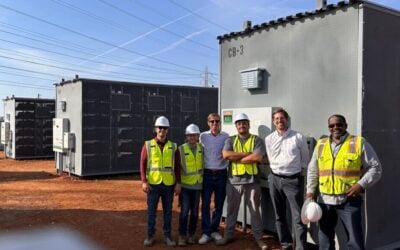
The image originally used on this article has been replaced with a picture of On.energy’s AI UPS solution supplied by the company after publication.