
Energy-Storage.news Premium speaks with co-founder and chief products officer of microinverter and home energy storage system supplier Enphase Energy, Raghu Belur, about the company’s recent focus on solid-state transformer technology.
ESN Premium previously spoke with Belur, in 2025, about the domestic content of the company’s residential battery energy storage systems (BESS) and its, at the time, latest earnings report.
In November 2024, our colleagues at PV Tech reported that the inverter market was experiencing declining prices due to shifting demand and technological changes.
One inverter manufacturer, Enphase, announced 500 job cuts and the discontinuation of its manufacturing agreement for a facility in Mexico.
Try Premium for just $1
- Full premium access for the first month at only $1
- Converts to an annual rate after 30 days unless cancelled
- Cancel anytime during the trial period
Premium Benefits
- Expert industry analysis and interviews
- Digital access to PV Tech Power journal
- Exclusive event discounts
Or get the full Premium subscription right away
Or continue reading this article for free
Less than a year later, the company announced the initial shipment of its AC-coupled IQ Battery 5P units, which met the new federal threshold for solar and storage tax credits from US manufacturing facilities.
Recently, the company has expanded focus to solid-state transformers, a power device that replaces bulky iron-core transformers with semiconductor technology. Instead of using magnetic induction to adjust voltage, it leverages high-frequency switching and a smaller medium-frequency transformer to actively control and convert power.
Belur explains that Enphase has been quietly developing solid-state transformer (SST) technology for AI data centres over the past nine months, positioning its IQ9 series microinverter as a solution to the growing power delivery issue facing hyperscalers.
Belur says the company’s entry into the SST market builds directly on two decades of power electronics development in residential solar. “What do we do really well? We have really high technology power electronics, power management platform—hardware, software, everything. That’s what we’ve developed over the last 20 years.”
The impetus for Enphase’s SST development came from a change in how data centres consume power. “Data centres are not specced in operations-per-second. They’re specced in watts, in kilowatts, in gigawatts. There really is a power problem,” he highlights.
Power density per rack has surged from a 30kW to 130kW, with projections reaching 250kW-500kW and eventually 1MW-per-rack. This escalation has exposed inefficiencies in traditional power delivery chains, which convert electricity multiple times from utility entry to server racks.
Enphase’s SST approach consolidates this process, converting medium voltage to 800 volts DC in a single stage, ideally, eliminating multiple conversion steps and the need for traditional uninterruptible power supply (UPS) systems.
Super cluster
Each 1.25MW SST unit comprises 342 microinverters—what the company calls a “super cluster,” analogous to GPU clustering in AI computing.
This design delivers three key advantages, according to Belur:
Sub-millisecond response time: The system can detect and respond to load fluctuations in less than one millisecond. This capability allows data centres to eliminate in-building energy storage sidecars, specialised battery and capacitor systems that consume valuable rack space.
“Get rid of that whole sidecar, fill it up with compute, and let the big battery deal with this massive fluctuation,” Belur says.
Built-in redundancy: The SST is intentionally over-provisioned by 10%, meaning the system continues operating even if 10% of power modules fail. Enphase expects only two of 342 modules to fail over 10 years, and failed units, weighing six to 10 pounds, can be robotically swapped without human intervention.
Manufacturing scalability: The power modules use the same supply chain and automated production lines as Enphase’s residential microinverters, with existing capacity in Texas and South Carolina. “We all know solar and storage are down quite a bit since the Inflation Reduction Act (IRA) days, and so we have a substantial amount of capacity available to build SSTs,” Belur notes.
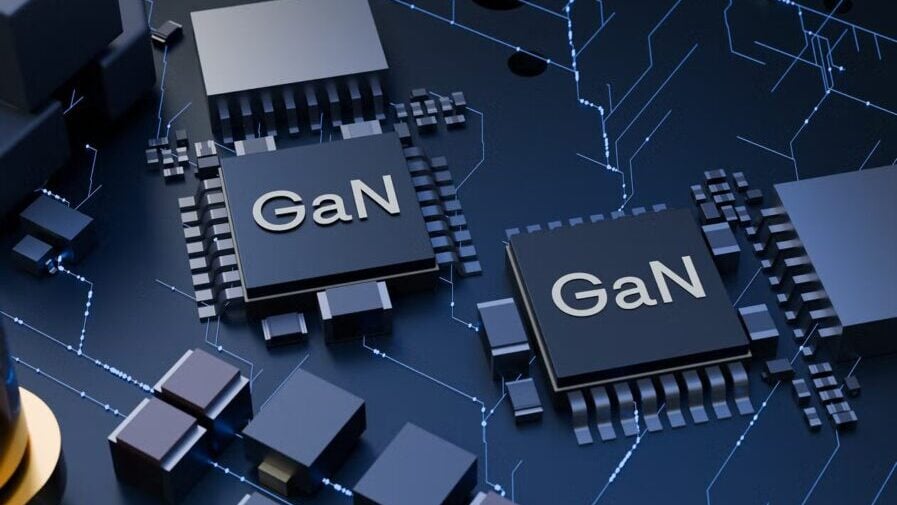
According to Belur, the central component of the SST design is gallium nitride (GaN) semiconductor technology, which he says is “a near-perfect fit for our microinverters” due to their relatively low 4kW power rating. This contrasts with competitors pursuing 140kW power modules using silicon carbide.
“GaN has developed so far and it’s going to continue down a cost curve that is not going to be matched by anybody else,” Belur notes.
The IQ9 platform was designed as a flexible foundation capable of accepting any input voltage, output voltage, or frequency, whether AC or DC. This would also position the technology for applications beyond data cemtres.
Belur outlined several adjacent markets for the SST technology. The same SST units sitting in front of battery energy storage systems for data centers can be deployed for traditional front-of-the-meter utility-scale applications, which Belur says “almost doubles the TAM from just data centers.”
The technology can also be connected in reverse for large-scale utility solar installations. With minor modifications—potentially software-only changes—the same device can enable fast DC charging for electric vehicles.
The ultimate goal, according to Belur, is replacing all utility-scale transformers with solid-state versions instead of traditional copper and iron wire transformers.
Strategic patent management
Belur also addresses Enphase’s recent patent transfer to Power Bridge. Intellectual property licensing firm PowerBridge Networks acquired more than 50 patents from Enphase in May, covering technologies linked to distributed energy systems, inverter technology, power management and grid-connected energy infrastructure.
Belur emphasies that the transaction involved a small percentage of the company’s overall patent portfolio and did not include core intellectual property.
“If there are patents that somebody else may find valuable, that aren’t as valuable for us at the moment, it makes good business sense,” he explains. The capital freed up from the transaction will fund new patent filings around SST technology.
“This whole company’s culture is innovation and intellectual property. We file hundreds of patents, so we pay extraordinary attention to patents and valuable patents that are germane to what our core business is right now,” Belur says.
Enphase has not disclosed specific timelines for commercial SST deployment or customer commitments.
