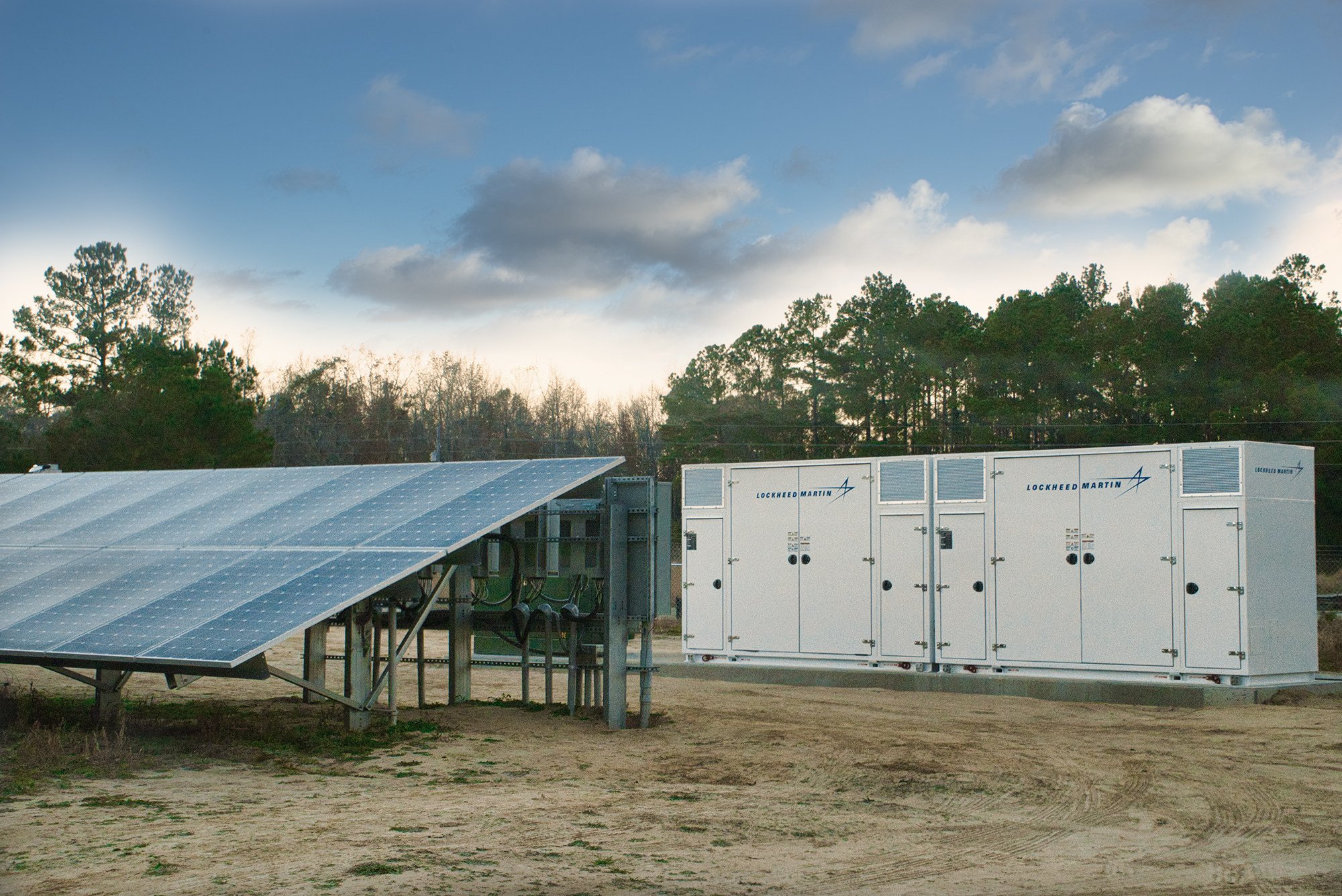
Defense and aerospace giant Lockheed Martin wants to be the first disruptive company of the flow battery era, with the expectation that its first devices will go into series production before the end of this year.
Energy-Storage.news met earlier this year with company VP for business development Dan Norton, who said that Lockheed Martin’s own coordination chemistry flow battery (CCFB) had neared the end of its development and test programme, which had gone “swimmingly and as planned”. The product has been some time in development, originally teased as expected to hit the market before the end of 2018, although this target was always understood to be flexible.
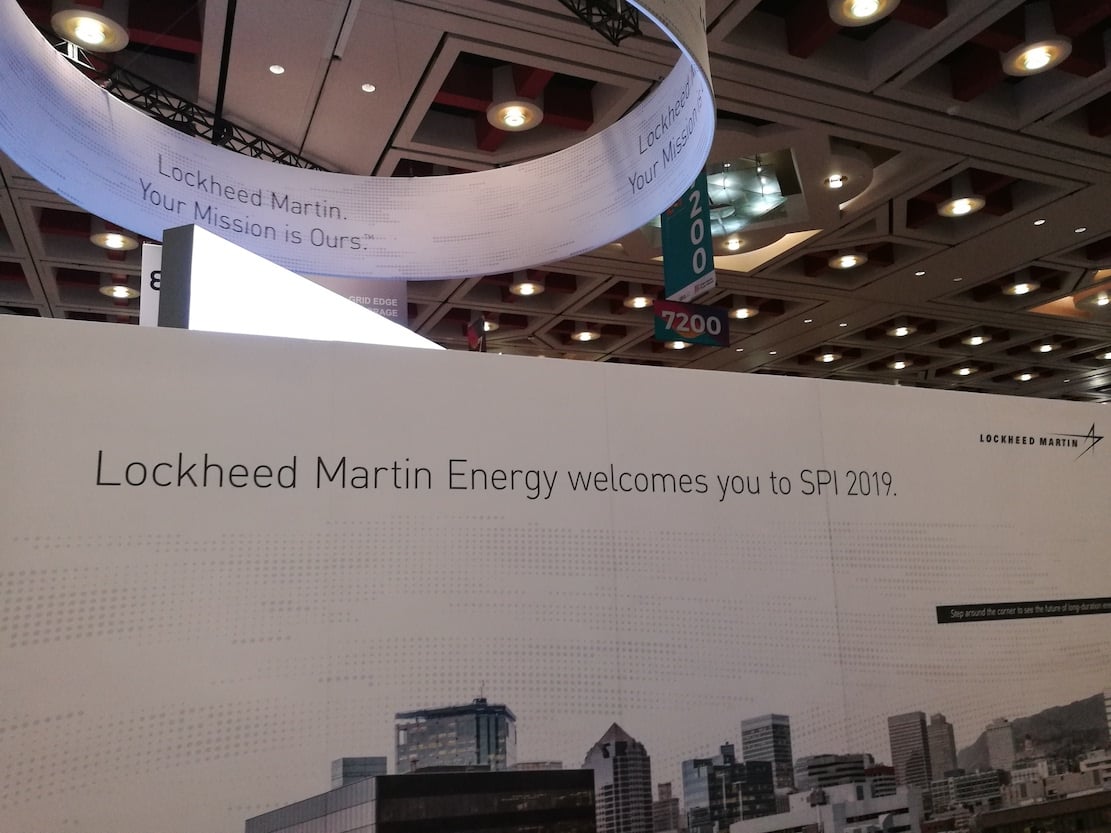
“We begin serial production on our unit number 1 towards the end of the year and we’ll go for full launch in the market some time next year,” Norton said, in an interview taped at this year’s Solar Power International in late September but only cleared for publication approval later.
That in itself is an indication of Lockheed Martin’s focus. The flow batteries are being developed within Lockheed’s Missiles and Fire Control division, and Norton said that as an energy security asset, the technology and market is “the next logical progression” for the company.
Try Premium for just $1
- Full premium access for the first month at only $1
- Converts to an annual rate after 30 days unless cancelled
- Cancel anytime during the trial period
Premium Benefits
- Expert industry analysis and interviews
- Digital access to PV Tech Power journal
- Exclusive event discounts
Or get the full Premium subscription right away
Or continue reading this article for free
While Lockheed has already launched GridStar lithium and seen successful deployments of over 100 units in North America, as the market moves from shorter to longer duration energy storage, Norton said, it identified a further opportunity.
“So we invested in (Sun Catalyx), a technology that’s a spinout of MIT, to create a co-ordinated compound chemistry flow battery, that is human- and environmentally-safe, that is balance-of-plant cost-effective and that is deployable worldwide,” Dan Norton said.
Projects could be ‘multiple megawatts to hundreds of megawatts’
Long-duration flow batteries offer a potential to decouple energy and power, meaning that while they tend to cost more upfront than lithium-ion batteries, they can effectively scale up fairly easily, simply by increasing the capacity of the tanks the electrolyte is pumped through. While the small handful of flow battery companies already out there in the market tend to favour either vanadium or zinc bromine, Lockheed is keeping tight-lipped still on the makeup of the proprietary electrolyte its GridStar Flow products will use.
Norton was however, more explicit on the type of projects Lockheed Martin will be going after.
“[We’re] talking about applications being major grid-scale, multiple megawatts, to hundreds of megawatt-sized storage. We want to do larger projects: the economies of scale certainly work out better on larger projects.”
There’s to be some expansion of the market areas covered by the company’s lithium-ion battery energy storage outside of North America in the coming months, but Norton said that focusing on that market alone – where customers tend to be commercial and industrial (C&I) scale, from community microgrids to military installations, rather than utility or larger-scale – would be limiting.
“As we know, lithium-ion is really good and effective in the two to four hour range. It has its limitations as you lengthen out the time you need to store,” Norton said.
“And as the world is marching to renewables and the ability to generate when the sun shines or the wind blows and then the ability to dispense when it doesn’t, you need longer duration than two to four. So you need to be able to think eight, 10, 12 hour duration storages and that’s the beauty of our flow battery.”
Staking an early disruptive claim
A report recently out from Navigant Research identifies a number of ‘leaders’ of the early flow battery market, including CellCube, Sumitomo Electric, Vionx and others. The market has been notoriously tough going already, with earlier leading players such as Immergy and VIZN Energy already falling by the wayside – although fighting talk persists from the team behind US-based VIZN.
Dan Norton argues that Lockheed Martin’s operational scale and established name and reputation stand it in good stead to take on that market.
“There’s been a lot of concern over the ability to deliver from small or medium-sized companies working in this marketplace. All of our customers, when they come and talk to me about long duration say that our logo really matters, because they know when they put it in the field that it’s going to work every time, all of the time.”
Norton said that his customers “want to work with larger players with a reliable reputation”. Meanwhile, flow competitors RedT and Avalon Battery are hoping that a merger between their two vanadium redox flow energy storage technology and development companies will create a “global player” in the market.