Leaning on an existing track-record and manufacturing scale of electric vehicles (EVs) and their batteries remains an essential component to delivering cost-effective energy storage, BYD global sales director Julia Chen has said.
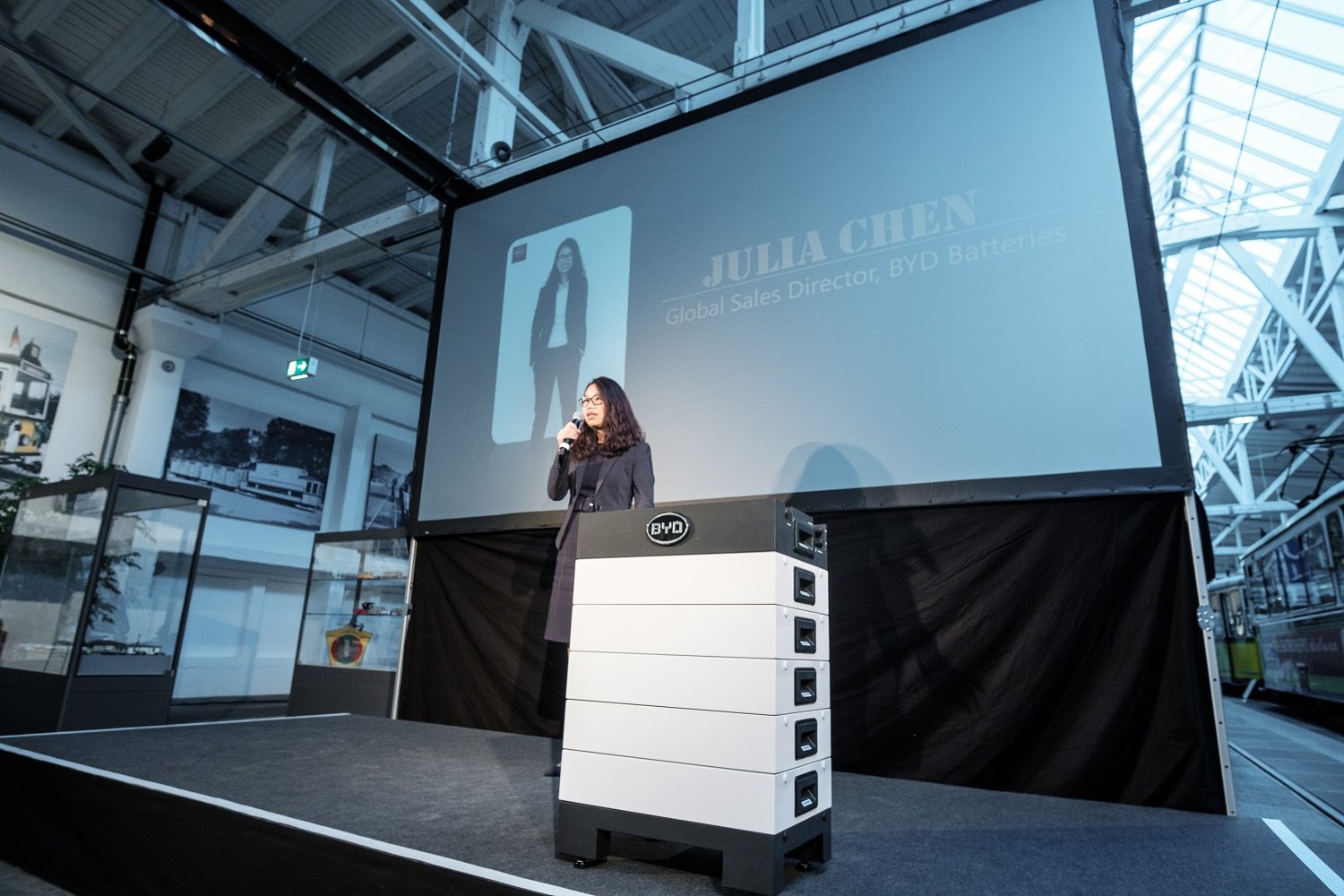
Chen was speaking with Energy-Storage.News at the Intersolar Europe / ees Europe trade show, which is taking place this week in Munich, Germany, where BYD was unveiling the latest iteration of its B-BOX residential to light commercial energy storage system.
The company remains best known in China as a prolific maker of EVs (and perhaps best known outside China as a Warren Buffet investment-backed venture) and is one of the few players thought to have the scale to rival Tesla in offering both electric transport and now stationary energy storage. According to Chen, BYD sold around 110,000 passenger model EVs in China last year alone.
“For the moment, battery demand is being driven by electrified transportation,” Chen said.
Try Premium for just $1
- Full premium access for the first month at only $1
- Converts to an annual rate after 30 days unless cancelled
- Cancel anytime during the trial period
Premium Benefits
- Expert industry analysis and interviews
- Digital access to PV Tech Power journal
- Exclusive event discounts
Or get the full Premium subscription right away
Or continue reading this article for free
“[The success of EVs] is a very strong driver for energy storage because by comparison, demand for batteries for stationary energy storage is very small. At BYD we try to use the platform we built for our EV batteries and bring these efforts and advantages to energy storage. This is the only way to do energy storage in a cost-effective way.”
BYD’s residential and light commercial B-BOX is available in a low voltage model which has been on the market for two years already, now joined by its high voltage counterpart. Chen touted the “modular, flexible and easy-to-install” B-BOX – claiming the lack of cabling required can reduce installation time to as little as 30 minutes – which can be scaled from 2.5kWh up to 410kWh.
“Our concept is that one product suits every application,” Chen said.
“With modular design we can start at 2.5kWh and people can expand [that] throughout its lifetime. For bigger systems, for commercial or for people who want to be independent, we give the solution from different parallel connections with different Sunny Islands (SMA inverters which are compatible with the B-BOX).”
Chen said the B-BOX is a versatile creature, with capabilities to aggregate systems together to provide grid services. The device can be discharged at the unusually fast rate of 2C for 15 minutes, while many residential systems only support discharge rates of 0.5C to 1C, which Chen claimed would not be fast enough for some grid-balancing programmes.