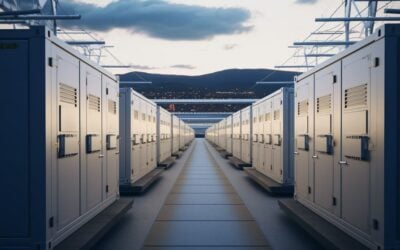
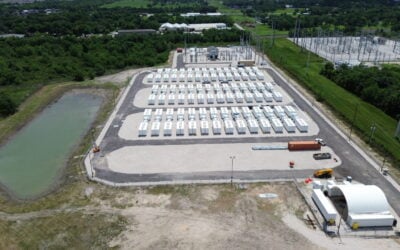
ABB flywheel-based PowerStore to stabilize power supply from wind/diesel hybrid plant in Marsabit. credit: ABB
Swiss-headquartered power and automation specialist ABB is to use its PowerStore technology, involving flywheels with wind and batteries plus solar, to integrate renewable energy and reduce reliance on diesel fuel in two separate micro-grid projects in Africa.
For the first project, ABB, known in the solar industry for its invertor technology, won an order from Kenya-based robotics and renewable energy firm Socabelec East Africa for the design, supply and installation of a flywheel-based Powerstore grid stabilising generator for a wind farm in Northern Kenya.
The wind farm is located at Marsabit, an oasis town with high winds, beside the desert in Northern Kenya, with a population of 5,000 and no connection to the national grid. The remote town, which requires a stable electricity supply, is currently powered by an isolated micro-grid supplied by diesel generators and two 275kW wind turbines.
In this case, ABB’s 500kW PowerStore has a spinning flywheel on magnetic bearings to store energy in the form of kinetic motion, rather than chemicals, as are used in battery systems. It also uses a pressurized helium environment to reduce frictional losses.
Try Premium for just $1
- Full premium access for the first month at only $1
- Converts to an annual rate after 30 days unless cancelled
- Cancel anytime during the trial period
Premium Benefits
- Expert industry analysis and interviews
- Digital access to PV Tech Power journal
- Exclusive event discounts
Or get the full Premium subscription right away
Or continue reading this article for free
The system will be integrated into the network alongside the controls of the existing diesel generators, in order to stabilise the grid and use any excess power generated from the wind turbines. The PowerStore will also protect the micro-grid from variations in frequency and voltage brought about by the intermittent wind power generation. The storage solution also has an automation and intelligent control function.
The project is expected to be completed by 2016.
In July 2014, the first grid-connected energy storage facility in Ontario, Canada, became operational, also using a flywheel storage facility, but with a much larger 2MW capacity. It was developed by storage specialist start-up NRStor and built by Temporal Power to provide regulation service to Ontario’s Independent Electricity System Operator.
Adding storage technology to micro-grids also follows a trend in the US where storage is now used in 44% of microgrids with 92% of that storage commissioned since 2012, according to GTM Research’s latest report.
For the second PowerStore project, ABB plans to install an integrated solar-diesel microgrid at its Longmeadow headquarters in Johannesburg, South Africa, which includes medium voltage switchgear manufacturing and protection panel assembly facilities.
In this case, ABB’s PowerStore grid stabiliser uses a 1 MVA/380 kWh battery combined with a 750kW rooftop PV installation in order to optimise the use of the solar power generated and provide backup in the case of power outages on the main grid.
Reducing the reliance on diesel also comes with the benefit of relieving consumers from the volatility of fossil fuel prices, which is a major concern for facilities across South Africa. Moreover, there remains a greater demand than supply of energy within the country.
Claudio Facchin, president of ABB’s power systems division, said: “Alongside traditional and renewable generation, microgrids are increasingly being deployed to provide electricity to remote or isolated areas. They can also serve as a flexible backup source for industrial and commercial facilities and help address power disruptions.”
ABB has more than 30 microgrid installations across the globe for projects including electrical grids on islands, remote communities and research and industrial institutions.
Last week, PV Tech Storage reported that a Spanish island had managed to run for four hours entirely using wind power and a pumped-hydro energy storage system using an artificial reservoir, which is another rarity in storage technology.