New York state is on course to meet its new 2030 target of 6GW of storage deployment, with storage projects in its interconnection queue growing 50% to 12GW.
New York storage deployment roadmap
The Department of Public Service (DPS) has issued its third ‘State of Storage’ annual report detailing the state’s progress in meeting its 2030 deployment goal, which was doubled in January from 3,000MW to 6,000MW.
It is in the process of updating the 2025 interim target, currently 1,500MW, to reflect the new 2030 one. By 2030, the state wants 70% of electricity to be from renewable sources.
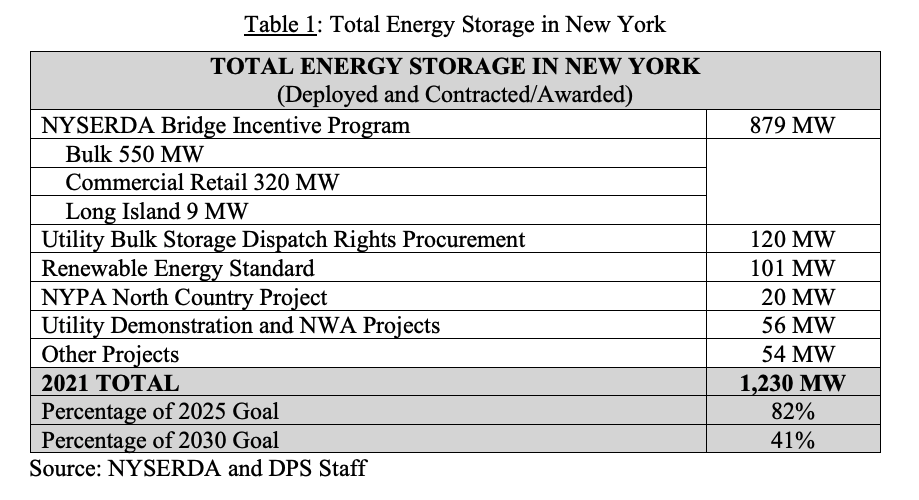
The DPS said that as of the end of 2021, total deployed and awarded or contracted energy storage projects stood at 1,230MW, or around 82% of the 1,500MW target. Progress appears to have been slow, however, as the figure means growth of just 4%.
Try Premium for just $1
- Full premium access for the first month at only $1
- Converts to an annual rate after 30 days unless cancelled
- Cancel anytime during the trial period
Premium Benefits
- Expert industry analysis and interviews
- Digital access to PV Tech Power journal
- Exclusive event discounts
Or get the full Premium subscription right away
Or continue reading this article for free
The figure for storage projects in the interconnection queue of 12,000MW, which includes New York utility interconnection queues and the New York Independent System Operator (NYISO) interconnection queue, grew much faster at 50%. Though the DPS adds that not all of those projects may be delivered on. One recently launched portfolio is Nala Renewables’ 280MW of BESS across four projects on Long Island, scheduled to go online in 2024.
The report breaks down the deployment figures in the table below, with the percentage figures at the bottom based on the old goals. These figures do not include two pumped hydro projects totalling 1,400MW which participate in the NYISO market and pre-date the 2025/30 goals.
Mixed use cases and incentives
The Bridge Incentive Program offers financial incentives to build 5MW-plus systems participating in wholesale markets, commercial retail projects up to 5MW and single-family residential systems paired with PV on Long Island.
Sixty-four out of the 77 commercial retail projects awarded Bridge incentives are there to time shift the renewable energy dispatch to times with a more valuable distribution grid value under Value of Distributed Energy Resource (VDER) compensation. The Long Island projects are paired with solar to help the local grid relieve demands during peak summer days under the Long Island Power Authority’s Dynamic Load Tariff.
Many of the Bulk projects provide or will provide wholesale services in the NYISO market. Some 14 comprising 550MW/1,835MWh have been awarded US$115 million in NYSERDA (New York State Energy Research and Development Authority) incentives for projects targeting downstate capacity or ancillary services revenues in the wholesale market.
System costs
The report says that installation costs averaged US$464/kWh for non-residential projects while those above 5MW averaged US$370/kWh in 2020/21. The total average cost is expected to increase by 22% over 2022 and 2023, compared with 2020/21, to US$567/kWh. However, it cites industry analyst reports which say the cost of large scale storage is expected to decrease into the US$150-200/kWh range by 2030.
Investor-owned utilities in New York state have been required to procure minimum amounts of energy storage to be operational by December 31, 2025. Con Edison has to procure 300MW, and along with other utilities issued a request for proposals (RFP) in August 2021. The Public Service Commission has rejected the idea of utilities owning the storage themselves, saying that refinements to market rules and the removal of barriers will obviate the need for that.
Market design changes in New York
The report also says that NYISO and stakeholders have made progressing in expanding the ways that storage can participate in the market. NYISO’s compliance response to Federal Energy Regulatory Commission (FERC) Order 2222, which requires ISOs to expand eligibility and improve participation for DERs, is still pending before FERC.
NYISO also has tariff modifications pending at the FERC that, if approved, it says will alleviate restrictions on energy storage and greatly expand aggregation opportunities. This includes removing buyer-side mitigation (BSM) costs (explained here) from all clean energy sources including energy storage.
One reform that has been accepted by FERC is the Co-located Storage Resources (CSR) market design which was implemented in December 2021. It allows for wind and solar resources collocated with energy storage that share an interconnection to participate in the wholesale markets as distinct resources under their respective participation models. Additionally, new CSR projects can submit a single interconnection request to reduce delays and costs.
In 2022, there are plans to bring in a new participation model that would allow colocated storage and renewables sharing an interconnection to share one point identifier (PTID), one bid and one schedule.
Conclusion
The report concludes by saying that the portfolio of programmes and actions approved by the Public Service Commission “…have been effective in building the foundations of a competitive market for qualified energy storage systems in New York.”
Before later adding: “DPS Staff recommends that no corrective actions to the Commission’s energy storage deployment policy are necessary at this time.”
The next review of the energy storage programme will take place in 2023 and DPS and NYSERDA are in the process of updating the roadmap to reflect the new targets.