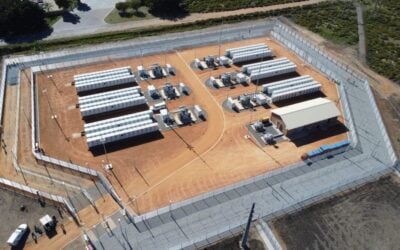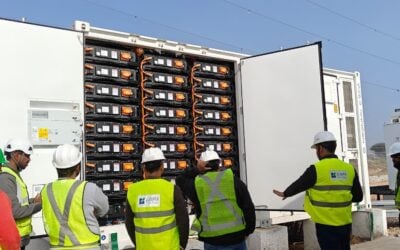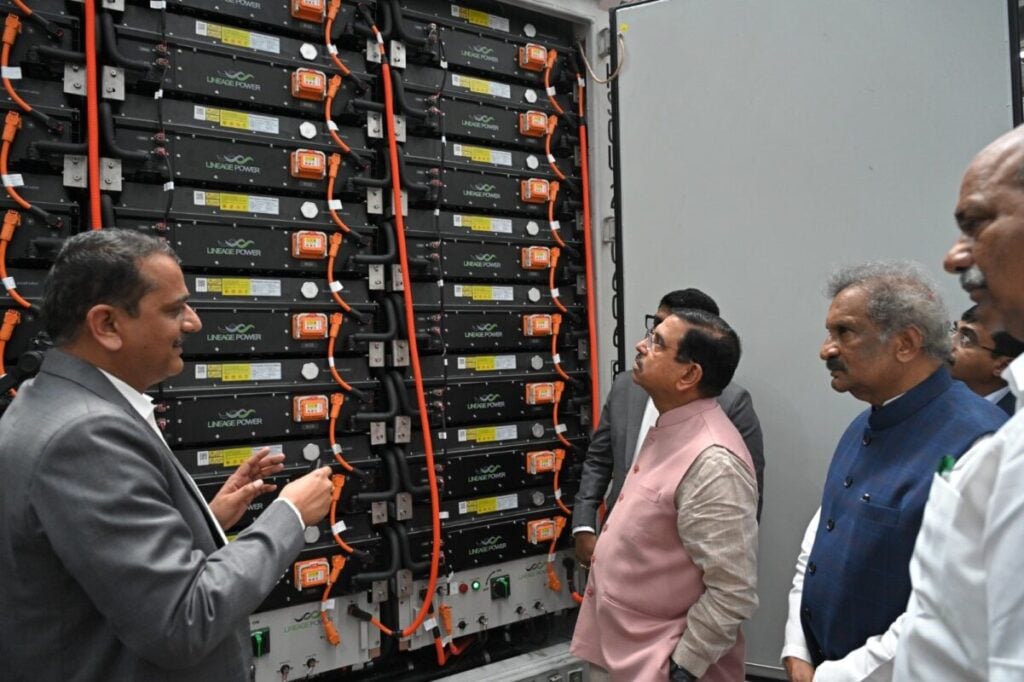
Energy storage is essential to capture solar and wind generation, Karnataka’s energy minister said, at the opening of the ‘first fully automated’ battery storage factory in India.
Lineage Power, a power conversion system (PCS) and power plant controls manufacturer with a background in the telecoms sector, inaugurated its 5GWh battery energy storage system (BESS) factory in Bengaluru, the capital of Karnataka, on Friday (27 June).
At the event, Karnataka energy minister KJ George said that battery storage systems would be established at all solar PV power plants, storing excess generation for supply to the grid “as and when required,” according to a tweet on social media platform X by the state government’s Department of Information and Public Relations (DIPR).
News outlet Deccan Herald quoted the minister’s remarks at the event’s sidelines. George pointed out that due to the growth of wind and solar PV in Karnataka and now represents 65% of generation.
Try Premium for just $1
- Full premium access for the first month at only $1
- Converts to an annual rate after 30 days unless cancelled
- Cancel anytime during the trial period
Premium Benefits
- Expert industry analysis and interviews
- Digital access to PV Tech Power journal
- Exclusive event discounts
Or get the full Premium subscription right away
Or continue reading this article for free
The state has run at a surplus for several years; however, “effective storage systems are essential to store this energy and supply it when needed,” such as during peak demand periods, Deccan Herald quoted the minister as saying.
Although the Herald did not mention a mandatory requirement for storage from KJ George’s remarks, the DIPR tweet implied some type of mandate would be forthcoming.
Karnataka factory ‘brings India closer to 500GW goal’
Lineage Power is owned by Pace Digitek, a telecoms and energy sector solutions company headquartered in Bengaluru. Pace Digitek acquired the technology company in 2014 from General Electric (GE), which had bought Lineage Power three years earlier from ABB.
Pace Digitek claimed the new factory in Bidadi, in Begaluru’s South District, is a “one of its kind, fully automated 5GWh BESS manufacturing facility” in a tweet on 25 June.
Pralhad Joshi, Indian Union government Minister of New and Renewable Energy & Consumer Affairs, Food & Public Distribution, also attended the event.
Joshi said the Lineage Power factory will produce 5MWh DC blocks for utility-scale applications paired with a 2.5MW PCS, with 5GWh annual production capacity.
Addressing the gathering, the minister: “highlighted that as more renewable energy flows into our grid, reliable and scalable energy storage will be essential. Projects like this bring us closer to our goal of 500GW of non-fossil fuel capacity by 2030,” Joshi tweeted to X.
In a recent Guest Blog for Energy-Storage.news, Debmalya Sen, president of the India Energy Storage Alliance (IESA), wrote that in addition to stimulating deployment of energy storage through tenders and incentive schemes, the Union government has recognised a need to promote domestic supply chains.
Manufacturing of battery cells, often considered the most complex part of the value chain, has yet to take off in India despite the award of subsidies to would-be manufacturers for 40GWh of advanced chemistry cell (ACC) batteries through the national Production-Linked Incentive (PLI) scheme.
On the other hand, Sen said it is expected that there will be 225GWh of annual production capacity online for battery packs within the country by the end of this decade.
India will not be dependent on batteries alone for energy storage for the grid. The Central Electricity Authority (CEA), which earlier this year said inclusion of energy storage should be mandatory in solar PV tenders, has modelled a need for significant volumes of pumped hydro energy storage (PHES) mostly to provide long-duration energy storage (LDES), alongside BESS.
Karnataka minister JK George said that along with a 2GW battery storage project, the state planned to implement three PHES plants, including the 2GW Sharavathi project, 1.5GW Varahi project and 1GW Pavagada project.
Meanwhile, to a much lesser extent some other storage technologies are being considered and evaluated, with state-owned power producer NTPC currently piloting the deployment of flow battery storage and a carbon dioxide-based LDES technology from Italian company Energy Dome.