Second life battery storage firm Moment Energy has announced a US$40 million Series B funding round to accelerate its battery factory.
Announced 5 May, this latest financing brings Moment Energy’s total capital raised to over US$100 million. It was an oversubscribed funding round led by venture capital (VC) firm Evok Innovations, with participation from firms Liberty Mutual Investments, W23 Global Fund, and the VC arm of Tokyo Gas, Acario.
Moment says the funding will be help the company accelerate its North American manufacturing operations, “solidifying its position as the leading second-life battery manufacturer.”
The capital will be used to scale specialist teams, increase production capacity in the US and Canada, and assist with the deployment of commercial battery energy storage systems (BESS).
Try Premium for just $1
- Full premium access for the first month at only $1
- Converts to an annual rate after 30 days unless cancelled
- Cancel anytime during the trial period
Premium Benefits
- Expert industry analysis and interviews
- Digital access to PV Tech Power journal
- Exclusive event discounts
Or get the full Premium subscription right away
Or continue reading this article for free
Moment highlights growing demand from data centres, ageing grid infrastructure, and battery supply chain bottlenecks as challenges that the company can address by “unlocking the largest untapped domestic resource: EV batteries already on North American roads.”
The second-life BESS company was awarded a UL 1974 certification in 2023. UL 1974 certifies the collection, storing, and manufacturing processes for repurposing EV batteries for BESS solutions.
At the time, Moment said it was the first company to receive a UL 1974 certification in North America.
Moment also has a UL 9540A certification. Published 13 March, the new edition of the UL 9540A certification adds large-scale fire testing (LSFT) requirements to its thermal runaway fire propagation testing.
The company uses a proprietary pack-swapping system which it claims extends system lifespan to 30 years, compared to a 15-year typical lifecycle of other systems. This further enables, with tax incentives, what the company claims is up to three times lower net costs, “reducing cycling costs to as low as 3 cents-per-kWh for industrial users.”
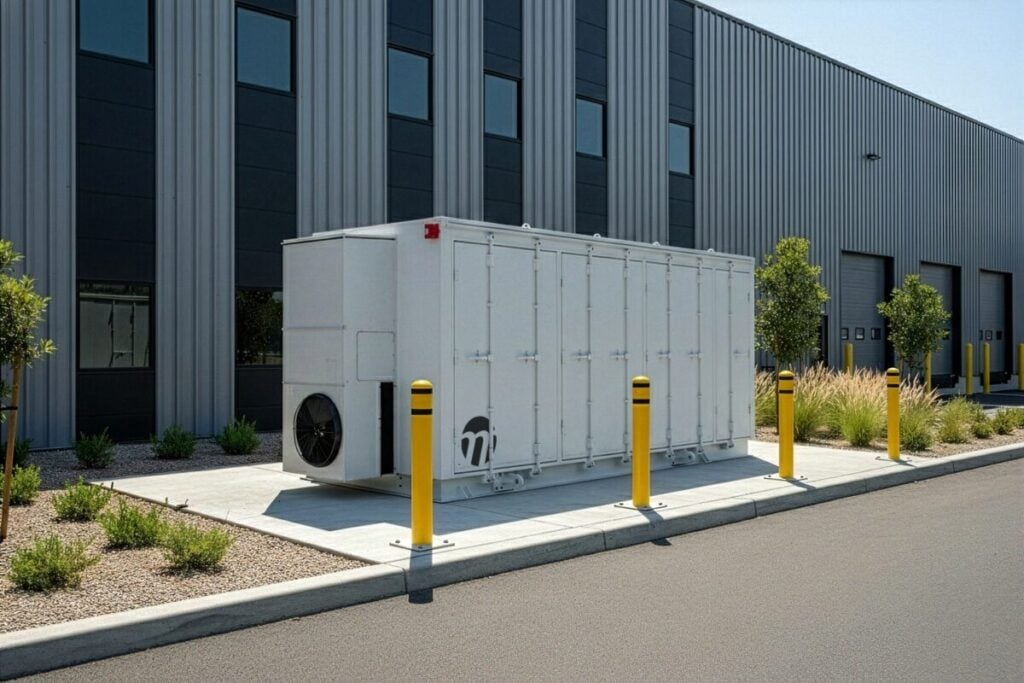
In 2025, Moment’s second-life BESS manufacturing hub in Vancouver, British Columbia, CA, reached full-scale production. The manufacturing facility produces Moment Energy’s Luna BESS, a 400kWh/1MWh system that can be scaled into 10MWh.
Speaking with Energy-Storage.news at the time, Moment co-founder and CEO Edward Chiang said that Moment works “directly with automotive companies to source batteries from surplus inventory and end-of-life vehicle stock. Moment currently has access to over 8GWh of supply and will continue to draw from the hundreds of gigawatt-hours that are expected to become available in the next few years.”
The news from Moment Energy also follows shortly after battery recycling company Redwood Materials laid off approximately 10% of its workforce, with CEO JB Straubel highlighting Redwood’s energy storage business.
Redwood Energy repurposes second-life EV battery packs with usable capacity for ESS applications, targeting hyperscalers, AI computing companies, and renewable developers who need large amounts of power capacity deployed quickly.
Marty Reed, partner at Evok, said of Moment Energy’s funding, “Moment Energy is the only player in the EV battery repurposing industry that has proven safety and scalability are not mutually exclusive. With a deep understanding of battery health and chemistry, Moment Energy is uniquely positioned to build and deploy high-performance, second-life systems at enormous scale.”