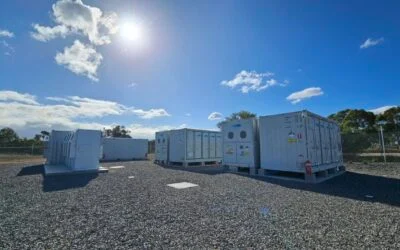
Australian energy ministers’ recent agreement to launch tenders for a mix of renewable energy and energy storage is a “major breakthrough in federal policy”.
That’s the view of Dr Bruce Mountain, energy economics expert at the Victorian Energy Policy Centre (VEPC), who warmly welcomed the high-level agreement and its promise to exclude coal and gas from procurement processes.
As reported by Energy-Storage.news earlier this month as Federal energy minister Chris Bowen and energy ministers from Australian states and territories met and decided in principle to launch a scheme to tender for dispatchable renewable energy on a competitive basis.
It is also expected that a Renewable Energy Storage Target (REST) scheme will be introduced for small-scale energy storage deployments.
Try Premium for just $1
- Full premium access for the first month at only $1
- Converts to an annual rate after 30 days unless cancelled
- Cancel anytime during the trial period
Premium Benefits
- Expert industry analysis and interviews
- Digital access to PV Tech Power journal
- Exclusive event discounts
Or get the full Premium subscription right away
Or continue reading this article for free
Energy minister Bowen said the agreement had come after years of discussion, perhaps less charitably described by trade group the Smart Energy Council as a “landmark day” that followed nine years of inaction on climate by Australia’s federal governments.
With leadership at the top of central government taken up by Prime Minister Anthony Albanese’ Labor Party in May, Labor, which ran on a platform which included promises to act on climate change and energy security issues, has already started making reforms to change that course.
“We’ve had a debate in the National Electricity Market (NEM) for the last four or five years on market design. It’s been a protracted, very arcane technical debate taken forward by the regulatory agencies,” Bruce Mountain told Energy-Storage.news in an interview.
The process had hit the buffers and been deadlocked because proposed solutions from regulatory agencies would always involve coal and gas-fired generation. Several ministers would not accept schemes that incentivised new gas generation or payments to existing coal.
“Essentially, with a change of government, the federal energy minister and the Energy Department took charge of this part of the process and sought agreements at a very high level with the states’ energy ministers, who under our constitution have the responsibility for electricity supply,” Mountain said.
“Where they have got to, is a very high-level description of a mechanism whose essential detail is that it will exclude coal and gas generation from compensation under the scheme.”
‘Biggest electricity policy issue’
Earlier this year, the energy economics academic had told this site that Australia had a pressing need for a coordinated policy on energy storage, most likely in the form of a target. Mountain and VEPC were far from alone in calling for a target or similar scheme, with the Smart Energy Council and Climate Council non-profit advocacy group also promoting the idea.
While, as Mountain said, the newly announced scheme isn’t quite the same as the REST he proposed, and indeed, details of the scheme, or schemes, haven’t yet been discussed, the academic said he was very pleased with the ministers’ provisional agreement.
“I’d said prior to the election federally, that a storage target would be the biggest electricity policy issue for the government,” Mountain said.
Labor’s election win on a pro-climate platform had handed the government a mandate to accelerate the energy transition. But while energy storage appeared to have a place in government plans, it appeared Albanese’s party saw increased investment in transmission as more capable of dramatically increasing the adoption of renewables and phasing out fossil fuels.
That’s perhaps why arguably the first major action on climate by Labor since taking office was the launch of the Rewiring the Nation AU$20 billion (US$13.34 billion) fund to invest in transmission corridors, to take clean energy around the country from where it can be abundantly produced to where it is most needed.
Both transmission and energy storage will be important – the Australian Energy Market Operator (AEMO) has modelled a need for 46GW/640GWh of energy storage in the NEM by 2050 – and the country is targeting running on 82% renewables by 2030.
Mountain believes the government has come to the view that storage is important and become explicit about expanding storage deployment.
“I think this is a major breakthrough at a federal level,” Mountain said, adding that at state level, the commitment to energy storage as a component of a cleaner grid has been evident for some time.
That’s nowhere more evident than in VEPC’s home state of Victoria, which has introduced one of the world’s biggest energy storage targets, mandated through the re-election of Premier Daniel Andrews’ regional Labor Party. Other examples include Queensland, Australia’s most carbon-intensive state, which is angling for very rapid adoption of renewables and storage.
Energy-Storage.news’ publisher Solar Media will host the 1st Energy Storage Summit Asia, 11-12 July 2023 in Singapore. The event will help give clarity on this nascent, yet quickly growing market, bringing together a community of credible independent generators, policymakers, banks, funds, off-takers and technology providers. For more information, go to the website.