Vehicle-to-grid (V2G) is now a proven technology but there is still plenty of work left to do for it to scale in the consumer vehicle sector.
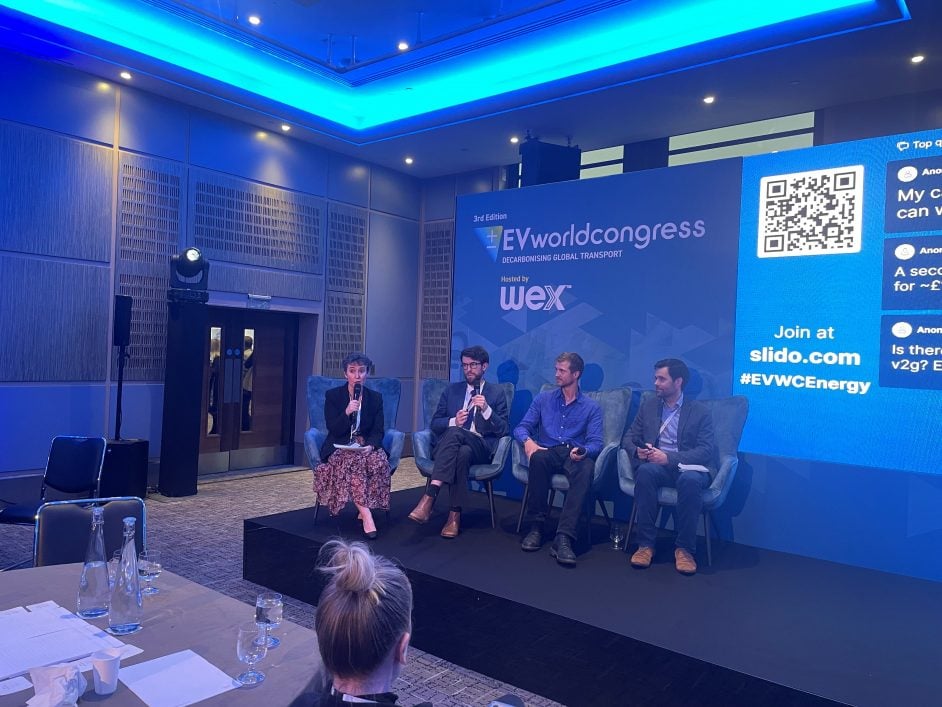
Panellists discussed the topic in the ‘The Future Of V2G; Can It Provide Long Term Grid Capacity As Scale?’ session last week (5 October) at the EV World Congress, a two-day event put on by Energy-Storage.news’ parent company Solar Media. The discussion was UK-focused but the challenges and barriers to adoption remain true across international markets.
“We’ve proven the technology works and it is now very easy to buy bidirectional chargers for your EV,” said Josey Wardle, innovation lead EV charging and V2G at Innovate UK. Rob Mangan, senior policy advisor at BEIS (Department for Business, Energy and Industrial Strategy) agreed but said the price needed to come down further.
John Murray, head of EVs for research firm Delta-EE, added that although the payback on the upfront capital cost was still very long, providing a back-of-the-envelope calculation of eight years. A future where people buy EVs with the surrounding infrastructure needed for V2G, with financing as available as it is today for the car, would help solve this.
Try Premium for just $1
- Full premium access for the first month at only $1
- Converts to an annual rate after 30 days unless cancelled
- Cancel anytime during the trial period
Premium Benefits
- Expert industry analysis and interviews
- Digital access to PV Tech Power journal
- Exclusive event discounts
Or get the full Premium subscription right away
Or continue reading this article for free
And even when it comes to smart charging, which could be seen as a precursor to V2G, only a small number of people do it, said William Goldsmith, head of grid and data services at smart charging app company Ev.Energy.
“Today it’s maybe only 5-10% of EV owners,” he said. But studies have shown that in the long-term that number should reach 90% and that eventually, vehicle-to-everything (V2X) could make peak demand from EV charging on the grid a net negative. I.e., when demand for charging EVs is highest, the number of EV batteries providing power to the grid would still outweigh this.
Murray added that V2G’s impact on an EVs battery life was something that customers raise concerns about and that more needed to be done communicating the minimal impact it would have on the battery. Working with car manufacturers to ensure battery warranties were still valid when participating in V2G programmes was particularly important.
BEIS’ Mangan added that another thing vehicle OEMs could do and are doing is familiarising customers with V2G technology by implementing similar, simpler things like vehicle-to-load (V2L), whereby an EV battery charges a single appliance, like a laptop or fridge. “A lot of that hardware can be seen as a stepping stone on the way to V2G/X,” he said.
Thalia Skoufa, transport practice manager at the non-profit innovation centre Energy Systems Catapult, said locations where fleet downtime is predictable (airports, fleet bases etc) held good potential for V2G, but it was hard to assess exactly how until the market was more developed.
Others agreed that fleets of vehicles would see adoption quicker than the consumer space, because of all the challenges discussed during the session.