Thermal energy storage (TES) technology company Kyoto Group’s latest project will displace the use of natural gas at a corn processing plant in Hungary, Europe.
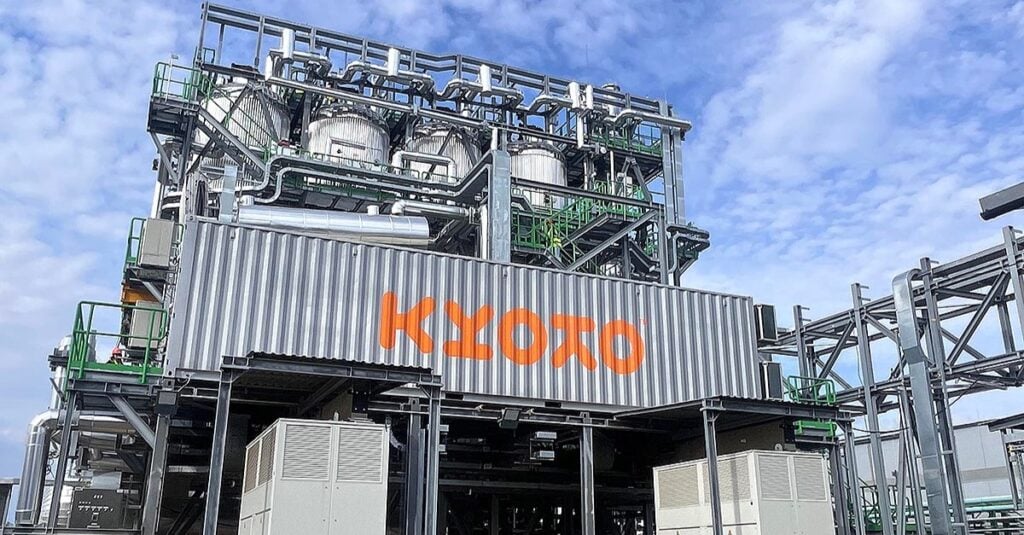
Last week (9 October), the Norway-headquartered startup announced the inauguration of the second-ever deployment of its Heatcube technology for the KALL Ingredients plant in Tiszapüspöki, in central Hungary’s Northern Great Plain region.
Kyoto Group claims Heatcube can provide low-cost industrial heat at scale in configurations from 10-20MW charging capacity and up to 14MW discharge capacity, 39-104MWh storage capacity and provide steam at temperatures ranging from 150 to 300 degrees Celsius.
The power-to-hear technology is also designed for a lifetime of more than 25 years, operating with an over 93% round-trip efficiency (RTE) and a usable energy storage density of approximately 280kWh/m².
Try Premium for just $1
- Full premium access for the first month at only $1
- Converts to an annual rate after 30 days unless cancelled
- Cancel anytime during the trial period
Premium Benefits
- Expert industry analysis and interviews
- Digital access to PV Tech Power journal
- Exclusive event discounts
Or get the full Premium subscription right away
Or continue reading this article for free
It utilises resistive heaters that convert electricity into heat, which is then stored in molten salt for later release when needed.
At the KALL Ingredients processing plant, a 56MWh Heatcube will provide more than 30GWh of process heat annually. In doing so, it will replace the customer’s use of natural gas and reduce its carbon emissions.
Additionally, the asset will be played into flexibility markets and Kyoto Group said it will charge with renewable energy whenever available.
Kyoto Group offers the technology either for purchase, or under a heat-as-a-service business model. KALL has opted for a 15-year heat-as-a-service agreement, and the project was delivered through Kyoto Group’s partnerships with its majority investor Kyotherm and energy trading partner and minority investor Energiabörze, a Hungary-headquartered trader and aggregator.
Thermal energy storage is often touted as a solution for decarbonising hard-to-abate emissions for industrial applications, with Kyoto Group among a range of providers seeking to commercialise their ideas.
However, barriers to adoption include the difficulty of providing high-quality, consistent heat—particularly at higher temperatures—and ensuring a seamless switchover from the end-user perspective.
Kyoto Group, which attracted Iberdrola as an investor in 2023, deployed its first 4MW/18MWh Heatcube system at a coal-fired combined heat and power (CHP) power plant in Denmark that year.
Others in the space include Israel’s Brenmiller Energy, Rondo Energy from the US, MGA Thermal in Australia, Kraftblock in Germany and fellow Scandinavian molten salt storage provider Hyme Energy, from Denmark. These companies are all looking to replace industrial heat processes, while others, such as Finland’s Polaris Energy, are targeting the domestic district heating space with lower temperature thermal storage in the form of its ‘Sand Battery’ technology.