
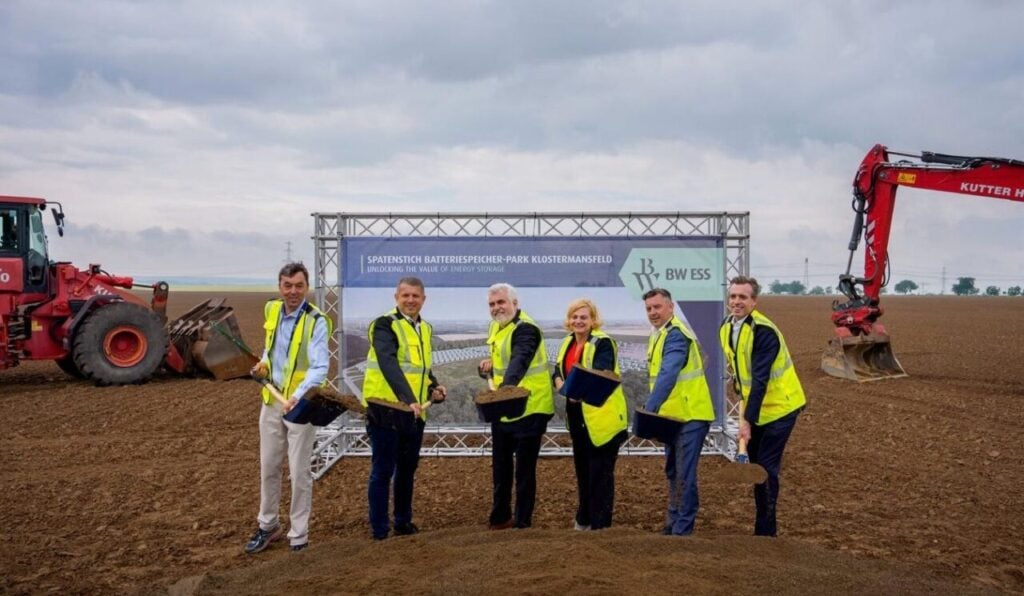
BW ESS’ executive director Roberto Jimenez discusses the company’s recently-announced first Germany project, in Klostermansfeld, Saxony-Anhalt, which could be one of Europe’s largest when completed in 2028.
It is BW ESS’ first project in Germany, which made its staggering 1GW/5.7-hour size all the more noteworthy when early-stage construction works were announced a few weeks ago. It makes Germany the company’s fourth country with projects in operation or construction, after the UK, Sweden and Australia (see all coverage of the firm here).
Jimenez, whose role at BW ESS has evolved to running the German division, explains that now that the past few years in Germany have been challenging for large-scale storage because of regulatory and policy uncertainty. But now that the grid fee exemption for projects coming online by 4 August 2029 has been cemented, the company is bullish on Germany.
In this interview he discusses the company’s strategy in Germany, mitigating flexible connection agreement (FCA) risks, the size and duration of the project, the timeline for completion, how it is approaching enlisting suppliers and EPCs and how it is thinking about routes-to-market (RTM) and commercialisation for the project.
Try Premium for just $1
- Full premium access for the first month at only $1
- Converts to an annual rate after 30 days unless cancelled
- Cancel anytime during the trial period
Premium Benefits
- Expert industry analysis and interviews
- Digital access to PV Tech Power journal
- Exclusive event discounts
Or get the full Premium subscription right away
Or continue reading this article for free
TSO-level strategy mitigates FCA risk: ‘horror stories at DSO level’
“So our approach to Germany was a bit more cautious before that, but we are now leaning into the market much more because things have cleared after the announcement from BNetzA,” Jimenez explains.
“Germany is on the up now. There are still challenges around FCAs etc, but the market is now on an uptick. We’re very excited about Germany. This is our first but there will potentially be more announced later this year.”
The challenge he refers to are FCAs, which is German system operators’ way of dealing with the huge backlog of battery energy storage system (BESS) projects connecting to the grid. These restrict a project’s activity in the electricity market, and we’ve covered them extensively including on a recent webinar with consultancy Clean Horizon.
Jimenez said the company has in general chosen to focus on large, transmission system operator-level (TSO) projects in part to face less constraints in connecting.
“We’ve chosen to focus on TSO level projects, which tend to have less restrictions than those at the DSO level. Connecting to TSO level Germany means you need to be generally at least 200MW, which is in line with our overall strategy of doing large projects,” he explains.
“What we have seen from TSOs in Germany is they have put together a paper which explains the restrictions they envision for all TSO projects. And those requirements or restrictions feel reasonable.”
“We are not working at the DSO level. We’ve heard horror stories from DSO level. Our thesis was always that if you connect at TSO level, you would face less restrictions and we are seeing that play out.”
The substation that the project will connect to is in the territory of 50Hertz, one of Germany’s four TSOs.
Early-stage construction
Jimenez clarifies that it is still early stage construction work with BESS suppliers and EPC services still to be contracted. Work has begun to reinforce the roads around the 15-hectare site and topsoil is being removed.
The firm has been relatively under the radar with the project so far. But it was asked by the municipality to make an announcement as the BESS is related to an upgrade of the nearby substation, and they wanted to show people progress at the site.
“We are now contracting the project with suppliers of equipment, engineering and construction services,” Jimenez explains, which we will delve more into further down.
“The most important milestone is when it hits COD, right now it is Q4 2028 that we are targeting. There is a bit of uncertainty on that as we are still working with the grid provider on energisation date, but we’ve procured long-lead items for project.”
Going big and long-duration
Not only is the project one of the largest in Europe to enter construction but going up to potentially 5.7-hours would also make it by far the longest duration large-scale BESS in Germany.
Jimenez does clarify that it may not go all the way to 5.7-hours initially, but it will go to at least 4-hours (1GW/4GWh), and probably more. The company is still working on optimising the duration of the project. Even 4-hours is still higher than the vast majority of large-scale projects in Germany. Only LEAG’s 1GW/4GWh project with Fluence is comparable.
Part of the reason behind going so big is that it will site at a critical juncture of the future German grid, which has a similar north-south generation-demand mismatch as in the UK.
“This substation that the project will connect is part of the critical backbone of Germany, it is to move energy north to south and east to west. There is a very significant infrastructure project called the SuedOstLink coming through this substation, and some other interconnector projects coming through this substation. This substation is very important for the German grid,” Jimenez explains.
“We also found we have a really nice land location, 150m away from the grid, for a project of this scale, you need a lot of land, and this has a lot of land close to this substation, so it made sense for us.”
“For us it is all about impact, we want to make an impact on the German market, and TSO projects are more impactful because they don’t have all these restrictions.”
Going for a longer duration is also related to BW ESS’ backing by its parent company BW Group, whose management clearly has a very bullish long-term view on energy storage, something Jimenez calls its ‘secret sauce’.
BW ESS funds projects’ construction from its own balance sheet before bringing in external financiers and offtakers during construction, which the firm believes gives it more leverage in negotiations. But for that you need a backer willing to take on construction and merchant risk.
Jimenez: “We don’t flip projects, we are here to build these things and operate for decades. The general approach is our projects are generally longer-duration than where the market is. We look at these making money in 2040/50, so to be robust, longer duration makes sense from our long-term ownership perspective. We’re not scared of longer-duration projects.”
Indeed, its two flagship UK projects Bramley (100MW/331MWh) and Hams Hall (350MW/1,243MWh) are well over 3-hours in duration, much higher than most other projects being built now. It also has an 8-hour BESS that won a contract in Italy’s MACSE auction, though all projects in that auction are between 6 and 8-hours.
Selecting suppliers and contractors
So when going this big, how do you approach selecting BESS suppliers and contractors? Jimenez says the firm is running a long tender process for BESS supply, which started at the beginning of 2026 and is targeting selection in Q3. It has its final list of suppliers which it is now whittling down.
“It’s a long process but the reason is we want to align well with suppliers on this project, particularly because of the very important grid fees date (4 August 2029). We feel prepared but of course things can change so we want to make sure we hit that date,” he says.
“Our approach is we like to work with people on a long-term basis, be it developers and suppliers. We tend to work with companies that give us priority.”
“The bigger challenge is are there enough EPCs to build this thing – the balance sheet you need to build this is big. For a 20MW project there might be 50 EPCs, for a project of this scale the group is smaller.”
Sungrow has supplied its two biggest UK projects, while BW ESS hasn’t revealed suppliers for other projects elsewhere yet.
Offtake and capex
On offtake and route-to-market (RTM) partners, Jimenez says: “We see a lot of interest in Germany from creditworthy counterparties. All the major utilities, all the oil and gas strategics, all the commodity traders are here, which is not surprising because it is Europe’s deepest and most liquid market. There’s opportunity for longer-term tolls, you have all this liquidity. We’re seeing a lot of interest for this project and beginning to have those conversations.”
We finished by asking Jimenez for a ballpark figure on how much capex is required for a project this size, but he says the figure is too commercially sensitive. “Everyone else is asking that too!”
Jimenez was a speaker at last month’s Energy Storage Summit at the Battery Show Europe, hosted by Energy-Storage.news publisher Solar Media and co-located with parent company Informa’s The Battery Show Europe.
That is followed in September by the inaugural Energy Storage Summit Germany in Berlin on 15-16 September, get tickets here. Use our code ESN30 for a 30% discount.
