Israel likely to need 8GWh of storage to meet 2030 renewable energy goals

LinkedIn
Twitter
Reddit
Facebook
Email
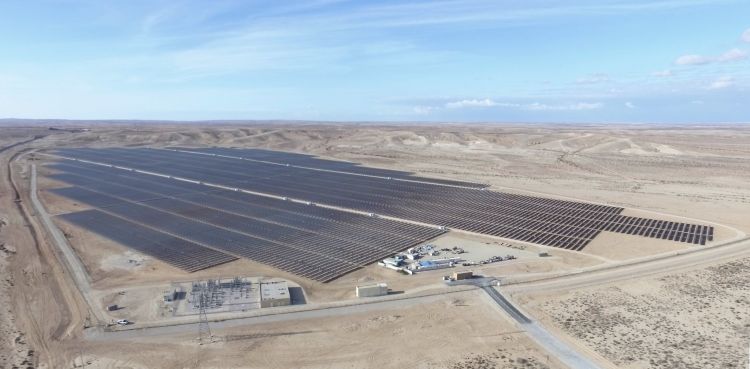
A utility-scale solar farm project in Israel’s Negev Desert. Image: JA Solar.

As much as 8GWh of energy storage may be required to enable Israel’s policy aim of sourcing 30% of its electricity from renewables by 2030 and to enhance the reliability of the electricity grid.

Yossi Sokoler, head of the regulatory department at the Israeli Electricity Authority (PUA), is among the speakers participating in next week’s Energy-Storage.news webinar, which focuses on Israel’s “electricity revolution”.

In his presentation, Sokoler will say that the deployment of around 2GW / 8GWh of energy storage is expected to be needed to help meet Israel’s renewable energy goals, which equates to the installation of 12GW of solar PV. Solar will make up 26% of the energy mix in 10 years’ time, with other renewable sources providing around 4%.

PUA is hosting a tender for solar-plus-storage projects which closes in late December. This follows on from a first auction which this summer lead to the award of 168MW of PV and 672MWh of energy storage.

This article requires Premium SubscriptionBasic (FREE) Subscription

Try Premium for just $1

  • Full premium access for the first month at only $1
  • Converts to an annual rate after 30 days unless cancelled
  • Cancel anytime during the trial period

Premium Benefits

  • Expert industry analysis and interviews
  • Digital access to PV Tech Power journal
  • Exclusive event discounts

Or get the full Premium subscription right away

Or continue reading this article for free

Other speakers at the webinar on Tuesday are Eitan Parnass, head of the Israeli Green Energy Association and Michael Salomon, CEO of energy storage consultancy firm Clean Horizon.

The audience will be able to ask questions during the session for a Q&A after the speakers’ presentations, moderated by Energy-Storage.news editor Andy Colthorpe.

The webinar hosted by Energy-Storage.news with Clean Horizon: Israel’s electricity revolution: Gain expert insights into the latest national solar+storage tender, takes place at 2pm CET on Tuesday, 17 November. You can sign up for the webinar here.
8 September 2026
Barcelona, Spain
Battery & Energy Storage Tech Europe (BESTE) is Europe’s industrial scaling platform for stationary and industrial battery applications — not EVs. Taking place 8–9 September 2026 at Fira de Barcelona, BESTE brings together utilities, IPPs, energy-intensive industries, data centres, ports, rail, maritime, defence and aerospace OEMs — all deploying or integrating battery storage at scale. Over 100 companies already confirmed — including EDP Renewables, Acciona, Endesa, Naturgy, Neoen, Galp, Basquevolt and Veolia — alongside 40+ expert speakers and international institutional support from BEPA, BVES, LDES and Volta Foundation. Where Europe’s battery & ES ecosystem turns projects into reality.
15 September 2026
San Diego, USA
You can expect to meet and network with all the key industry players again in 2025 from major US asset owners, operators, RTOs and ISOs, optimizers, software and analytics providers, technical consultancies, O&M technology providers and more.

Read Next

Premium
July 3, 2026
Energy-Storage.news Premium speaks with energy storage market experts Raafe Khan of Camelot Energy Group and Oliver Kerr of Aurora Energy Research on FERC’s recently issued show cause orders.
Sponsored
July 3, 2026
As hardware margins compress and consolidation accelerates, smart appliance brand’s energy division argues that intelligent software—not just batteries—will determine who survives
July 3, 2026
Australia’s 55 grid-scale BESS generated a combined AU$17.98 million in estimated gross energy and FCAS market revenue during June 2026.
July 3, 2026
AGL has delivered a solar and battery microgrid described as “one of the largest privately owned non-mining microgrids in Australia”.
July 1, 2026
Independent power producer (IPP) Grenergy has signed a 1TWh night-time power purchase agreement (PPA) for its 3.5GWh Elena BESS project in Chile.