India’s growing energy storage industry shares the enthusiasm of its solar counterpart in welcoming the Modi government’s aims and ambitions, according to one industry veteran.
PV Tech spoke to Rahul Walawalkar, executive director of the India Energy Storage Alliance (IESA), as the country’s Ministry of New and Renewable Energy (MNRE) prepares to issue a Request for Proposals in the coming weeks for a number of energy storage demonstration projects, which will be selected by the end of this year. In addition to his work with IESA, Walawalkar is also vice president for emerging technology and markets at Indian company Customised Energy Solutions.
MNRE invited expressions of interest (EOI) in July for four areas where storage could be used. The ministry will look at integrating large-scale solar and wind into transmission grids, rural micro grids, at commercial micro grids and also at large-scale standalone energy storage projects. From these four areas, Walawalkar explained, the government must select at least one project for each area, which Walawalkar estimates could mean additional funding going to as many as 10 different projects. The final selection of projects will take place in January.
Rahul Walawalkar said that so far, his organisation and its members had been “encouraged” by what it had seen so far from Narendra Modi’s government.
Try Premium for just $1
- Full premium access for the first month at only $1
- Converts to an annual rate after 30 days unless cancelled
- Cancel anytime during the trial period
Premium Benefits
- Expert industry analysis and interviews
- Digital access to PV Tech Power journal
- Exclusive event discounts
Or get the full Premium subscription right away
Or continue reading this article for free
“We are quite encouraged by the announcements and some of the information we are getting about the government’s intentions. Obviously we have to wait until some of the concrete measures get announced, but just regarding energy storage, the Ministry of New and Renewable Energy, has already created a standing committee on energy storage and hybrid systems. A national level committee specifically looking at deployment and research and even long-term manufacturing capability in India for energy storage and hybrid systems.”
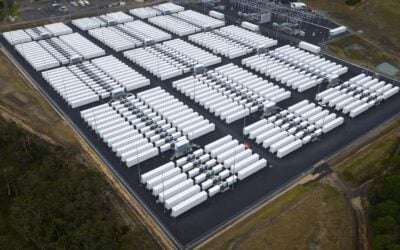
India’s government has taken a proactive stance on energy storage, in addition to its ambitious goals and plans for solar. Image: Tat Power Solar.
Meanwhile, the Powergrid Corporation of India, a state-owned utility responsible for around half of the country’s transmission networks, has already made its own inroads into taking storage seriously, Walawalkar said.
“Already Powergrid Corporation of India has a multibillion dollar project called Green Energy Corridor, to enable solar from, say Rajasthan or Gujarat to take it to some of the other parts of the country. They’ve identified five renewable-rich regions and they expect in the next five years more than 30GW of renewables will be added, mainly wind and solar and then they will build transmission for that.”
Walawalkar said over US$300 million has already been allocated from the Green Corridor to energy storage projects. German development bank KfW also loaned a substantial sum to Powergrid Corporation of India for the scheme, with some reports claiming the amount loaned could rise to as much as US$1 billion. This income will be supplemented by cash from a national fund which works on the ‘polluter pays’ principle.
“Other money could be made available through the Clean Energy Fund. For any coal power which is generated, there is a surcharge put in which goes to the Clean Energy Fund, so maybe some of that will be allocated to this project. The details, in terms of what kind of energy storage will be used, is still being worked out. Powergrid Corporation has already issued an RFP two months back to deploy 3.5MW energy storage projects for frequency regulation, to balance the grids. One with lithium-ion, one with advanced lead acid and another with alternative technologies like sodium sulfur, or flow batteries. More than 20 companies are bidding for this project.”
According to Walawalkar, strong drivers for energy storage exist in a country where there is limited access to energy for much of the rural population, contrasted with intensive use of energy typical of modern cities in other areas. In addition to the high-profile projects discussed by Powergrid Corporation of India and MNRE, another example is the government’s plan to connect the millions who have little or no access to electricity.
“There are more than 300 million people in India right now who don’t have access to electricity. The government has set up an ambitious plan within the next three to five years to give everyone at least eight hours of electricity access. So they’re looking at more than 1,000 microgrids in different villages to try to reach out to this population rather than waiting for centralised transmission and distribution networks reaching the villages. Storage will be a key part of it and solar will obviously be a key part of it too.”