
As the battery storage market continues its strong growth trajectory, battery manufacturers are ramping up production to meet increased demand.
Historically, battery manufacturing has been largely concentrated in China, and while this continues to be the case, there has been a stronger push to establish facilities overseas.
This article primarily uses data from the BatteryStorageTech Bankability Ratings Report, which covers over 50 leading battery suppliers, to examine the evolving manufacturing landscape and the importance of the supply chain.
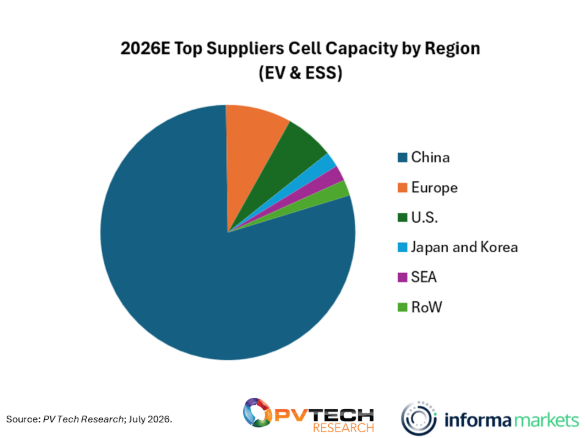
For the companies featured in the report, cell manufacturing capacity is set to increase by over 25% in 2026, with Europe due to see the largest rise. This is primarily attributed to the EV battery-centred facilities, with Hungary emerging as a major hub. CATL is expected to begin cell manufacturing in the company’s new Debrecen facility this year, and EVE Energy has plans for a 30 GWh site in the same city.
Try Premium for just $1
- Full premium access for the first month at only $1
- Converts to an annual rate after 30 days unless cancelled
- Cancel anytime during the trial period
Premium Benefits
- Expert industry analysis and interviews
- Digital access to PV Tech Power journal
- Exclusive event discounts
Or get the full Premium subscription right away
Or continue reading this article for free
Battery makers are increasingly expanding production in Southeast Asia, possibly to diversify trade and take advantage of the manufacturing incentives offered by the countries. Recent completions include EVE Energy’s facility expansion in Malaysia and REPT opening a lithium-ion cell and ESS base in Indonesia. The region’s mineral-rich nature and large nickel supply have also drawn interest in the mid- and upstream supply chain, primarily in Indonesia, with CATL’s battery manufacturing hub currently under construction and aiming to cover the full battery value chain.
Another region that has attracted investment is the Middle East and North Africa. There have been over 35 GWh of battery and 45 GWh of cell manufacturing plans announced in the region in recent years. India has also been ramping up its battery production capacity; one key difference is that most of the facilities are being opened by domestic players, with over 10 GWh of energy storage battery-specific facilities completed so far this year. This comes as India’s operational energy storage capacity has seen exponential growth of late, spurred by nearly 60 GWh of standalone battery storage tenders awarded by the end of 2025 and the new tranche in the Viable Gap Funding (VGF) scheme.
India, while still heavily reliant on cell imports, is aiming to localise production further with the aforementioned VGF scheme requiring a minimum of 20% domestic content. Other countries are also prioritising locally produced equipment; in South Korea’s energy storage auction, extra points were awarded for domestic industrial contribution, and the U.S provides a 10% domestic content bonus for the investment tax credit (ITC).
China is expected to remain the leading player in battery manufacturing for many years yet. So far, there have been over 900 GWh of newly announced or approved battery manufacturing capacity in the country, along with over 120 billion yuan in investment.
He who controls the lithium controls the (battery) universe
While lithium carbonate prices have declined from the year-to-date peak in May, they remain significantly higher than a year ago. This has been reflected in the price of batteries themselves, and, with the larger-cell-capacity segment not yet mainstream, the cost benefits they could provide have not been fully realised.
Suppliers that do not manufacture cells may be more affected by higher lithium prices, with less control over the supply chain and reduced pricing power overall. In addition, fixed contracts signed when prices remained low could be impacting margins in the first half of this year. Companies newly entering the industry are more likely to buy cells given the high capex production entails, and this lower barrier to entry means intensified competition amongst integrators, which could pressure companies to keep prices low to gain market share.
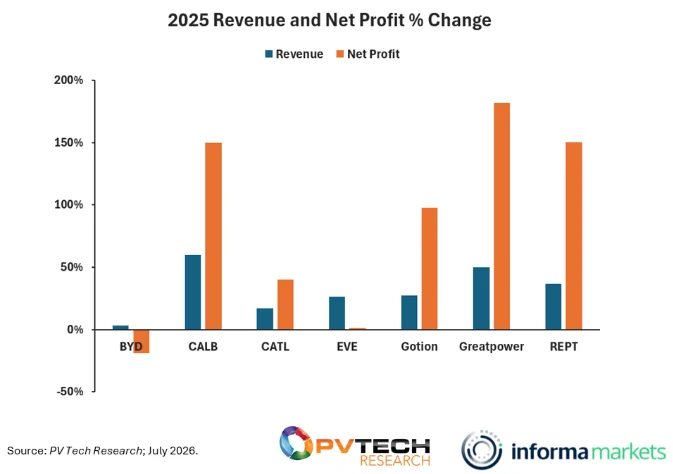
Looking at the leading cell manufacturers, aside from BYD, the companies showed robust growth in both revenue and net profit in 2025. This is particularly seen in CALB, Great Power, and REPT Battero, who all experienced a 100% or higher increase in net profit attributable to shareholders. The first quarter of 2026, however, shows a mixed bag of results; despite EVE Energy posting a 31% rise in net profits, it also saw lowered margins compared to Q1 2025.
Cell production remains heavily concentrated, with the top 10 suppliers accounting for over 80% of output. China not only leads in cell manufacturing but also in midstream activities, refining most of the world’s lithium. While lithium prices have been highly influenced by the country’s processing capabilities, the opening up of lithium carbonate futures and options on the GFEX to foreign traders will place further pricing power in China. There has been an increasing number of battery material plants in Southeast Asia, mostly set up by Chinese companies, such as BTR’s anode plant in Indonesia and XTC’s planned cathode plant in Malaysia.
Countries are actively trying to reduce dependence on China within the lithium supply chain. The G7 leaders formed a Critical Materials Alliance to increase co-operation and reduce dependence on a single supplier outside the group for several materials, including lithium, to under 60% by 2030. India is also planning a Production Linked Incentive scheme for lithium and nickel processing.
Despite only one operating lithium mine in the U.S, there have been several plans for new mining ventures such as the currently under construction Thacker Pass mine, in which the DOE owns a 5% stake. There has been an accelerated push towards a fully domestic supply chain, and in 2026, under the FAST-41 program, three lithium battery-related projects were given federal permitting, including the South West Arkansas Project, which aims to produce 22,500 tonnes of lithium carbonate a year.
The market for alternative battery chemistries has been growing, with increased investment in sodium-ion battery manufacturing facilities and CATL launching its first utility-scale sodium-ion battery product. Sodium, being a much more abundant resource, could help reduce the strong dependence on any single region in the supply chain, and there have been significant investments in new manufacturing, with over 20 billion CNY in newly announced plans in China this year and the US’s first giga-scale sodium-ion facility from Peak Energy. However, many alternative chemistry-focused companies are still in early stages and experiencing financial difficulties, and it is unlikely that lithium-ion will be fully replaced anytime soon.
Overall, despite localisation efforts in the battery supply chain, it will take a while for the effects to be realised. In the meantime, with nearly 2 billion tonnes/annum of cathode and 1 million tonnes/annum of anode material plans announced just this year so far, China continues to soar past other nations and dominate the production ecosystem.
