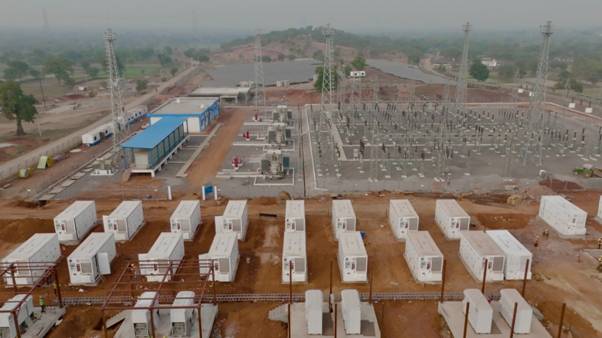
Maharashtra’s electricity regulator, the Maharashtra Electricity Regulatory Commission (MERC), has proposed mandatory battery energy storage system (BESS) requirements for variable renewable energy (VRE) projects seeking grid connectivity.
The proposals are part of a broad overhaul of Maharashtra’s open access and transmission rules. Under the draft Maharashtra Electricity Regulatory Commission (Intra-State Transmission Connectivity and General Network Access) Regulations, 2026, applicants seeking connectivity for variable renewable energy sources including solar and wind would have to install an energy storage system (ESS) meeting one of two criteria.
The first option would require storage equivalent to at least 50% of the applied connectivity capacity, with a minimum discharge duration of two hours. The second would require an ESS with a power rating of at least 25% of the applied connectivity capacity and a minimum discharge duration of four hours.
The draft rules also propose a minimum usable storage capacity of 1MWh per MW of sanctioned connectivity for applications up to 2030, rising to 2MWh per MW thereafter.
Try Premium for just $1
- Full premium access for the first month at only $1
- Converts to an annual rate after 30 days unless cancelled
- Cancel anytime during the trial period
Premium Benefits
- Expert industry analysis and interviews
- Digital access to PV Tech Power journal
- Exclusive event discounts
Or get the full Premium subscription right away
Or continue reading this article for free
MERC has published the proposed connectivity and distribution open access regulations alongside draft regulations covering BESS, rooftop renewable energy, forecasting and scheduling, renewable purchase obligations and the state grid code.
The proposals form part of the commission’s effort to align Maharashtra’s electricity market rules with the state’s Renewable Energy and Energy Storage Policy 2025-26 to 2035-36. The policy is published by the Maharashtra Energy Department.
Maharashtra had 20.40GW of installed solar capacity and 6.45GW of wind capacity as of 31 August 2026, with total renewable energy capacity, including biogas and hydropower, standing at 33.28GW, according to the Ministry of New and Renewable Energy (MNRE).
In July 2025, Maharashtra State Electricity Distribution Company Limited (MSEDCL) launched a tender for 2GW/4GWh of BESS capacity across Maharashtra, with the projects intended to provide on-demand charging and discharging services to the state’s distribution network.
Maharashtra joins a growing group of states—including Rajasthan, Kerala and Tamil Nadu—introducing rules and frameworks to accelerate BESS deployment.
BESS requirements would apply to pending applications
The proposed storage provisions would take effect from publication of the final regulations and would also apply to pending connectivity applications where in-principle connectivity approval has not yet been issued.
For co-located hybrid projects, developers could seek connectivity equal to the highest installed capacity among the renewable generation sources or the ESS.
For non-co-located hybrid projects, separate connectivity applications would be required at each point of connection to the intra-state transmission system.
The draft would also allow renewable generators and ESS projects to add generation or storage capacity within their sanctioned connectivity quantum, subject to prior approval from the relevant nodal agency.
Existing and proposed connectivity holders would be able to add solar, wind or BESS behind an existing connectivity point.
Solar-hour access proposed
MERC has proposed defining solar hours as 7am to 6pm, unless subsequently changed by the commission.
Under the proposed solar-hour access framework, eligible entities would have injection scheduling and drawal rights during solar hours but would not have injection and scheduling rights during non-solar hours.
Existing or approved connectivity based on solar generation would be converted to solar-hour access within six months of the regulations coming into force. Such entities would have the option to apply for full-day access within the same six-month period.
The draft would also permit eligible connectivity holders to change their renewable energy source, either wholly or partly, while retaining their existing connectivity quantum.
Such an application would have to be made within 18 months of the grant of in-principal connectivity or 18 months before the effective date of general network access, whichever is later.
A source change would be permitted once and would be subject to availability of non-solar-hour access.
Open access threshold set at 100kW
MERC has proposed that consumers with a contract demand or sanctioned load of at least 100kW would be eligible for green energy open access.
Multiple connections held within the same electricity circle of a distribution licensee could also be aggregated to meet the 100kW threshold.
Consumers sourcing renewable electricity directly from generators would be allowed to procure capacity of up to twice their contract demand or sanctioned load.
The draft defines long-term open access as access exceeding 11 months and extending up to 25 years, while short-term open access would cover periods from one day to 11 months.
The State Transmission Utility would act as the nodal agency for long-term access, while the State Load Despatch Centre would handle short-term access.
Storage gets proposed network-charge exemptions
The draft proposes exemptions from specified network charges for ESS connected to the intra-state transmission or distribution network where electricity is drawn solely for intermediate storage.
The proposed exemptions cover intra-state transmission charges, demand charges, wheeling charges, cross-subsidy surcharge and additional surcharge, provided the stored electricity is consumed within Maharashtra.
For renewable energy-based open access transactions, transmission charges would be levied on a rupees-per-kW-per-month basis, with the applicable rates to be determined through MERC tariff orders.
Banking moves to time slots
The proposed Distribution Open Access Regulations would introduce a time-slot-based mechanism for banking renewable electricity.
MERC’s proposed banking mechanism would divide the day into different time slots depending on the consumer’s contracted renewable energy capacity.
For consumers with 10kW to 100kW of contracted renewable capacity, the draft proposes four banking slots, each lasting six hours.
For consumers with contracted renewable capacity between 0.1MW and 1MW, the framework would provide eight banking slots of three hours each.
For larger consumers with 1MW to 5MW of contracted renewable capacity, the number of slots would increase to 12, with each slot lasting two hours.
Consumers with more than 5MW of contracted renewable capacity would face the most granular arrangement, with 24 separate banking slots, each lasting one hour.
The draft proposes fixed banking and standby charges in INR/kW/month and variable charges in INR/kWh.
The working group established by MERC has estimated a base-case fixed banking and standby charge of INR139/kW/month (US$1.44/kW/month), while the variable charge could tentatively range from INR3-4/kWh, based on market-discovered tariffs and prevailing storage costs.
MERC stressed that these figures are proposed values and are not final notified charges. For consumers using time-of-day tariffs, banked energy would first be adjusted against slots carrying the highest energy charges.
Consumers with contracted renewable capacity of 5MW or more would face a further adjustment limit, with banked energy in any slot capped at 10% of their consumption from the distribution company during that slot.
15-minute scheduling proposed for larger consumers
The draft also proposes a transition to 15-minute scheduling for consumers above 5MW within three years.
For consumers with contracted renewable capacity above 3kW, unused banked energy would lapse at the end of the relevant settlement period. Renewable energy certificates would then be issued to the generator for the lapsed energy.
Consumers would be permitted to change their electricity supplier once per calendar month, subject to SLDC approval.
Existing consumers that have already used banking, or applied for banking under the existing open access framework before the new regulations are notified, would receive a one-time option to remain under the MERC Distribution Open Access Regulations, 2019 and related amendments and orders until their agreements expire.
Alternatively, they could migrate to the proposed banking framework. Consumers adding to their existing open access renewable capacity would have to move to the new framework.
Maharashtra targets larger renewable and storage deployment
The proposed rules are intended to support Maharashtra’s wider renewable energy and storage targets. The state’s Renewable Energy and Energy Storage Policy 2025-26 to 2035-36 is the policy framework underpinning the regulatory changes.
MERC said the broader package is intended to support renewable integration, energy storage deployment, grid reliability and more efficient use of network infrastructure.
The commission has also proposed separate Battery Energy Storage Systems Regulations, 2026, alongside the connectivity and open access rules. The BESS draft is listed among MERC’s current draft regulations.
The proposed regulatory package comprises seven draft instruments covering intra-state transmission connectivity and general network access, distribution open access, rooftop renewable energy, BESS, forecasting and scheduling, renewable purchase obligations and the state grid code.
MERC is inviting comments, suggestions and objections from consumers, developers, utilities, industry participants and other stakeholders. The consultation deadline is 12 October 2026, with counter-submissions due by 15 October.
The proposed requirements come as India’s central electricity regulators are also tightening technical and grid-integration requirements for energy storage.
This month, the Central Electricity Regulatory Commission (CERC) proposed new grid-operating requirements for standalone energy storage systems, including a minimum 50MW aggregate trial run, staged commissioning provisions for larger projects and primary frequency-response requirements for qualifying storage systems connected at 33kV and above.
Additionally, the Central Electricity Authority (CEA) proposed mandatory grid-forming inverter capability and co-located storage for new renewable energy projects from July 2027.
The Renewable Energy India Expo and The Battery Show India will run from 22-24 October 2026 at India Expo Mart, Greater Noida, bringing together developers, utilities and global technology providers. The event is co-located with the Energy Storage Summit India, now in its second annual edition, which will offer a dedicated agenda for asset owners, developers and policymakers working through the commercial and regulatory questions shaping India’s energy storage build-out.