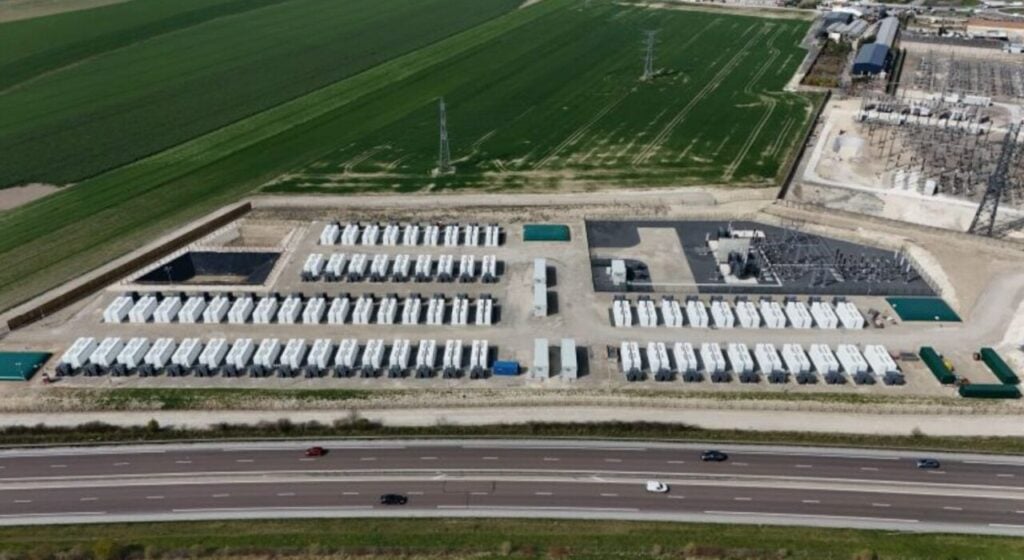
BESS investments in the French market are moving to longer durations, with saturation expected to hit the secondary reserve market, currently the main way operational projects make their money.
That’s according to Damien Guy, founder and CEO of battery energy storage system (BESS) technical advisory NR Flex.
“The projects online today are basically just doing secondary reserve (automatic Frequency Restoration Reserve, or aFRR, ancillary service – Editor). But all the aggregators and market participants are all getting prepared to change that as the batteries start to set the prices in the ancillary service markets,” Guy said.
“A few months ago 100% of projects were 2-hours, which is what secondary reserve requires. In the past few weeks I’ve heard of a few projects, 3, 3.5 and even 4-hours getting financed, which is a game changer.”
Try Premium for just $1
- Full premium access for the first month at only $1
- Converts to an annual rate after 30 days unless cancelled
- Cancel anytime during the trial period
Premium Benefits
- Expert industry analysis and interviews
- Digital access to PV Tech Power journal
- Exclusive event discounts
Or get the full Premium subscription right away
Or continue reading this article for free
Guy was a key figure in building out France-based power firm EDF’s internal energy storage capabilities, both in France and the US, over a decade there until 2024 when he founded NR Flex.
Secondary reserve the driver, but revenue stack will soon diversify
The pick-up in BESS investment in the last two years in the French market is mainly down to the secondary reserve market opening in June 2024, with very high prices.
Following that, interest in the French market grew and the operators with large-scale projects online now (Amarenco, Harmony Energy, Neoen, TagEnergy etc) are those who had secured grid connections already by that point and could get to ready-to-build (RTB) soon after.
NW Groupe meanwhile was an early mover in the French market, and had a lot of capacity online already before secondary reserve (through a specific strategy of deploying hundreds of small 1MW assets on MV grids).
In the next 6-12 months, multiple gigawatts of new capacity will come online, Guy said. That will drive down the prices in secondary reserve and force a new multi-market optimisation strategy.
“For sure, it’s only a question of when there’s going to be that cliff-edge between the price of secondary reserves and the opportunities in the other energy markets,” Guy explained.
“The big question is what the market is going to look like after that cliff-edge. The revenue stack will become a combination of multi-market revenues, from ancillary services, intraday and day-ahead, with a bit of capacity market (CM), but not much. The question is if all that in combination will be above the limit you need to make a battery profitable, which is in the range of €100-120,000/MW/year (US$112-134,610/MW/year).”
BESS project delivery in France
Guy added that, to-date, the main delivery mechanism for BESS in France has been via the turnkey approach where one party takes on responsibility and payment to build and maintain a project.
This takes all the risk off the project owner and turnkey service buyer, and is common when a market is first getting off the ground. Operators tend to then take their experience and do more integration and separate contracting in-house with each project.
“For the past two years the projects we were doing were pretty much exclusively turnkey procurements. Though, it is changing now, with clients more open to it and they ask us to build the specifications for split contracting. But the question is where you split, AC versus DC, and who the players are. Because your approach on this can mean that some players stop being in the equation.”
“I’m not certain about French banks’ willingness to finance split scope projects, but I think they would, we’ll have to see. But it’s going to come, because with turnkey, there’s a limited number of players who can provide a turnkey contract and stand behind that and its warranties for 15 years.”