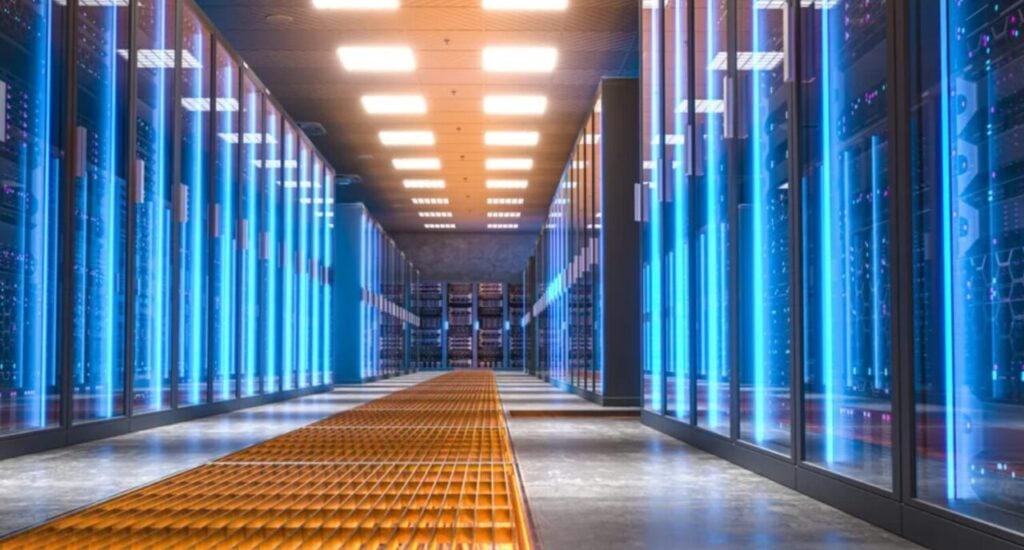
Engineering giant Siemens will develop a reference architecture purpose-built for Nvidia AI data centres, in collaboration with Fluence and incorporating nVent-aligned design considerations.
The reference design aims to translate Nvidia’s AI factory vision into a deployable, industrialised electrical, power and controls architecture for hyperscalers, co-location providers and specialised cloud infrastructure providers, aligned with Nvidia’s DSX Vera Rubin platform and its NVL72 compute architecture.
Siemens’ reference design supports a total facility capacity of 136MW, including a 100MW IT load, with utility connections at a nominal voltage of 34.5kV and medium- and low-voltage distribution extending to individual rack interfaces.
The architecture has been developed to support Tier III concurrent maintainability, meaning any component can be serviced without interrupting data centre operations.
Try Premium for just $1
- Full premium access for the first month at only $1
- Converts to an annual rate after 30 days unless cancelled
- Cancel anytime during the trial period
Premium Benefits
- Expert industry analysis and interviews
- Digital access to PV Tech Power journal
- Exclusive event discounts
Or get the full Premium subscription right away
Or continue reading this article for free
Fluence will integrate its Smartstack battery storage system into the design to handle grid instability events, including voltage and frequency fluctuations, black start capability and load smoothing for AI workloads that can draw power unevenly.
Fluence’s Smartstack is a modular, containerised battery storage system that integrates lithium-ion batteries, power conversion systems, thermal management and advanced software controls into a pre-assembled, plug-and-play unit designed for utility-scale and commercial applications.
According to Jeff Monday, Fluence’s chief growth officer, the Smartstack platform delivers critical grid-support functions, including demand response and AI load smoothing services, capabilities he claims address one of the most operationally challenging aspects of running dense AI computing infrastructure at scale.
nVent, which has deployed more than 2GW of liquid-cooling capacity globally, will provide thermal management services, with Sara Zawoyski, president of nVent Systems Protection, stating that the company’s operational experience enables it to “translate reference architectures into deployable thermal solutions that perform reliably from day one at this scale.”
The reference design incorporates nVent-aligned electrical design parameters to ensure compatibility with Nvidia workloads and system architectures, with a planned expansion to include advanced thermal management capabilities in a forthcoming supplement.
Prefabricated medium- and low-voltage skids are intended to reduce on-site construction work and shorten commissioning times, a feature designed to address the speed-to-revenue pressure that data centre operators face as AI infrastructure deployment accelerates.
Fluence’s data centre push
As Energy-Storage.news reported last month, order intake for the first half of Fluence’s financial year reached US$2 billion, twice that of the same period in 2025, with the company securing a record contracted backlog of US$5.6 billion and reaffirming full-year guidance of between US$3.2 billion and US$3.4 billion in revenue.
In the same earnings release, Fluence (Nasdaq: FLNC) confirmed it had signed master supply agreements with two major hyperscalers and expected to book its first order from one of them during the current quarter.
The Siemens reference architecture announcement follows that disclosure and provides the technical framework through which those hyperscaler relationships could translate into deployable projects.
Fluence has been explicit about where it expects this to play out at speed. Speaking exclusively to ESN Premium at the Energy Storage Summit Australia 2026 earlier this year, Monday predicted that once standardised battery storage blueprints are finalised with hyperscale customers in the US, deployment in Australia will accelerate rapidly, describing the data centre battery storage opportunity as a “slingshot” moment for the market.
The data centre opportunity for battery storage has been developing for several years, but the pace of AI infrastructure buildout is compressing timelines.
Indeed, battery storage can serve data centres in multiple ways (Premium Access): replacing diesel generators for backup power, smoothing demand to reduce peak grid charges and enabling facilities to participate in grid services markets, all of which are functions that improve both the economics and the environmental profile of data centre operations.
The design challenge, however, is not straightforward. As discussed at the Energy Storage Summit USA 2026 in March, designing battery storage for AI data centre co-location remains a moving target, with use cases, sizing requirements and integration models still evolving as AI workload profiles and grid connection constraints vary widely between sites and markets.
You can find out more on how energy storage is supporting the rollout of AI data centres on Energy-Storage.news.