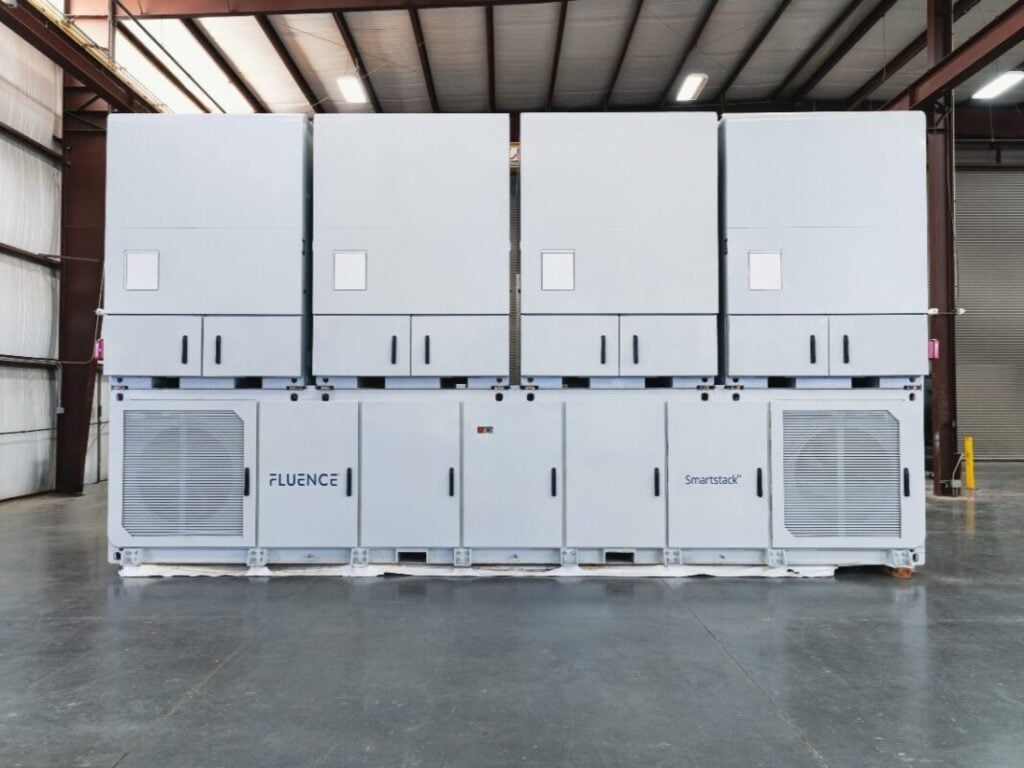
Fluence’s share price rose sharply after its Q2 2026 financial results came out, with the company reaffirming full-year revenue and EBITDA guidance.
With the NASDAQ-listed shares trading at US$13.56 ahead of the announcement on Wednesday (6 May), Fluence stock was trading at US$24.16 when markets closed on Friday for the weekend, up 78%.
It followed a set of results in which the US-headquartered battery energy storage system (BESS) technology provider and renewable energy software and services company reported a doubling of order intake and a 7.7% year-on-year increase in revenue.
The company’s financial year runs from the beginning of October. Its latest release for the second quarter of 2026 covers the three-month period ending 31 March 2026. Fluence reported total revenue of US$464.9 million, up from US$431.6 million in the same period last year.
Try Premium for just $1
- Full premium access for the first month at only $1
- Converts to an annual rate after 30 days unless cancelled
- Cancel anytime during the trial period
Premium Benefits
- Expert industry analysis and interviews
- Digital access to PV Tech Power journal
- Exclusive event discounts
Or get the full Premium subscription right away
Or continue reading this article for free
In what CEO Julian Nebreda characterised as a quarter of “significant progress” for Fluence, order intake for the first half of this year stands at US$2 billion, twice that of Q2 2025. Adjusted gross margin was 11.1%, aligning with the company’s expected 11%-13% range and bouncing back from 5.6% in Q1, when additional costs attributable to two non-US projects impacted profitability.
The company’s order backlog stands at US$5.6 billion, up a little from US$5.6 billion in the previous quarter. While it did see some slowdown in Q2 as “higher lithium prices temporarily slowed down some customer decisions,” US$600 million in new orders have already been signed in the third quarter. Nebreda said in an earnings call that 50% of those Q3 2026 orders have been signed with new customers.
Ending the quarter with around US$900 million of total liquidity, Fluence reaffirmed its previously issued fiscal year 2026 guidance on revenue, annual recurring revenues (ARR) and adjusted EBITDA.
These are for between US$3.2 billion and US$3.4 billion in revenue, an adjusted EBITDA of between US$40 million and US$60 million, and approximately US$180 million in ARR by the end of FY2026.
While cost of goods and services also rose slightly, Fluence’s quarterly gross profit improved by 9.5% from US$42.6 million in Q2 2025 to US$46.6 million. Net loss narrowed year-over-year to US$29.2 million from US$41.9 million.
Charlotte Gisbourne, energy storage analyst at our colleagues Solar Media Market Research/PV Tech Research, noted that Fluence’s quarterly deployments declined 82% compared to Q2 2025 in gigawatt-hour terms, from 1.7GWh to 0.3GWh. Gisbourne said this may be a response to uncertainty in the US market over the past year, particularly policy changes that led to developer hesitancy.
Hyperscalers ‘in a hurry’ to get deals done, Fluence CEO says
Despite significant growth in orders booked and steady deployments that came from its established developer and utility customer base, the main focus of analysts’ questions on an earnings call with Nebreda and Fluence CFO Ahmed Pasha was on an area where it has yet to turn customer interest into revenue or profits: hyperscaler data centres.
In the previous Q1 2026 earnings call, Nebreda had teased that it expected growth in data centre demand for batteries would translate into orders in “the next quarters,” although no deals had yet been signed.
This time out, the CEO said an initial data centre project order from one hyperscaler is expected to be signed “within the third quarter”.
During Q2 2026, Fluence signed master supply agreements (MSAs) with two hyperscale data centre developers that had put out solicitations seeking qualified technology providers for forthcoming projects, mostly, but not exclusively, in the US.
“The selection process for both of these MSAs was subject to multiple rounds of review, and in each case, Fluence was chosen after meeting criteria specific for each customer,” Nebreda said.
“In one case, the customer’s process began with 26 different BESS vendors, and Fluence was the first to complete all qualifications to sign a global MSA,” the CEO said, while in the other, “the customer had requirements which made it hard for many competitors to comply with.”
With Nebreda saying that at least one of the MSAs is expected to bear contractual fruit in the near term, several analysts on the call jumped to enquire further, including the selection process and what the hyperscalers were looking for.
According to the CEO, Fluence demonstrated its ability to meet “very stringent requirements” through its background managing fast-response systems, along with knowledge of how data centre applications will work and “how grid codes work globally”.
“Their main need is quality of power, helping them manage the fluctuation of the data centres, helping them do it quickly and effectively. That’s what they need, and that’s what we prove with our advanced controls and our products; we can prove very, very quickly to them that we can do it,” Nebreda said.
Again, while Fluence is not yet off the starting line, the company believes it is well-positioned with the two MSAs to begin capturing demand. The company claimed a 12GW pipeline of data centre opportunities as of the end of its Q2.
Amid a global race to build computing capacity, especially for AI training workloads, hyperscalers are “in a hurry” to get their projects built and this desire for speed-to-power means that a faster conversion rate is expected versus orders from “our normal utility developers,” the CEO said.
Main US cell supplier under new ownership
Meanwhile, an ongoing trend that pre-dates the current data centre wave is the turn towards domestic content in key markets, especially the US.
Over the past four years or so, Fluence has been bringing more of its US production in-house with the opening of a network of regional factories, including a module factory in Utah and enclosure and battery management system (BMS) manufacturing in Arizona.
Nebreda emphasised in the call that Fluence was the first to offer “a complete US domestic supply chain,” enabling a “one‑stop solution from early project development through delivery and installation and continuing over the full operating life,” with in-house EPC capabilities and dedicated service organisation.
However, it remains dependent on third-party suppliers for battery cells.
The company’s main supply of lithium iron phosphate (LFP) cells in the US comes from the factory in Smyrna, Tennessee, opened by AESC in 2012, when it began making nickel manganese cobalt (NMC) cells for electric vehicles (EVs).
As with other US-based manufacturers of EV cells, including LG Energy Solution and Samsung SDI, AESC retooled some of its EV lines to cater to demand from the BESS market.
Although AESC is headquartered in Japan, its majority owner is China’s Envision Energy. To comply with OBBA-introduced rules on material assistance from prohibited foreign entities (PFEs) and foreign entities of concern (FEOCs), the battery maker sold the Smyrna factory to a US startup, Fixx Energy, on 31 March 2026.
Fixx Energy was founded by venture capitalist Brett Conrad and is headed by CEO Jeff Juger, who was formerly with Chinese solar PV manufacturer Jinko Solar.
In the previous quarter, Nebreda revealed that Fluence had made an offer pertaining to ownership of the factory, which AESC opted not to pursue.
While cell manufacturing is the part that it still continues to outsource, Fluence will remain a long-term offtaker from Smyrna. Despite the new ownership the Tennessee factory continues to produce cells that qualify for tax credits and Nebreda said a new multi-year supply agreement was quickly signed with Fixx Energy.
Fluence has also secured a second domestic source of supply from FY2027, from an as-yet undisclosed supplier.
The company is also evaluating additional US supply options for growth beyond 2027. This will likely include more EV-to-BESS production line conversions, with suppliers judged based on metrics such as the timeline to first production, ramp speed, technical characteristics, and location relative to Fluence’s existing US domestic supply network.