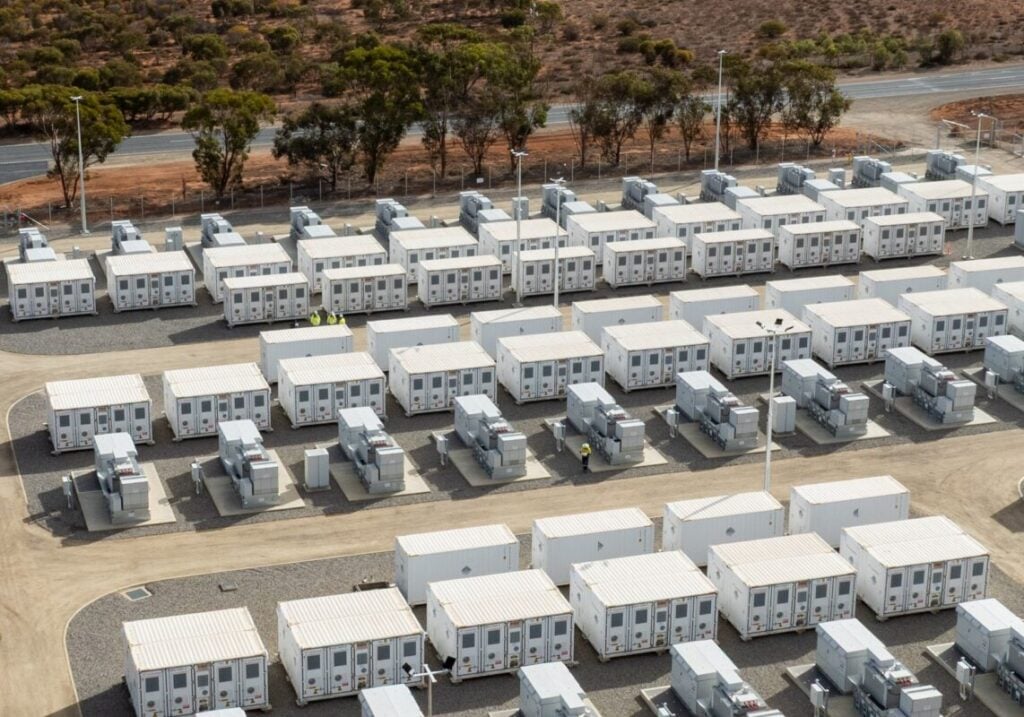
Developer Epic Energy has commenced commercial operations at its 100MW/200MWh Mannum battery energy storage system (BESS) in South Australia.
This marks the completion of the site that the company acquired from Canadian Solar project development subsidiary Recurrent Energy in January 2024. The transaction included a contract for Canadian Solar to provide its SolBank battery solution for the site via the vertically integrated solar PV manufacturer’s energy storage division, e-STORAGE.
The AU$130 million (US$85 million) battery storage system achieved full operational status on 10 October, following the commissioning process that began after the project was registered with the Australian Energy Market Operator (AEMO) in May.
The system can deliver 100MW of power to the National Electricity Market (NEM), which spans Australia’s eastern and southern states and territories, for up to 2-hours.
Try Premium for just $1
- Full premium access for the first month at only $1
- Converts to an annual rate after 30 days unless cancelled
- Cancel anytime during the trial period
Premium Benefits
- Expert industry analysis and interviews
- Digital access to PV Tech Power journal
- Exclusive event discounts
Or get the full Premium subscription right away
Or continue reading this article for free
Located approximately 60km east of the state capital, Adelaide, the Mannum BESS forms part of Epic Energy’s broader Mannum Energy Park development, which includes two existing solar PV power plants with a combined generation capacity of 35MW and an established substation.
The BESS represents the third project Epic Energy has acquired from Recurrent Energy at the Mannum site, following the 7MW Mannum Stage One and 39MW Mannum Stage Two solar installations.
Following the acquisition from Canadian Solar, Epic Energy worked through AEMO’s registration process before entering the commissioning phase, which involved extensive testing coordinated with both AEMO and transmission network operator ElectraNet.
Epic Energy CEO Clive D’Cruz emphasised the system’s role in supporting grid stability during Australia’s energy transition. The Mannum BESS is designed to manage variability in renewable energy generation while providing essential grid services to enhance system reliability in South Australia’s electricity network.
Canadian Solar subsidiary Recurrent Energy completed the sale of the project to Epic Energy in January 2024, with construction beginning in the first half of that year.
Epic Energy has partnered with UK-based optimisation specialist Habitat Energy to manage the battery storage system’s commercial operations. Habitat Energy uses algorithmic trading strategies to maximise revenue from electricity market participation while providing grid stability services.
The Mannum BESS commissioning occurs as South Australia continues to expand its energy storage developments. The state government has launched its first 700MW tender for long-duration energy storage, targeting projects with eight or more hours of storage duration to support the state’s 100% net renewables goal by 2027.
Meanwhile, Australia’s NEM surpassed 6.5GWh of battery storage capacity for the first time, demonstrating rapid deployment across the eastern states. The federal government’s fourth Capacity Investment Scheme tender awarded 11.4GWh of solar-plus-storage projects, with 12 of 20 successful projects including large-scale batteries.