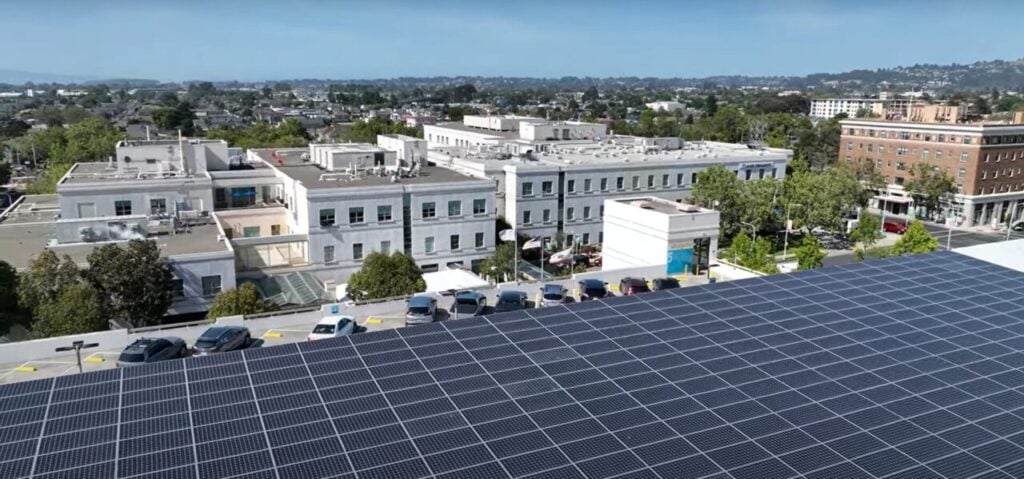
Zinc hybrid cathode battery and storage system maker Eos has secured an order with Faraday Microgrids to deploy a 3MW/15MWh system on tribal land in California, US.
The 3MW/15MWh Eos Z3 system will be used for a commercial microgrid application.
The California Energy Commission (CEC) will partially fund the project to aid in developing a renewable energy microgrid equipped with a ‘highly flexible’ long-duration energy storage (LDES) system for the tribe’s facilities.
It is set to provide backup power, utility ancillary services and demand savings, and is Eos’ second project with Faraday.
Try Premium for just $1
- Full premium access for the first month at only $1
- Converts to an annual rate after 30 days unless cancelled
- Cancel anytime during the trial period
Premium Benefits
- Expert industry analysis and interviews
- Digital access to PV Tech Power journal
- Exclusive event discounts
Or get the full Premium subscription right away
Or continue reading this article for free
Eos, based in New Jersey, US, manufactures a zinc-based battery that aims to provide an alternative to lithium-ion (Li-ion) batteries for medium to LDES applications, specifically those requiring a 6 to 12-hour discharge at full-rated power.
In March, the company communicated that it expects its 2025 revenues to be approximately ten times higher than those of 2024.
Faraday is a California-based company specialising in microgrid projects. In 2023, the company led a large-scale solar microgrid project in California, also with funding from the CEC and a zinc-bromine battery from Australian company Redflow (Redflow has since gone out of business). That project was set to be deployed for the Paskenta Band of Nomlaki Indians.
Eos has also previously been enlisted to provide its batteries for a microgrid in California, from developer Indian Energy.
Microgrids have been more widely adopted in California, due to their ability to disconnect from the grid in the event of a power outage and continue to provide energy.
In March of this year, California utility Pacific Gas and Electric (PG&E) announced its intent to award up to US$43 million in grant funding for nine new community-driven microgrids in the state.
In 2024, San Diego Gas & Electric (SDG&E), a leading investor-owned utility (IOU) in California, launched four ‘advanced’ microgrids with 180MWh of battery storage.
David Bliss, Faraday’s CEO said of the company’s new project with Eos:
“This will support a Native American community and contribute to bulk grid-edge power stability and availability — demonstrating the ability of distributed energy resources to support the safety and growth of vibrant communities in California and across North America.”