The rising costs of coal and gas mean that the adoption of renewable energy is a “survival issue” for countries in Southeast Asia, and energy storage is critical to the transition.
That was the take of Shuvendu Bose, an energy expert and senior advisor to the Ministry of Energy of the United Arab Emirates (UAE), who spoke with Energy-Storage.news ahead of this week’s Energy Storage Summit Asia 2026 conference.
According to Bose – who was expressing personal opinions and not on behalf of the UAE government for our conversation – countries in Southeast Asia, including the ASEAN members, can achieve far higher GDP multipliers in a knowledge-based economy than in an oil- or coal-based economy.
While the region will likely grow as a global manufacturing hub, AI and automation are reducing the proportion of more labour-intensive industrial activities. Within the next 10-15 years, it is anticipated that high levels of automation will be the norm.
Try Premium for just $1
- Full premium access for the first month at only $1
- Converts to an annual rate after 30 days unless cancelled
- Cancel anytime during the trial period
Premium Benefits
- Expert industry analysis and interviews
- Digital access to PV Tech Power journal
- Exclusive event discounts
Or get the full Premium subscription right away
Or continue reading this article for free
“Then the component of the labour will go out of the whole economic-macroeconomic equations. Once the labour component is out, it is left with the IT, and the energy cost will be the bottom line,” Bose said.
Energy cost is the single biggest driver of competitive advantage for ASEAN manufacturing and therefore tariffs paid by electricity users must come down, or cost increases must be suppressed.
Yet coal, on which much of the region depends, has seen soaring prices both in the capital costs of plant construction and in fuel: Bose noted that since around 2007, the international price of coal has risen from around US$40 per tonne to a high of ~US$400 by 2022.
“That means also the marginal cost of energy has gone up. Coal is no longer cheap,” Shuvendu Bose said.
LNG costs will rise from 2030 onward, “because the old cheap gas fields are gone,” and the cost of investment in new fields is higher.
“Now, if you fuel your economy with coal and gas, and obviously nuclear is costlier, your tariff is going to remain higher. So the only solution in hand definitely is renewable energy, which is cheaper and cheaper, which will fuel [the] economy, and this economic design must be there,” Bose said.
Even looking beyond climate change mitigation, the energy transition is not an option Southeast Asian nations can afford to deny, it is “a survival issue,” Bose said.
“If they don’t become competitive, manufacturing will move back to the US or Europe, because labour is no more the critical factor [that is was] when it started.”
The big question is then around how this will be achieved. While the cost of generation from variable renewable energy (VRE) resources becomes cheaper, energy storage is a vital tool for integrating its output into the system and adding the flexibility to make renewables dispatchable.
This will include battery energy storage systems (BESS) that can optimise the concurrent need for investment in the transmission network, standalone and co-located BESS with renewable energy projects, and distribution-level energy storage, Bose said.
Energy systems are built to accommodate the 10% to 20% of peak load they experience over roughly 400 to 800 hours of every year.
“This load is coming from the distribution and load centre demand deviation curve, so you are designing your asset generation, transmission, distribution; everything is designed for the asset as per the highest load,” Bose said.
If sited correctly and strategically, energy storage can flatten the load curve, which is a design philosophy that Shuvendu Bose believes “has to be there in the entire Asian continent, not only Southeast Asia, everywhere, and this is irrespective of any location.”
Shuvendu Bose will join me, Andy Colthorpe, onstage at Energy Storage Summit Asia 2026 tomorrow (2 July) in Bangkok, Thailand, for the panel discussion ‘What are the Implications of the ASEAN Renewable Energy Long-term Roadmap?’
Also joining will be Dr Tharinya Supasa, head of sustainable renewable energy at the ASEAN Centre of Energy, the architects of the roadmap, alongside solar and energy storage expert Somesh Shah from consultancy AFRY and Thailand Energy Technology Association (TESTA) president Dr Pimpa Limthongkul.
Regional coordination essential, Thai Ministry of Energy representative says
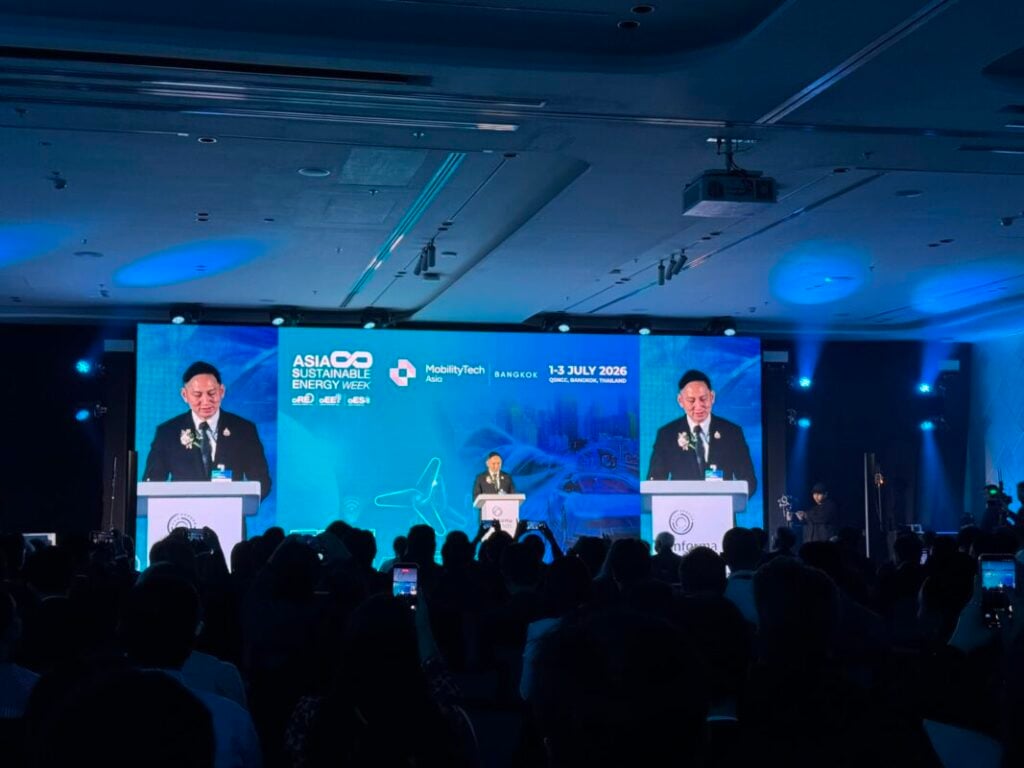
Energy Storage Summit Asia, now in its fourth year, takes place as part of Asia Sustainable Energy Week (ASEW) and covers a broad range of technologies, with around 30,000 visitors expected at the Queen Sirikit National Convention Centre (QNCC) over three days. The ASEW opening ceremony took place this morning.
Keynote speaker Dr Veerapat Kitafuengfoo, Permanent Secretary of the Thai Ministry of Energy, said that it is essential for Thailand and its ASEAN partners to establish energy security while aligning with the regional and national pathways to net zero emissions.
“Natural gas has been a reliable transition fuel,” Dr Kitafuengfoo said, but “leaves us with deep structural vulnerability,” with the spot price of LNG subject to fluctuations and rises that increase financial pressure.
Thailand can no longer depend on volatile fossil fuels, he said, and while rapid response mechanisms deployed by the government have been successful in stabilising baseline costs, the long-term requires investment in new assets.
The Ministry of Energy’s long-term energy plan emphasises renewable energy and the implementation of energy efficiency measures. Initiatives will include streamlining rooftop solar PV regulations, investing in energy storage and virtual power plant (VPP) development, and enforcing household and commercial building energy efficiency standards, the Ministry secretary said.
However, the goals cannot be achieved “in isolation” by Thailand or any one country alone. Regional cooperation is required, leveraging the different strengths countries may have in solar, wind or hydroelectricity, for example.
Multilateral partnership can lower system costs and “significantly” enhance political stability in the region, but it will require cross-border direction, including the harmonisation of regulatory frameworks. There must be cooperation on market design and international collaboration to foster clean energy sectors including hydrogen, carbon capture and battery manufacturing, the secretary said.
ASEAN should move to a clean decentralised power structure through “one affiliated, coordinated action,” he said.
Dr Pimpa Limthongkul of TESTA, in a panel discussion that followed the Ministry of Energy representative’s keynote speech, said that energy storage is “no longer an option,” but is now an important asset at the regional and national levels.
Energy storage trade association president Dr Limthongkul also took up the theme of regional collaboration between ASEAN nations. The challenge, she said, is to share goals at both levels.
Countries could meet their national goals and coordinate across the wider region by setting targets and then gathering and sharing data on progress. She gave the example of growing electric vehicle (EV) scrap as EV adoption takes pace, arguing that this can be perceived as either as a threat to sustainability or an opportunity to create circularity in the economy and industry.
Read the Energy-Storage.news blog ‘Trends to look out for at Energy Storage Summit Asia 2026.’
Energy-Storage.news publisher Solar Media (part of the Informa Group) hosts Energy Storage Summit Asia 2026 on 1-3 July at QSNCC, Bangkok, Thailand.
The conference takes place during ASIA Sustainable Energy Week 2026 (ASEW), the region’s most influential platform for driving clean energy. Our readers can enjoy an exclusive 20% discount on tickets using the code ESN20 at checkout. For more information, visit the official website.