
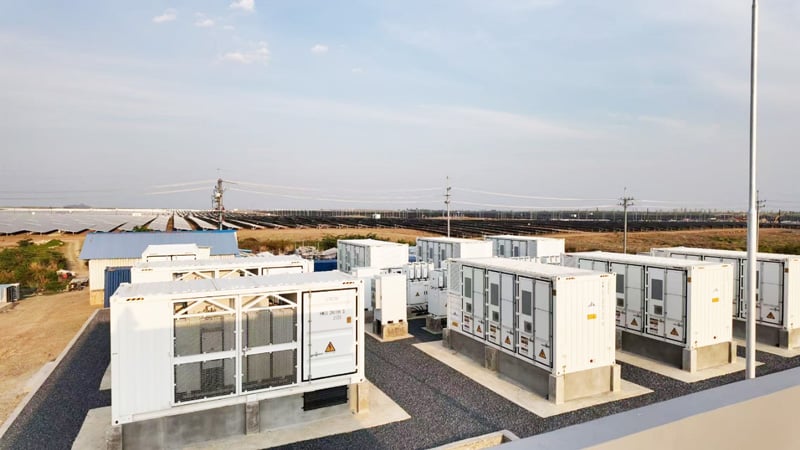
The energy storage market across Southeast Asia is evolving rapidly, with landmark project milestones, shifting regulatory frameworks and the growing energy demands of AI all set to shape the conversation at the Energy Storage Summit Asia 2026.
Taking place next week, 1-3 July, at QSNCC in Bangkok, Thailand, we look at some of the key debates set to take centre stage at the event, which is co-located with the ASIA Sustainable Energy Week (ASEW).
The co-located events will unite over 30,000 visitors from 60+ countries and 1,400 major brands, creating one of Asia’s largest gatherings of energy professionals. While hosted in Thailand, the Summit addresses the ASEAN region and wider Asia-Pacific (APAC) market, reflecting the increasingly regional nature of investment, policy and deployment.
In the lead-up to the summit, Energy-Storage.news has gathered insights from developers, investors and analysts on the themes defining the ASEAN energy storage market. Some of these perspectives will be expanded on at the event itself.
Try Premium for just $1
- Full premium access for the first month at only $1
- Converts to an annual rate after 30 days unless cancelled
- Cancel anytime during the trial period
Premium Benefits
- Expert industry analysis and interviews
- Digital access to PV Tech Power journal
- Exclusive event discounts
Or get the full Premium subscription right away
Or continue reading this article for free
Vietnam’s two-part tariff sets a regional precedent
A regulatory shift in Vietnam has drawn attention from across the region.
With the implementation of Circular No. 62/2025/TT-BCT in January 2026, Vietnam became the first major ASEAN economy to introduce a formal two-part tariff structure for battery energy storage systems, introducing separate capacity and energy charges that pay batteries for both availability and delivery.
Writing for Energy-Storage.news, senior climate and energy strategist Sunita Dubey described the move as a decisive shift away from energy-only compensation and toward a framework that recognises storage as a multi-service asset.
The reform addresses a long-standing structural barrier across ASEAN markets, where revenue volatility and policy ambiguity have kept developers and lenders at bay.
The implications extend well beyond Vietnam’s borders. Dubey argues that the rest of the region now faces a choice: follow early and accelerate the clean energy transition, or delay and confront rising grid instability.
With more than US$750 million in investment potentially unlocked in Vietnam alone this year, and a pathway to US$5.7 billion by 2030, the stakes are substantial.
FESSIA: Regulatory frameworks are the ‘missing link’ in ASEAN’s energy transition
The policy challenge is not limited to Vietnam. A recent report from the Future Energy Storage & System Integration Alliance (FESSIA), developed in collaboration with DNV, describes BESS as the “missing link” in ASEAN’s energy transition, arguing that regulatory frameworks, not technology readiness, are the primary barrier to deployment.
FESSIA has counted just 1.4GW of BESS in operation across ASEAN, against the backdrop of a near-90% reduction in global storage costs since 2013.
FESSIA CEO and founder Liming Qiao, speaking at the report’s launch at Ecosperity Week 2026 in Singapore, said that the value of flexibility in the power system “must become central to power-system planning, operations, and market design.”
The report highlights revenue stacking as essential to unlocking the full economic and system value of storage, strengthening project economics, improving investment certainty and reducing exposure to market volatility.
For the Philippines, DNV modelled that co-located solar and BESS could deliver US$2.25 billion in yearly revenues by 2030 if scaled appropriately, while making BESS the cornerstone of the ancillary services market could cut system costs by up to US$275 million annually.
Cambodia’s 1GWh grid-forming project is a landmark for the region
At the project level, a milestone from Cambodia has placed the country at the forefront of grid-forming technology adoption in ASEAN.
In March, a 500MW/1,000MWh battery storage system with grid-forming inverters entered commercial operation in Pursat province, developed by Phnom Penh-headquartered SchneiTec at the site of one of its existing solar PV plants.
Cambodia’s official news agency, AKP, described the project as a “significant and historic achievement” and as the country’s first and largest of its kind.
SchneiTec said the asset would enhance grid reliability by minimising power fluctuations, enabling greater renewable energy integration and reducing reliance on fossil fuels, positioning Cambodia as a leader in grid-forming inverter adoption across the region.
The project follows a smaller 12MWh grid-forming testbed commissioned by SchneiTec and Huawei Digital Power in mid-2025, which demonstrated inertial response performance well beyond standard requirements.
That earlier project had demonstrated the technical viability of the approach, whilst the 1GWh asset represents its commercial deployment at scale.
Thailand’s market lags despite policy ambitions
Not all ASEAN markets are moving at the same pace. A recent analysis by PV Tech Research analyst Charlotte Gisbourne finds that Thailand’s battery storage market continues to lag behind its neighbours, despite the country’s strong renewable energy ambitions and upstream manufacturing incentives.
The country’s enhanced single buyer model, in which state-owned EGAT remains the primary offtaker for grid-scale energy storage, has limited the development of the ancillary services market that is proving critical to bankable storage economics elsewhere. As of December 2025, natural gas still accounted for 67% of EGAT’s electricity generation, with solar and wind contributing only around 2% of the country’s total energy mix.
The draft Power Development Plan 2024 targeted 10GW/10.5GWh of operational battery storage by 2037, but with no finalised policy framework and a liberalised market still some way off, the trajectory remains uncertain.
Gisbourne notes that a 2GW direct power purchase pilot targeting data centres, requiring producers to use only renewable energy sources, could yet drive increased interest in storage as a supporting technology.
Policy certainty the biggest influence on APAC investment decisions
Against this uneven regulatory backdrop, Banpu NEXT, the smart energy arm of Thailand-based integrated energy company Banpu, has articulated the challenge facing developers across the region with clarity.
In an interview with Energy-Storage.news, Colin Koon Peng Ho, head of energy generation and trading at Banpu NEXT, says that policy certainty and regulatory mechanisms now outweigh cost considerations in APAC battery storage investment decisions.
Ho identifies regulatory ambiguity around grid connection pathways as one of the most significant barriers to scaling utility-scale BESS deployment, noting that clarity on front-of-meter and behind-the-meter classifications is critical to developing viable revenue models.
He singles out Southeast Asia’s predominantly single-buyer markets as the key structural challenge, arguing that opening up grid access and establishing suitable revenue models will be the primary driver of accelerated growth between 2028 and 2030.
Looking further ahead, Banpu NEXT sees utility-scale grid-connected and co-located models as the most attractive investment opportunities in the region, driven by high renewable energy penetration rates and the need for grid capacity upgrades.
Ho also anticipates a shift toward greater localisation in supply chains as regional manufacturing capacity develops.
Developers must engage early with regulators, utilities and communities
The lessons of more mature markets are beginning to filter through to Southeast Asian developers.
In an exclusive interview with Energy-Storage.news ahead of the summit, Mahdi Behrengrad, head of energy storage at developer Pacifico Energy, warns that battery storage developers in Southeast Asia should engage as early as possible with regulators, utilities and local communities, drawing on the experience of Japan, where a wave of developer interest caught regulators off guard and led to rapidly tightening conditions for grid connection and market participation.
Behrengrad, who led the development of Japan’s first BESS projects to commercially trade energy in the wholesale electricity market, says the pattern of increasing regulatory strictness after an initial period of openness is one Southeast Asia should watch carefully.
From grid connection to environmental permitting to cybersecurity requirements, the Japanese market saw conditions tighten significantly within a matter of years.
Community engagement is equally important, he argues, noting that a boom in land acquisitions linked to both storage and data centre development is already creating friction with local communities across the region.
Developers must work to build a supportive environment before entering market, rather than after problems emerge.
APAC data centres are driving demand, but risk locking in fossil fuels
One of the most significant new demand drivers for energy storage across the region is the rapid expansion of AI data centres.
According to modelling by ArkTerra Partners, 24.2GW of data centre capacity has been announced across nine APAC markets between 2025 and 2030, but without long-duration storage solutions to back renewable energy supply, the pipeline risks locking in a decade of fossil fuel dependency.
ArkTerra founding partner Pavina Adunratanasee, writing for Energy-Storage.news, argues that on a business-as-usual grid the 24.2GW pipeline is tracking toward 166 million tonnes of CO2-equivalent per year by 2030.
In markets such as India and Indonesia, meeting AI infrastructure demand without firm renewable energy will default to coal. In markets with access to cheap domestic gas, it defaults to gas peakers.
Adunratanasee points to deal structures emerging in the United States as templates that are directly transferable to APAC once the storage and demand response ecosystem matures.
The barrier in the region, she argues, is not technology readiness but a project development capital gap at the pre-feasibility stage, with a structured pathway needed to take first-of-a-kind enabling technology projects from concept to signed offtake agreements.
Energy-Storage.news publisher Solar Media (part of the Informa Group) will host the upcoming Energy Storage Summit Asia 2026 on 1-3 July at QSNCC, Bangkok, Thailand.
The conference takes place during ASIA Sustainable Energy Week 2026 (ASEW), the region’s most influential platform for driving clean energy. Our readers can enjoy an exclusive 20% discount on tickets using the code ESN20 at checkout. For more information, visit the official website.
