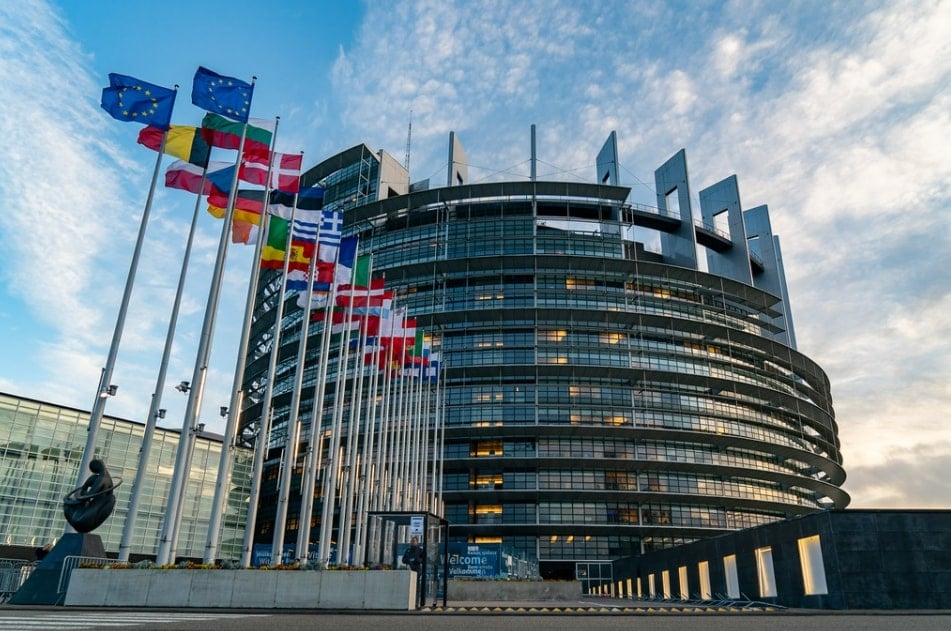
Trade association EASE has urged policymakers to recognise the vital role energy storage can play in solving energy sector challenges as European Union (EU) elections take place.
With EU elections underway from 6-9 June, EASE—the European Association for Storage of Energy—sent out a media alert regarding a ‘manifesto’ it published in March ahead of the runup to voting. EASE said energy storage is a “crucial tool” to boost energy security and industrial competitiveness, help lower energy bills across Europe and enable decarbonisation.
According to various media reports, the climate is more of a hot-button topic than ever in some European Union Member States, while ever since the 2022 invasion of Ukraine by Russia sent the cost of imported gas skywards, energy costs have been a constant headline issue.
EASE argued that energy storage paired with locally generated renewable energy can replace gas peaker plants, reducing dependency on polluting fossil fuel imports. Clean energy technologies can also help stabilise and reduce consumer and industry exposure to high and volatile electricity prices.
Try Premium for just $1
- Full premium access for the first month at only $1
- Converts to an annual rate after 30 days unless cancelled
- Cancel anytime during the trial period
Premium Benefits
- Expert industry analysis and interviews
- Digital access to PV Tech Power journal
- Exclusive event discounts
Or get the full Premium subscription right away
Or continue reading this article for free
At the same time, the risk of falling short of the EU’s 2030 decarbonisation targets can be mitigated by leveraging energy storage to maximise the adoption of renewables integration on the grid, reduce the cost of transmission and distribution (T&D) infrastructure upgrades, and decongest increasingly constrained networks.
Grid congestion costs in Germany alone totalled €4 billion (US$4.36 billion) in 2022, while the country experienced more than 150,000 electricity supply interruptions in the previous year. EASE also noted that around 60% of energy is imported across Europe.
Storage deployment in the continent is accelerating, with over 10GWh of new installations recorded in 2023, about 70% of which were residential battery systems.
At the top level, European Union lawmakers have recognised the potential roles energy storage must play in meeting goals that include 90% renewable energy by 2040 and a net zero economy by 2050 while maintaining and enhancing energy security and stability of supply.
In April 2023, European Commissioner for energy Kadri Simson described energy storage as a “centrepiece” of the energy transition in a speech to Members of European Parliament (MEPs), while proposed reforms to Electricity Market Design a couple of months later and since voted in for adoption by the EU highlighted that increasing shares of renewables would be impossible without energy storage deployment increasing.
However, the various plans have also contained missed opportunities to address barriers to storage deployment, according to EASE and the Energy Storage Coalition, which the trade association is part of, along with counterparts in solar PV, wind power, and Bill Gates’ Breakthrough Energy sustainability VC group.
At the beginning of this year, the Energy Storage Coalition also said that EU Member States’ draft National Energy and Climate Plans (NECPs) largely fell short in supporting energy storage. Only Spain and Portugal’s NECPs were assessed to be “on the right path” on two out of three metrics, and none of the 27 states’ plans were commended in all three areas.
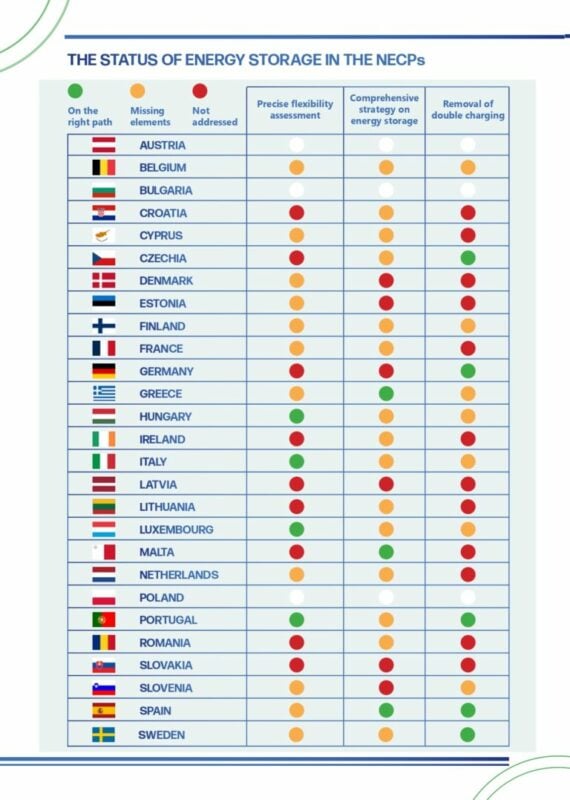
‘Six-point plan: ‘Remove barriers, enable long-term investment certainty’
EASE’s manifesto contains a six-point plan to achieve the various goals set out:
- Accelerate regulatory changes to eliminate persistent barriers to storage deployment and ensure NECPs are ambitious and in line with EU goals. These would include rapidly implementing Electricity Market Design reform and the EU’s long-awaited Clean Energy Package while addressing “legal ambiguities” in the latter.
- Develop a European Union energy storage strategy. Various Member States have introduced different schemes and tools to support storage, including Contracts for Difference (CFDs), capacity markets and auctions, and these should be coherently designed and complementary, EASE said.
- Align the EU Heating and Cooling Strategy with climate and energy security policy drivers. This would enable greater efficiencies and sector coupling, with EASE noting that in the industrial sector, for example, some 2,500TWh of waste heat could be recovered globally using energy storage system technologies.
- To swiftly write into law 2040 decarbonisation targets. A leaked draft earlier this year set out the 90% by 2040 target, and putting the EU on that trajectory would provide certainty to investors in the clean energy sector including storage.
- Develop local electricity flexibility markets and new market products, which would integrate rising shares of renewable energy, limit curtailment and cost-efficiently solve network constraints and congestion.
- Update grid use and access fee structures, including the elimination of double taxation—where storage resources in most EU countries are charged fees twice, for discharging into the grid as well as for receiving power from it—taking into account the positive impact of energy storage on network management and decarbonisation. In most EU Member States, and in many other parts of the world, grid regulations were drawn up long before the advent of grid-connected battery storage, meaning that storage resources are defined as both ‘generators’ supplying into the grid and ‘load’ drawing from the grid, and levied charges accordingly.