The European Investment Bank (EIB) has approved a loan request from Swedish start-up Northvolt that will see the bank provide a financing facility of up to €52.5 million US$64.8 million to support Northvolt’s pilot demonstration facility.
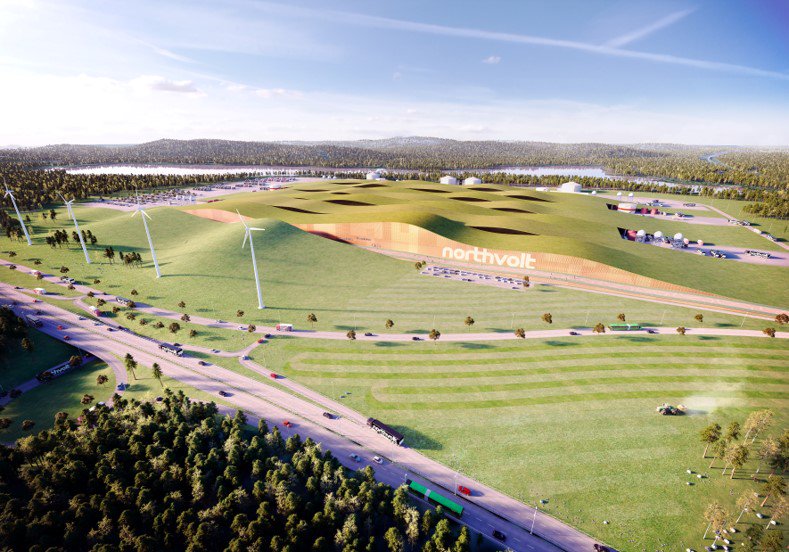
Northvolt is targeting the eventual development and construction of gigawatt-scale, ‘gigafactory’ manufacturing facilities for lithium battery production in Europe. After narrowing location down to two sites in Sweden, Västerås and Skellefteå in July last year, the company signed up ABB as a prospective technology supplier to the factory a short while after that.
The EIB financing will be supported by InnovFin – EU Finance for Innovators’ Energy Demonstration Projects facility — along with the financial support of the EU under Horizon 2020 Financial Instruments.
All involved parties are expected to finalise negotiations, with Northvolt expected to start construction of its demonstration line over the coming months. The demonstration facility will be used to show the the commercial viability of the concept and to qualify and industrialise products together with Northvolt’s customers. The batteries produced will be used in transport, stationary storage, and industrial and consumer applications.
Try Premium for just $1
- Full premium access for the first month at only $1
- Converts to an annual rate after 30 days unless cancelled
- Cancel anytime during the trial period
Premium Benefits
- Expert industry analysis and interviews
- Digital access to PV Tech Power journal
- Exclusive event discounts
Or get the full Premium subscription right away
Or continue reading this article for free
The demonstration site, located in Västerås, Sweden, will also feature a research facility and will employ between 300-400 people. Launching this facility stands as another step towards Northvolt establishing its large-scale li-ion battery factory in Skellefteå — with the company eventually targeting a production of 32GWh battery capacity on a yearly basis.
Peter Carlsson, CEO of Northvolt, said: “Europe is moving rapidly towards electrification. Northvolt’s objective is to build the world’s greenest battery to enable the transition. With the support from the European Investment Bank and the European Union, we are now one step closer to establishing a competitive European battery manufacturing value chain.”
Vice President of the European Commission in charge of the Energy Union Maroš Šefčovič added: “Batteries are a strategic component of our competitiveness and to capture a new European market worth €250 billion (US$310 billion) annually as of 2025, we need to act fast. I therefore welcome the decision taken by the EIB, which will help this industry-led project take off the ground. It is important to pool all available instruments at the national and European level, such as InnovFin. The European Battery Alliance will continue supporting prospective partnerships throughout the value chain.”